
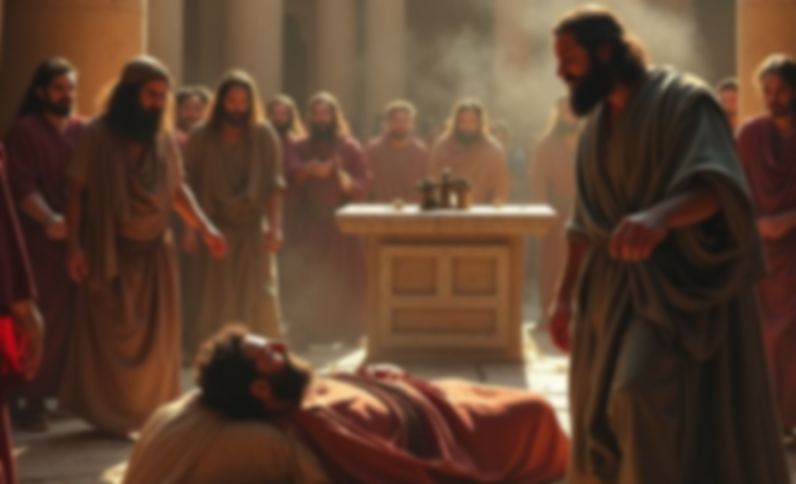
One of the arguments against the preterist (past) interpretation of the Olivet Discourse and the use of the second person plural “you” is an appeal to Matthew 23:35: “And so upon you will come all the righteous blood shed on earth, from the blood of righteous Abel to the blood of Zechariah son of Berechiah, whom you murdered between the temple and the altar.” The claim is made that Jesus’ use of “you” can only refer to Zechariah son of Berechiah from the Old Testament. This would mean that the use of “you” would not be limited to those of that generation. The use of the second-person plural runs through Matthew 21-25, and there is no indication that Jesus has two distinct audiences in view. I take the view that Jesus referred to Zechariah, son of Berechiah, who was murdered by some of those to whom Jesus was addressing. I covered this interpretation in my book Wars and Rumors of Wars. While my view differs from the study below, Rev. John MacPherson’s interpretation takes Jesus at his word. —Gary DeMar
ZACHARIAS: A STUDY OF MATTHEW 23:35
by Rev. John MacPherson, Free Church Manse, Findhorn, Forres, Scotland.
The four possible persons to whom the reference is made. the son of Jehoiada; the son of Barachiah; the son of Baruch; the father of John the Baptist.
In the New Testament, with the exception of the opening chapter of Luke, the name of Zacharias occurs only in one passage, Matt. 23:35, which is repeated again in Luke 11:51. The personality of the Zacharias of Luke 1 is pretty well defined, but considerable difficulty arises when we seek to determine who the Zacharias is to whom our Saviour refers in his words of threatening and warning addressed to the Pharisees. There are evidently four possible answers, or, at least, there are four different persons among the Jews of earlier or later times to whom some writers with more or less plausibility have supposed the passage to refer. These in their historical order are: 1) Zacharias the son of Jehoiada, 2) Zacharias the son of Barachiah, the post-exilian prophet, 3) Zacharias the father of John the Baptist, and 4) Zacharias the son of Baruch, slain by the Zealots in Jerusalem, in A.D. 67.
It may be interesting and instructive to glance at the claims that have been put forward for each of these in the interpretation of Matt. 23:35.
I. The interpretation of this passage, which has been most popular, and which still is the prevalent one, is that which identifies the Zacharias of Matthew with the son of Jehoiada. The story as given in 2 Chron. 24:20-22 is well known. In consequence of his faithful denunciation of prevailing ungodliness, he was stoned in the court of the house of the Lord, Joash forgetting Jehoiada’s kindness, the martyr with his dying breath invoking God’s righteous retribution: “The Lord look upon it and requite it.” This incident evidently made a deep impression upon the Jews. The assassination of Joash, recorded in the 25th verse, is emphatically described as done on purpose to avenge this cruel murder. And in later ages legends arose and gained currency which showed how the iniquity and baseness of the deed had keenly touched the moral and religious consciousness of the people. In several tracts of the Talmud**[1]** we find the tradition that it was on the great day of Atonement, on which this crime was perpetrated and that the blood stains could never be washed out. It is also told that when Nebuzaradan entered the temple on the day when it was taken, blood, which by experiment he found not to be that of the sacrificial victims, calves, rams or lambs, bubbled upon the pavement, and, hearing that it was the blood of a prophet who had been slain for foretelling his victory, he caused thousands to be slain there, till at last the bubbling ceased, and Zacharias was avenged. This incident must have occurred sometime before B.C. 800. The remoteness of the date is the first difficulty that presents itself, if we assume that it is to this Zacharias that Jesus refers in the words recorded by Matthew. The common explanation is that our Lord selected the first and the best recorded instances of suffering for righteousness’ sake as given in the Old Testament according to the Jewish arrangement of the canon which assigned to Chronicles the last place. No doubt such an explanation is just possible,[2] but surely it bears upon it a most suspiciously artificial appearance. Another difficulty in the way of this interpretation lies in the designation of Zacharias by Matthew as “son of Barachias.” Various expedients have been tried in order to get over this perplexing statement. Clearly the Old Testament story gives Jehoiada as father of Zacharias, but some would assume that Barachias may have been a son of Jehoiada, who, dying young, left his son to be brought up by the grandfather; others, that Barachias was another name of Jehoiada; and others, more radical critics, that the words, “son of Barachias,” are a gloss that has crept into the text, or an error of the evangelist or of an early copyist. Of course, it is quite possible to conceive any one of these suppositions to be correct, but they all stand on the same footing, that of pure suppositions without the slightest shadow of support for any sort of proof. Yet another difficulty occurs in the phrase, “whom ye slew.” Undoubtedly the natural interpretation of the words would refer the incident to the times of those addressed by the speaker, and would understand the allusion to be to some contemporary occurrence, something that had happened in the memory of that generation. It is little wonder that [Theodor] Keim exclaims impatiently, “Can men read? Matt. 23:35, ‘ye, ye have slain.’” Such an accumulation of difficulties must render the usual interpretation more than doubtful, and possible only as a last resource, when no other explanation presents itself less in need of the invention of ingenious guesses and hypotheses. While heartily recognizing the historical character of the story told in Chronicles, Ewald says unhesitatingly (Hist. iv, 141, note 1): “It is a mistake to suppose that this Zacharias, son of Jehoiada, is the one referred to in Matthew 23:35.”
II. The claims of the prophet Zechariah have been advocated by comparatively few, and by these mainly on account of the designation “son of Berechiah,” which is common to Zech. I:I; Matt. 23:35. We hear of this view, as one that has been held by some, from Chrysostom and Jerome. It may be observed in passing that there are other two earlier prophets of this name mentioned in the Old Testament, one belonging to the days of Uzziah (2 Chron. 26:5), supposed by Hitzig to be the author of Zech. 9-11, and another belonging to the days of Ahaz (Isa. 8:2), to whom Hitzig assigns Zech. 12-14, and others, with greater plausibility, chaps. 9-11. The father of the last-mentioned Zechariah is called Jeberechiah. There is really no trace anywhere, either in canonical or in apocryphal literature, of any of those prophets suffering a violent death. All the circumstances of their times speak against the likelihood of any such occurrence. But for the appearance of the name Berechiah as that of the father of the prophet, as seeming to harmonize with the designation of Zacharias in Matthew, this theory would never have been suggested. It is extremely doubtful whether the words “son of Barachia” really belong to the gospel text. They are omitted in Luke, and in the gospel of the Hebrews in this place we have “the son of Jehoiada.” If this phrase be withdrawn the only vestige of plausibility is taken away from this attempted identification.
Wars and Rumors of Wars
A first-century interpretation of the Olivet Discourse was once common in commentaries and narrative-style books that describe the fall of Jerusalem in AD 70. There is also a history of skeptics who turn to Bible prophecy and claim Jesus was wrong about the timing of His coming at “the end of the age” and the signs associated with it. A mountain of scholarship shows that the prophecy given by Jesus was fulfilled in exacting detail when He said it would: before the generation of those to whom He was speaking passed away.
Buy NowIII. It has been proposed by some to identify the Zacharias of Matthew with Zacharias, the son of Baruch, slain by the Zealots. The story is told by Josephus (Wars, IV, 5, 4). In A.D. 67, the small party of Zealots in Jerusalem had shut themselves up for security in the temple. Having contrived to get a message sent to the Idumaians and to have them admitted to the city, the Zealots and Idumaians together set up a reign of terror in the city, slaying all the respectable and peaceable among the inhabitants. Zacharias, a worthy man and of spotless character, though acquitted by a council which they had set up for the purpose of carrying out the form of a trial, was cut down by two of the party, who exclaimed as they did so: “Here hast thou also our voices.” In regard to this, Schürer says: “Some have sought wrongly to identify this Zacharias with the one mentioned in Matt. 23:35, and Luke 1:51” (Hist. of Jewish People, I, ii, 229, note). The only modern critic of eminence who seriously entertains this view is Keim (Jesus of Nazara, v. 216 ff.). And he uses this assumption as an argument in favor of the spuriousness of the whole passage. He puts aside the idea that Jesus could possibly here refer to the murder which had occurred some 800 years before, as though it were the latest instance of the murder of a righteous man, or as though the Scribes and Pharisees of his own generation could be held personally responsible for it. On the other hand, he maintains that everything becomes clear when we understand the reference to be to Zacharias, the son of Baruch, whose death by the Zealots was the direct fruit of Pharisaism. This brings down the composition of the gospel to the days of the fall of Jerusalem; that Jesus should predict the incident is absurd; but the comparatively late writers sought to cover up the anachronism by substituting Barachias for Baruch. How it could have happened that a writer sufficiently near the date of the Zealot story to know all its details, and so keenly alive to the awkwardness of putting so late a name into the mouth of Jesus that he actually felt compelled to give it an antique coloring, should yet choose to make use of this incident in preference to unobjectionable instances that must have been ready to his hand is not in the very least made clear.
IV. We turn now to the best of the proposals made in the interpretation of this passage. It has been suggested that the Zacharias of Matthew is Zacharias, the father of John the Baptist. Clearly one great advantage that the supporters of this view have lies in this, that the age of this Zacharias fits exactly the requirements of the reference by our Lord. If so be that the father of John the Baptist was put to death in this way, then most naturally, without any artificial device as in the case of the son of Jehoiada, it would be charged against our Lord’s own generation, so that addressing them he could say, “him have ye slain.” We need not trouble ourselves about the words, “son of Barachias.” The only real difficulty lies in the question as to whether there is any reason to suppose that the forerunner’s father died a death such as is here described. Keim would dismiss the matter summarily by saying that such an account of his death is an apocryphal fable. This is easily said; but it should be remembered that Origen and Basil regarded the tradition as no fable, but as solid and trustworthy. The story as told by Origen is extremely interesting. In his Commentary on Matthew (ed. de la Rue III, p. 845) he points to the ἐφονεύσατε [ephoneusate], “ye have slain,” as reason for seeking out some contemporary event. He tells of a tradition which he had heard, how that Zacharias, acting as high priest, allowed Mary, after the birth of Jesus, to enter that part of the temple reserved for virgins on the plea that she was still a virgin, and for this offense against the law the men “ of that generation” put him to death between the temple and the altar. While Origen seems only to have had an oral tradition, Epiphanius of Salamis knew of a book called Γεννα Μαριας [Genna Marias / Decent of Mary], current in Egypt among the Ophites, which told of Zacharias’ death, but declared that it was inflicted by the Jews because he had discovered their secret worship. The story of Zacharias’ death occurs in Protevangelium Jacobi, one of the oldest of the New Testament apocrypha, already known to Justin Martyr, where the author of the deed is Herod, and the occasion Zacharias’ declaration that he knew not where John was, when Herod, disappointed in his attempt to get possession of the infant Jesus, demanded of Zacharias that he should give up his son. The same story practically in this last form is given in a Slavonic MS. which had been evidently translated from an unknown Greek original, published lately in a German translation.[3] In addition we have here the legend of the blood becoming petrified and remaining as a witness against Herod. Other similar traditions might be quoted from other apocryphal works. But this should be noted, that while the details vary in consequence of the accretions of legendary matter, they all describe the death in what must be regarded as practically the same way. The accounts given of the immediate occasion and attendant circumstances of his death may be apocryphal fiction, but that he was put to death by violence within the precincts of the temple seems to be a valid, well-attested fact out of which and around which all the rest grew. If then it be so that we can accept the story of Zacharias’ death as historical, the interpretation of the passage in Matthew is plain. We shall not require to reject it as spurious, with Keim, nor shall we need to have recourse to more than doubtful expedients, as has commonly been the case, in order to show how Zacharias may be regarded as last in the series begun by Abel, or how the death of the son of Jehoiada, any more than that of the son of Adam, can fairly be charged as personal guilt against the men of Jesus’ own generation.
Originally from Rev. John MacPherson, “Zacharias: A Study of Matthew 23:35,” The Biblical World*, Vol. 9, No. 1 (January 1897), 28.*
The Greatest and the Least: A Biblical Theology of John the Baptist
John was the transitional figure providing a clear path and a smooth road from the covenant with Adam to the new covenant with the Second Adam. As the final and greatest prophet of the Old Testament, John embodied and fulfilled the very purpose of the Law: revealing Jesus as the Bringer of God’s Kingdom.
Buy Now[1] ‘Taanith 69: I, 2; Sanhedrin 96: 2. Also Targum on Sam. 2:20.
[2] It is accepted by Stanley, also by Kohler in Herzog; but Keim (v. 218), after mentioning it, says scornfully: “Can men read?”
[3] Alexander Berendts, Studien über Zacharias-Apokrypken und Zacharias-Legenden [Studies on Zacharias Apocrypha and Zacharias Legends], Leipzig, 1895.