
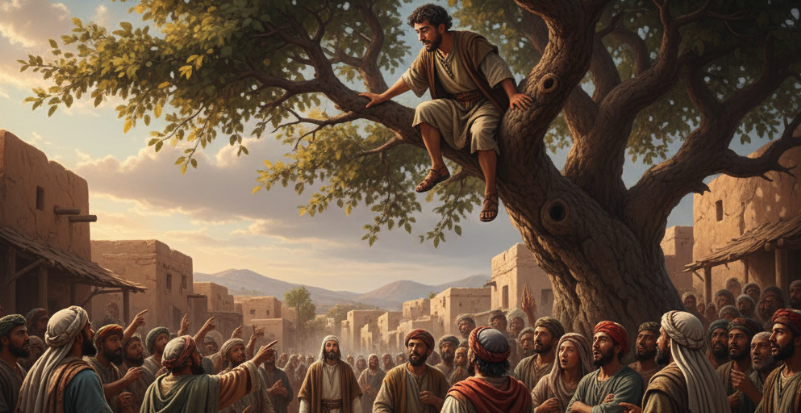
In a sermon this past Sunday, we heard about Zacchaeus, who climbed a tree to see Jesus as He passed by. Our pastor, uncharacteristically, even sang the first few lines of ‘Zacchaeus Was a Wee Little Man.’
Zacchaeus was a wee little man
And a wee little man was he
He climbed up in a sycamore tree
For the Lord he wanted to see
Zacchaeus may have been a “wee little man,” but he was complicit in being a big taxer. He took advantage of his position, most likely defrauding the Roman government by wetting his own beak by skimming what he had exacted from his own people. Politics has not changed. Upon his conversion, Zacchaeus stated that he would make fourfold restitution to whoever he had defrauded (Ex. 22:1, 4).
Restitution is a biblical solution to theft rather than incarceration. Consider the following from Charles Colson, who wrote the chapter “The Kingdom of God and Human Kingdoms” in the book Transforming Our World.
Recently I addressed the Texas legislature…. I told them that the only answer to the crime problem is to take nonviolent criminals out of our prisons and make them pay back their victims with restitution. This is how we can solve the prison crowding problem.
The amazing thing was that afterwards they came up to me one after another and said things like, “That’s a tremendous idea. Why hasn’t anyone thought of that?” I had the privilege of saying to them, “Read Exodus 22. It is only what God said to Moses on Mount Sinai thousands of years ago.”[1]
Some commentators contend that a fourfold restitution might be related to the future potential of what is stolen. A prized bull, for example, is worth more than cows. A prized dairy cow might be worth more than other dairy cows. The loss of either because of theft or malfeasance will have a generational effect. The same is true for horses. The stud value of Triple-Crown winner Secretariat was incalculable. He was bred to 58-60 mares per year. The initial stud fee was $70,000 in the 1970s. He sired over 600 foals, with many becoming successful racehorses. Horse breeding is a $39 billion business.

Victim's Rights
Victim's Rights is a detailed study of Exodus 21 and 22: the case laws. It identifies the fundamental principle of biblical civil justice: the obligation of civil government to defend the interests of the victims of crime, and the obligation of the criminal, not the State, to pay restitution. We hear the phrase, "He has paid his debt to society" after some murderer or brutal thief has spent three or four years in jail. But what about his victim and the victim's heirs? What has he paid to them? Nothing. The criminal does not owe a debt to society. He owes a debt to his victim.
Buy NowBut sheep are not as economically valuable as oxen, bulls, or horses. So why fourfold restitution? Gary North’s remarks are insightful. I would suggest that you get his book Victim’s Rights and James Jordan’s The Law of the Covenant, both republished by American Vision.
In the Bible, animals image man.[2] Sheep are specifically compared to men throughout the Bible, with God as the Shepherd and men as helpless dependents. The Twenty-Third Psalm makes use of the imagery of the shepherd and sheep. David, a shepherd, compares himself to a sheep, for God is described as his shepherd (Ps. 23:1). Christ called Himself the “good shepherd” who gives His life for His sheep (John 10:11). He said to His disciples on the night of His capture by the authorities, citing Zechariah 13:7, “All ye shall be offended because of me this night: for it is written, I will smite the shepherd, and the sheep of the flock shall be scattered abroad” (Matt. 26:31). He referred to the Jews as “the lost sheep of the house of Israel” (Matt. 10:6), echoing Jeremiah, “Israel is a scattered sheep” (Jer. 50: 17a) and Ezekiel, “And they were scattered, because there is no shepherd: and they became meat to all the beasts of the field, when they were scattered” (Ezk. 34:5). Christ spoke of children as sheep, and offered the analogy of the man who loses one sheep out of a hundred. The man searches diligently to locate that one lost sheep and rejoices if he finds it. “Even so it is not the will of your Father which is in heaven, that one of these little ones should perish” (Matt. 18:14). It is thus the helplessness of sheep rather than their value as beasts of burden or dominion that makes four-fold restitution mandatory**[3]**…. Sheep are representative of the utter helplessness of men. An attack on the sheep under a man’s control strikes at his position as a covenantally responsible steward. David risked his life to save a lamb (or perhaps lambs) captured by a bear and a lion, and he slew them both (I Sam. 17:34-36), taking the lamb, apparently unharmed, out of the mouth of the lion: “I caught him by his beard” (v. 35). As God had delivered him out of the paw of both lion and bear, David told Saul, so would He deliver him out of the hand of Goliath (v. 37). Again, David was comparing himself (and Israel) with the lamb, and comparing God with the shepherd. Thus, the recovery of a specific lost or stolen sheep is important to a faithful shepherd or owner, not just a replacement animal.
Perhaps the best example of sheep as a symbol for defenseless humans is found in Nathan’s confrontation with King David concerning his adultery with Bathsheba, wife of Uriah the Hittite. Nathan proposed a legal case for David to judge. A rich man steals a female lamb from a poor neighbor, and then kills it. “And David’s anger was greatly kindled against the man; and he said to Nathan, As the LORD liveth, the man that hath done this thing shall surely die: And he shall restore the lamb fourfold, because he did this thing, and because he had no pity” (II Sam. 12:5-6). Then Nathan replied to him, “Thou art the man.” Uriah had been the neighbor; Bathsheba is the ewe lamb who, biblically speaking, has been killed, the death penalty being applicable in cases of adultery (Lev. 20:10).
David recognized that the four-fold restitution was applicable in the case of stolen and slaughtered sheep. But in fact, Nathan was not talking about a lamb; he was talking about a human being. He used the symbol of the slaughtered sheep for the foolish woman who consented to the capital crime of adultery. The woman had been entitled to protection, especially by the king. Instead, she had been placed in jeopardy of her life by the king. The king had proven himself to be an evil shepherd.
*****
What the stringent restitution penalties of Exodus 22:1 point to is a general principle: how you treat oxen and sheep is indicative of how you treat other men.[4]
Oppressive taxation affects all areas of life—from workers (oxen) and families who are trying to raise children (Luke 2:1-2).
The Law of the Covenant
If we take a man-centered approach to these laws, we might say that the purpose of this legislation is only to ensure human prosperity. Such an approach to the law of God misses the most basic point. These laws show us God's own genuine personal care for His world, and as such these laws cannot be altered by human whim. To be sure, the Bible is man-oriented, and thus obedience to these laws will improve human life; but the laws are God's, and cannot be changed by man. Thus, as we examine the laws in Exodus 21-23, our first concern must be the glory of God, not whether these laws seem right to us sinful men. If we start with God, we will soon see how these laws also improve human life.
Buy NowA ten percent tax was deemed tyrannical (1 Sam. 8). Zacchaeus understood what he had been involved in and that Jesus was the Good Shepherd. He had been fleecing the most vulnerable people, and he knew it. He pledges to give half of his possessions to the poor.
[1] Charles Colson, “The Kingdom of God and Human Kingdoms,” Transforming Our World: A Call to Action, ed. James M. Boice (Portland, OR: Multnomah, 1988), 154-155.
[2] Animals in men’s image: [James B. Jordan, The Law of the Covenant: An Exposition of Exodus 21-23 (Powder Springs, GA: American Vision)] p. 122. He cites Prov. 6:6; 26:11; 30:15, 19, 24-31; Dan. 5:21; Ex. 13:2, 13. When I use the noun “image” as a verb, I am reminded of one cynic’s remark: “There is no noun in the English language that cannot be verbed.”
[3] Maimonides ignored all this when he insisted that if a thief “butchers or sells on the owner’s premises (an animal stolen there), he need not pay fourfold or fivefold. But if he lifts the object up, he is liable for theft even before he removes it from the owner’s premises. Thus, if one steals a lamb from a fold and it dies on the owner’s premises while he is pulling it away, he is exempt. But if he picks it up, or takes it off the owner’s premises and it then dies, he is liable.” Maimonides, Torts, “Laws Concerning Theft,” Chapter Two, Section Sixteen, p. 67.
[4] Gary North, Victim’s Rights: The Biblical View of Civil Justice (Powder Springs, GA: American Vision, [1990]). 195-196, 200.