

Gary discusses different immutable aspects of monetary policy and economics.
The modern world has debased its coinage. No nation’s mint issues silver coins as common coinage—only as collectibles. By the mid-1960’s, silver coins were replaced by central bank counterfeits.
In 1965, most money was not coinage, as is true today. Most money was a combination of paper currency and bank checks. Printed currency of any denomination all looked alike. The “dross” was paper and ink, worth a few cents. The “silver” was the face value of the bill. The central bank’s profit—mark-up—on printing these bills was enormous. The governments had laws against printing counterfeit bills, but their central banks printed nothing but counterfeit bills. What held this process in check was the threat that people could bring in their paper money or write checks and get gold coins. That ended in Europe in late 1914: World War I. It ended in the United States in 1933. It ended for silver coins in the United States in 1964.
Today, most money is digital. All digital money is counterfeit money. We do not even see the money any longer. We use pieces of plastic. Computers communicate with each other. Counterfeit money is morally wrong. It is a form of theft. But economists do not like to invoke ethics in their analysis of economic cause and effect. They also do not like to criticize theft by civil governments as theft, for that brings up this ethical issue: “Thou shalt not steal” (Exodus 20:15). It does not say, “Thou shalt not steal, except by majority vote.”
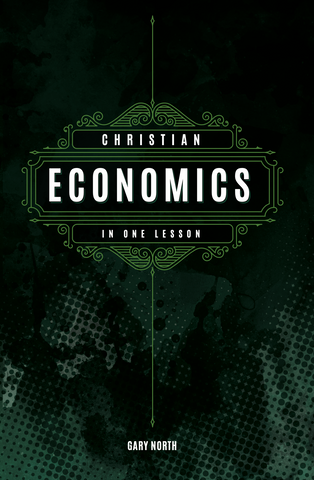
Christian Economics in One Lesson
Christian Economics in One Lesson is Dr. Gary North's reworking of Henry Hazlitt’s classic introduction to economic thought, Economics in One Lesson. That book set the standard as an introductory economics book. Nothing has come close to replacing it ever since it was first published in 1946. Christian economics must begin with the issue of ultimate ownership. This sets it apart from modern economic analysis, which begins with the issue of scarcity. Second, this leads to the issue of theft, which in turn raises the issue of ethics.
Buy NowGary discusses different immutable aspects of monetary policy and economics. Politicians and economists act like they can control and turn economic laws the way they want them to go. This is not possible, as Gary points out with three quick lessons from real-life scenarios.