
Please consider a year-end donation to American Vision to keep us going strong in 2026!
The late Otto Scott, a former journalist, editor, historian, and author of ten books and numerous articles, was attracted to the gospel accounts of Jesus’ life because they didn’t agree on every point. Scott recounts how he became a Christian after reading the gospels and their differences:
Well, my wife was Christian and took our daughter to church all the time. I would attend out of courtesy. One night I was reading late, and my little girl came out of the bedroom and wanted to know about this business of turning the other cheek. I had no idea where that idea came from, but I thought it might be the Bible. I had a Bible in the house, of course, and I picked it up and read the Gospels—all four in one swoop. It was the contradictions [differences] in the testimony of these four different men that convinced me. As a reporter, I had interviewed a lot of men, and I was on the crime beat at one point. I knew that if you get four men who tell you the same story they probably are colluding because no four men see the same thing the same way. One sees one significant element; one sees another. Although there was a close resemblance in the reporting of certain incidents in the Gospels, they were not identical. I was instantly convinced. I don’t think a person could have convinced me, but those varying contemporary histories did.”[1]
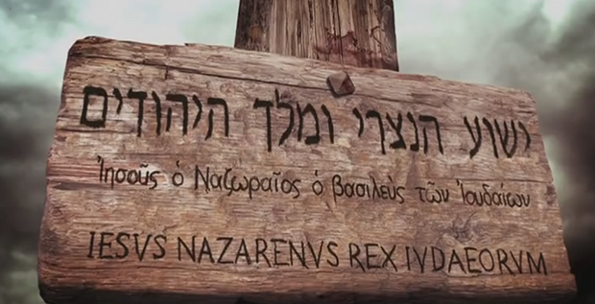
Let’s look at another harmonization issue that some claim is a contradiction. The Synoptic Gospels are the first three books of the New Testament—Matthew, Mark, and Luke. They are described as “synoptic” because they present a similar view of the life and teachings of Jesus. This term comes from the Greek word synoptikós, meaning “able to be seen together” or “giving an account of the events from the same point of view.” Our word “synonym” is derived from the same Greek word and refers to a word that has the same or nearly the same meaning as another word. These three gospels share substantial content, often in the same sequence and, in some cases, with almost identical wording. Consider the legend that appeared above Jesus’ head as He hung on the cross.
- “This is Jesus the King of the Jews” (Matt. 27:37).
- “The King of the Jews” (Mark 15:26).
- “This is the King of the Jews” (Luke 23:38).
- “Jesus the Nazarene, the King of the Jews (John 19:19).
There was a controversy when the inscription was made and placed above Jesus’ head for all the world to see.
They took Jesus, therefore, and He went out, carrying His own cross, to the place called the Place of a Skull, which in Hebrew is called, Golgotha. There they crucified Him, and with Him two other men, one on either side, and Jesus in between. Now Pilate also wrote an inscription and put it on the cross. It was written: “JESUS THE NAZARENE, THE KING OF THE JEWS.” Therefore many of the Jews read this inscription, because the place where Jesus was crucified was near the city; and it was written in Hebrew, Latin, and in Greek. So the chief priests of the Jews were saying to Pilate, “Do not write, ‘The King of the Jews’; rather, write that He said, ‘I am King of the Jews.’” Pilate answered, “What I have written, I have written.” (John 19:17-22)
John’s account is complete and includes all the elements of Matthew, Mark, and Luke. We learn from John that the posts were written “in Hebrew, Latin, and Greek” (John 19:20). The best solution is usually the easiest—the gospel writers picked only what they needed to tell their story. There’s enough in each of the accounts to explain who Jesus is and the content of His mission.
Each is true and accurate in its own right. All of them state that Jesus is “the king of the Jews.”
Thinking Straight in a Crooked World
The nursery rhyme "There Was a Crooked Man" is an appropriate description of how sin affects us and our world. We live in a crooked world of ideas evaluated by crooked people. Left to our crooked nature, we can never fully understand what God has planned for us and His world. God has not left us without a corrective solution. He has given us a reliable reference point in the Bible so we can identify the crookedness and straighten it.
Buy Now[1] Quoted in James P. Lucier, “Otto Scott Steers by the Compass,” Insight (1999). In the same interview, Scott comments: “On the historical side,” Scott writes, “each time you look into the background of a certain line of activity, it looks different. The first historical background I did was for the Ashland Oil book. It was an attempt to put the history of the company against the contemporary events of the period through which the company had grown. But my attempt was sort of a tour of the surface—what you get from looking at ordinary accounts of the times beginning in 1918. But the next time I looked at the period, when I was writing the history of Raytheon, the background looked different. I began to go into history in a more serious way.”