

Is it a crime to steal from your neighbor? It is. Is it a crime for a group of neighbors to steal from another group of neighbors for a “worthy cause”? It is. Is it a crime to elect some of your neighbors to a political position so they can take money from other neighbors to benefit other neighbors? No, but it should be! No one’s income should be taxed. Many people will ask, “How will we pay for everything?” Certainly not by taking money from some people and giving it to other people! That’s stealing, even if a majority votes for it.
Maybe political governments should not be in the business of being in our business. Who will build the roads? The same companies that build them now. How will we pay for the roads? The people who use the roads. That’s what’s done now. If you don’t drive on roads, you don’t pay anything. Of course, you will pay for the roads indirectly when you purchase goods that travel on streets and highways. Apply the principle to education, medical care, housing, clothing, food, and nearly everything else. If you use it, you pay for it.
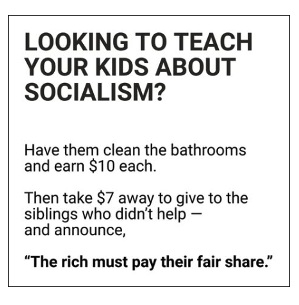
Now let’s talk about the minimum wage. Forcing a minimum wage on companies is economic tyranny. Think about it. The government is forcing employers to pay people a set amount, regardless of what they do for the employer. Higher wages also mean higher prices. Not only will employers have to pay $15 per hour, but they will also face higher Social Security and Medicare costs. Remember that employers pay the same amount of Social Security and Medicare “contribution” as an employee. In addition, the states and the Federal government will get more tax revenue since the pay increase will mean more money to tax and spend on worthless and unconstitutional programs.
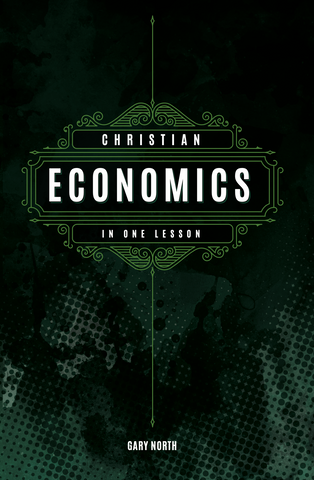
Christian Economics in One Lesson
Christian Economics in One Lesson is Dr. North's reworking of Henry Hazlitt’s classic introduction to economic thought, Economics in One Lesson. That book set the standard as an introductory economics book. Nothing has come close to replacing it ever since it was first published in 1946. Why is it necessary to replace a classic? This one targets Christians. (Orthodox Jews are invited to come along for the ride.) Ethics are placed at the heart of this analysis: the deliberate breaking of the window. Hazlitt did not—not explicitly, anyway.
Buy NowWage gains will be passed through to prices for goods and services. In time, everyone will be back where they started. Market conditions, demand for goods and services, and the state of the economy determine wages and prices. Of course, employers are always looking for ways to cut costs, but in the end, to stay in business, they strive to hire the most skilled, productive, and responsible workers for the least cost.
Employers who hire minimum-wage workers are usually operating on thin profit margins. Suppose they get hit with something like a 25 or 50 percent increase in the minimum wage. In that case, to offset the additional labor costs, employers may lay off a fourth of their workers and redistribute the work to the remaining employees. Unlike our government, businesses can’t print money. They may also turn to human substitutes, such as robots, kiosks, and self-checkout lanes.
“First, you have to raise prices, otherwise you’ll be out of business,” owner Selwyn Yosslowitz [of Marmalade Café] told the Times. So higher prices for diners. That’s “first.” We imagine you can guess what’s “second.” “We will try to re-engineer the labor force,” Yosslowitz said. “Maybe try to reduce the number of busboys and ask servers to bus tables.” In other words: “Maybe we’ll fire some folks and the people who keep their jobs will have to be more efficient.” (Source)
Inexperienced young people are the first to suffer when the minimum wage increases.
It used to be that when two people competed for the same job (with equal skill levels), the person who would work for less would get the job.
An employer could take a risk on someone who lacked experience because he or she didn’t have to pay that person what an experienced worker might demand. Many of the jobs available to teens are low-skilled.
By making it illegal to pay someone less than a government-mandated minimum wage, those with less experience are at a disadvantage. Employing teenagers is now a classic Catch-22 dilemma.
“Do you have experience?,” the shop owner asks.
The teenager is honest and shows initiative by answering, “No, but I’m willing to work at a lower wage to gain experience.”
“Sorry,” the shop owner says. “I would be breaking the law if I hired you for any amount less than the minimum wage. I can hire someone with experience at the same wage I’d have to pay you.”
“But I can’t get experience if you won’t hire me.”
“Tough luck. Complain to your newly elected socialist congressman.”
Renee Ward, the founder of the job posting site Teens4Hire.org, offers a similar story. “If you have two candidates for a job, and one has experience and will take $10 an hour, and the other is a teen with no experience, who do you think would get the job? When jobs aren’t there for anyone, it’s that much harder.”
You might respond, “Sure, you can say this because you make a lot of money.” I sure make more than I did at my first job—$50 a week washing pots and pans at a country club. Do the math. It was a little more than a dollar an hour.
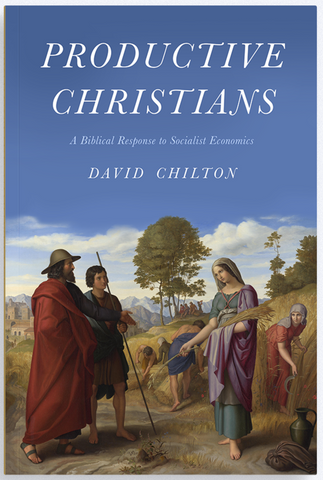
Productive Christians in an Age of Guilt Manipulators
In Productive Christians: A Biblical Response to Socialist Economics, David Chilton exposes the follies and fallacies of socialism, and also systematically outlines the biblical alternative — an alternative that lays the groundwork for real justice, progress, prosperity, and freedom for the rich, the poor, and everyone in between. This new edition also includes a 23-page appendix that Chilton wrote 43 years ago. "Studies in Amos" is an eight-part article series originally released in 1980.
Buy NowI worked at a New Year’s Eve party at a restaurant when I was 16 with no hourly wage. The only money I got was in tips. The no-wage guarantee made me work very hard to get good tips. I made $20 for three hours of work. That was in 1966. That was big bucks back then.
I worked in the produce department at Kroger after school, weekends, and during the Summer. This experience enabled me to get a job in Florida during a soft economy. When I went in to apply, the manager told me that they were not hiring. He asked me if I had experience. I did. I ended up working 60 hours a week. There was no union like there was at Kroger. My hard work was noticed, and I was offered the assistant manager’s job at a new store the company was opening.
It was these types of jobs and less-than-optimal working conditions that incentivized me to do better. I gained work experience and references. I worked through high school, had two jobs in college, and worked my way through seminary as a custodian and assistant bookstore manager.
Get the government out of the minimum wage business, and you’ll see the economy grow, prices fall, and wages that will keep up with expenses. The best workers will get the best jobs at the best prices. Also, cut every unconstitutional government program and eliminate the income tax. Follow the Pareto Principle in government hiring, where 20% of the workers produce 80% of the results. Government jobs are votes for creeping socialism. The same is true for guarantee income programs. Rep. Bonnie Watson Coleman (NJ-12) announced the reintroduction of the Guaranteed Income Pilot Program Act, legislation that would establish a nationwide pilot program to test the viability of a federally funded income support program that keeps more American families from experiencing permanent financial fallout and lasting poverty from a single unexpected crisis. This will lead to more votes for socialism and generational poverty.