
Please help us meet a $15K matching challenge here
What is the focus of redemptive history? Is it Jesus or the modern state of Israel? This is not a trick question. Every Christian would say Jesus is the focus and center of redemptive history. Our calendars used to use BC for Before Christ and AD for Anno Domini, that is, “the Year of our Lord.” Our nation’s Constitution affirms this in words just below George Washington’s signature, “Done in the Year of our Lord … one thousand seven hundred and Eighty-seven.” The year 1787 marked the number of years since the birth of Jesus Christ. In academic, scientific, and educational contexts, BC has been replaced by BCE (Before Common Era), and AD by CE (Common Era). So far, we still follow the dating based on the birth of Jesus that even BCE and CE acknowledge. Our constitutional framers did not do what the French Revolutionaries did by starting with a ‘New Year One’ and replacing the seven-day creation week with a ten-day week. Our Constitution notes that Sunday is a day of rest based on the change from the seventh day (Saturday) Sabbath to the first day of the week (Sunday), the “Lord’s Day” based on the biblical calendar (Article I, Section 7, Clause 2).
The birth of Jesus changed the world forever, and Israel was the chosen nation to make it happen.
For to us a child is born,
to us a son is given;
and the government shall be upon his shoulder,
and his name shall be called
Wonderful Counselor, Mighty God,
Everlasting Father, Prince of Peace (Isa. 9:6).
Without the nation of Israel, the redemptive work of Jesus would not have happened. The genealogies found in the gospels of Matthew and Luke confirm this truth.
So all the generations from Abraham to David are fourteen generations; from David to the deportation to Babylon, fourteen generations; and from the deportation to Babylon to the Messiah, fourteen generations (Matt. 1:17).
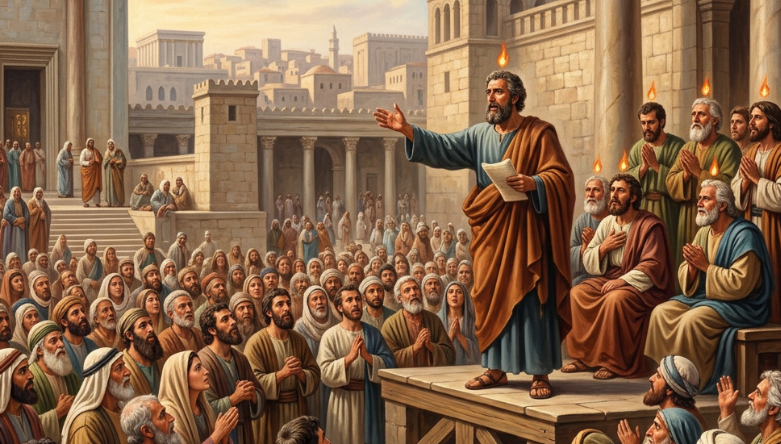
The magi inquired about the “King of the Jews” (Matt. 2:2). Even in death, Jesus was identified as “the King of the Jews.”
“This is Jesus the King of the Jews” (Matt. 27:37).
“The King of the Jews” (Mark 15:26).
“This is the King of the Jews” (Luke 23:38).
“Jesus the Nazarene, the King of the Jews (John 19:19).
This declaration was a worldwide proclamation. We learn from John that the inscriptions were written “in Hebrew, Latin, and Greek” (John 19:20), the main languages of the Middle East, Asia Minor, and the farthest boundaries of the Roman Empire at that time. At least some portions of the Bible have been translated into more than 4,000 languages, out of a total of 7,396 known languages (including sign languages and Braille) to proclaim that Jesus is the source of reconciliation with God.
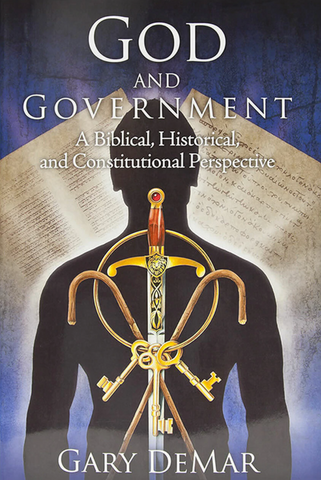
God and Government
With a fresh new look, more images, an extensive subject and scripture index, and an updated bibliography, God and Government is ready to prepare a whole new generation to take on the political and religious battles confronting Christians today. May it be used in a new awakening of Christians in America—not just to inform minds, but to stimulate action and secure a better tomorrow for our posterity.
Buy NowChristianity would not exist without the Jewish nation. God made that the case. That’s why Israel was chosen by God.
“The LORD did not make you His beloved nor choose you because you were greater in number than any of the peoples, since you were the fewest of all peoples, but because the LORD loved you and kept the oath which He swore to your forefathers, the LORD brought you out by a mighty hand and redeemed you from the house of slavery, from the hand of Pharaoh king of Egypt (Deut. 7:7-8).
The message of the kingdom went first “to the lost sheep of the house of Israel” (Matt. 10:6). Paul declared that the gospel message was “to the Jew first” (Rom. 1:16; 2:9). Israel’s role in God’s redemptive plan for the world is self-evident. No matter how unfaithful Israel had been in the past, sent into exile for 70 years, and nearly wiped out by the evil Haman (Esther 3), God faithfully guided and directed His chosen nation through people like Zechariah and Elizabeth, Mary and Joseph, Simeon and Anna, John the Baptist, and Jesus’ disciples, Let’s not forget Stephen, Paul, and Timothy, among others.
So, what of Israel today? What role does Israel play in prophetic history? What’s left on the prophetic calendar to be accomplished? Has anything been postponed? Will the temple be rebuilt? Should it be rebuilt? Nothing in the New Testament says anything about a rebuilt temple. There is no need for one because the temple was always planned for obsolescence. Jesus was the temple (John 2:13-22). He was “the door” (10:7, 9) and the “chief cornerstone” (Matt. 21:42; Acts 4:11; Eph. 2:20; 1 Peter 2:6). Jesus serves as the High Priest and Mediator between God and humanity, a role most fully explained in the New Testament book of Hebrews. Unlike the Old Testament Levitical priests who offered repeated animal sacrifices, Jesus offered Himself as the perfect, once-for-all sacrifice for sin, thereby securing eternal redemption.
Today’s pop-prophecy writers continually accuse those who hold to these truths of being ‘antisemitic’ because we believe the gospel unites Jews and Gentiles in Christ (Eph. 2:11-22). We believe the destruction of the temple in AD 70 marked the end of the covenant’s exclusive and temporary nature with Israel. This never meant that God was finished with Israel, not in the least. The first believers were Jews. The first New Testament ekklēsia (improperly translated as ‘church’) was made up exclusively of Jews (Acts 5:11). The first evangelists were Jews. Jews were being saved from “every nation under heaven” (2:5). The gospel went to “the Jew first and also the Greek” (Rom. 1:16). Paul’s message was “for the sake of the hope of Israel”[1] (Acts 28:20). Of course, there was opposition from many of the Jewish religious leaders (28:22-30).
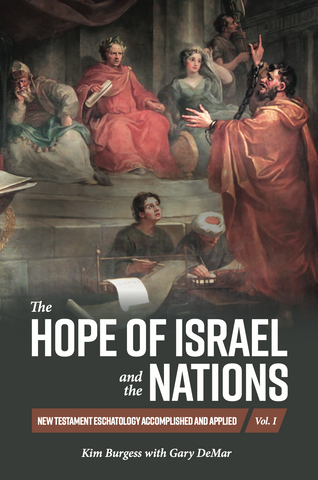
The Hope of Israel and the Nations
The reader and student of the Bible must first understand the content of the New Testament writings in terms of how those in the first century would have understood it. The New Testament is written against the background of the Old Testament. The shadows of the Old were fulfilled in the reality of the New. All the rituals and ceremonies were fulfilled in Jesus. The same is true of the temple, land, blood sacrifices, the nature of redemption, the resurrection of the dead, the breaking down of the dividing wall dividing Jews and Gentiles, and so much more. The New Testament's emphasis is on the finished work of Jesus and its application, not only to that Apostolic generation but to the world today.
Buy NowAdditionally, the Bible records a significant event in Acts 6:7 , where “a great many of the priests were becoming obedient to the faith” and joined the early Christian community in Jerusalem, marking a transition in which the traditional priestly role expanded to include believers. Paul was never deterred from his mission because he knew that not every Jew would come to Christ, and that has not changed. Dispensationalists want to revive that period of history that included the destruction of the temple that took place before that generation passed away (Matt. 24:1-3, 34). They believe and teach that there will be another Jewish holocaust that will result in the slaughter of millions of Jews and billions of non-Jews around the world. They tell us that this is a prophetic inevitability.
These facts are not up for debate. The Bible is clear. Does this mean that Jews today are disenfranchised? Not any more than non-Jews are disenfranchised. Peter gave this answer to this question: “What must I do to be saved?”
“Repent, and each of you be baptized in the name of Jesus Christ for the forgiveness of your sins; and you will receive the gift of the Holy Spirit. For the promise is for you and your children and for all who are far away, as many as the Lord our God will call to Himself.” And with many other words he solemnly testified and kept on urging them, saying, “Be saved from this perverse generation!” (Acts 2:38-40)
That answer has not changed. It remains the same for Jews and non-Jews. It’s the starting point—not the end point—of worldview thinking and application. End-time thinkers can’t think beyond what they believe are inevitable prophetic events: zero hope for the church and sure disaster for a single end-time generation of Jews living in Israel. We are in a waiting game in anticipation of some great end-time cataclysmic events that can’t be avoided. Nothing is going to be built because it’s all going to be destroyed. Lovers of Israel only see hope when Jesus returns to Earth to set up His millennial kingdom. We sit. We wait. We anticipate. Nothing on this side of Revelation 20 matters.
Can you imagine what the world would have been like through the centuries if Christians had embraced this kind of thinking? Israel is not the focus of history. Jesus is. If you love Israel, then make that the message.
[1] Kim Burgess with Gary DeMar, The Hope of Israel and the Nations, 2 vols. (Powder Springs, GA: American Vision, 2024).