
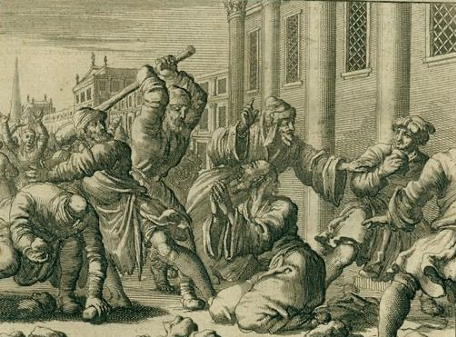
James wrote to his fellow Christians at a time when hostilities and attacks were coming from the religious leaders of Israel. The book of Acts shows that some (many?) Jews opposed the Gospel, and many Jews embraced the Gospel (Acts 1-2), including some priests. Priests first confront Peter and John in Acts 4:1, where they, along with the captain of the temple guard and the Sadducees, arrest the apostles for teaching that Jesus was resurrected from the dead. Later, in 6:7, a significant number of priests become obedient to the faith, marking a major shift from opposition to acceptance among some of the religious leadership in Jerusalem. What was the response?
So they stirred up the people and the elders and the teachers of the law. They seized Stephen and brought him before the Sanhedrin. They produced false witnesses, who testified, “This fellow never stops speaking against this holy place and against the law. For we have heard him say that this Jesus of Nazareth will destroy this place and change the customs Moses handed down to us” (6:12-14).
Stephen was later murdered by the Jewish religious establishment led by the Pharisee Saul (23:6). Luke tells us that Stephen’s executioners laid their garments at the feet of Saul (7:58), who approved of the mob’s murderous actions (8:1). Saul later ravaged the church, entering the homes of believers and sending them to prison, including female believers (8:3).
After his conversion, Paul was nearly assassinated by a group of more than forty zealous Jews in Jerusalem following his arrest (23:12-22). The conspirators were outraged by Paul’s teachings on the resurrection and his mission to the Gentiles, viewing him as a heretic who defiled the Temple. They swore a solemn oath not to eat or drink until they had killed him. J.B. Phillips writes in the “Translator’s Preface” in his The Young Church in Action: A Translation of the Acts of the Apostles.
Throughout the book the main enemies of the Church’s life, as in the life of Christ Himself, were the entrenched self-righteous—in this case the Jews. The persecution by non-Christians was spasmodic and more than once designed to please the Jews [Acts 12:1-3]. But all the bitter relentless campaign of persecution and misrepresentation, particularly of Paul, must be laid at the door of the Jews. Christ said that “Yea, the time cometh when whosoever killeth you will think he doeth God’s service.”[1]
James was dealing with the issues of his day, “miseries which are coming up upon you” (5:1-6). The “you” was them. It’s possible that whoever this group was, they “condemned and put to death the righteous” (v. 5), as James said earlier: “You lust and do not have; so you commit murder. And you are envious and cannot obtain; so you fight and quarrel. You do not have because you do not ask” (4:2).
Jesus said to that generation of religious leaders, “I am sending you prophets and wise men and scribes; some of them you will kill and crucify, and some of them you will flog in your synagogues and persecute from city to city” (Matt. 23:34). Paul may have had them in mind in 2 Corinthians 11.
…imprisonments, beaten times without number, often in danger of death. Five times I received from the Jews thirty-nine lashes. … dangers from my countrymen, dangers from the Gentiles, dangers in the city, dangers in the wilderness, dangers at sea, dangers among false brothers (vv. 23-26).
According to Acts 14:19, Paul was stoned by a mob and dragged outside the city of Lystra, where he was left for dead. Jesus was continually threatened with stoning (John 8:59; 10:31-39; 11:8). On one occasion, in the synagogue at Nazareth, the crowd was filled with fury and tried to throw Him off a cliff (Luke 4:28-29).
Revelation and the First Century
With Revelation and the First Century, Francis Gumerlock has done an invaluable service to everyone interested in prophecy and church history. Dr. Gumerlock provides dozens of citations from early church history proving that many of them held a preterist view from the very first days of Christianity onward.
Buy NowJames tells his readers to “be patient … until the coming of the Lord” (v. 7), which is said to be “near,” and uses the example of a farmer and his planted crops. A farmer could hardly be told to be patient if the harvest was far in the future. Like the farmer, James told his readers, “you too be patient … because the coming of the Lord is near” (v. 8). This is most likely not a reference to the Second Coming. Adam Clarke wrote, “He seems here to refer to the coming of the Lord to execute judgment on the Jewish nation, which shortly afterward took place. He is already on his way to destroy this wicked people, to raze their city and temple, and to destroy their polity forever; and this judgment will soon take place.” Alexander Ross agrees: “The word speaks of the coming of Christ in kingly majesty and glory. Such a ‘royal visit’ took place at the Fall of Jerusalem, when the Divine judgment fell with shattering effect on the Jewish community…. As already stated, in a very real sense the words, ‘Henceforth, from this moment onwards, ye shall see the Son of Man sitting at the right hand of power and coming on the clouds of heaven’ (Mt. 26:64).”[2] This is what Jesus described in Matthew’s Gospel:
• “Now the king was angry, and he sent his armies and destroyed those murderers and set their city on fire” (Matt. 22:7).
• “Truly I say to you, all these things will come upon this generation…. Behold your house is being left to you desolate” (23:36-38).
• “This generation will not pass away until all these things take place” (24:34).
According to Frank Gumerlock, “At least four medieval commentators on the Epistle of James interpreted the ‘day of slaughter’ in James 5:5 as the first-century destruction upon Jerusalem and Judea at the hands of the Romans.”[3] In the book The Day of His Coming by Herbert Henry Gowen, we find the following:
The whole letter is written in the solemn shadow of a great impending judgment [that took place in Jerusalem in AD 70]. The rich**[4]** are to weep and howl for their “miseries which are coming” upon them; the brethren are exhorted to “be patient until the parousia of the Lord.” “Behold,” he cries, “the Judge is standing before the doors.”
Jesus said something similar in Matthew 24:33: “so, you too, when you see all these things, recognize that He is near, right at the doors.” The “you” referred to those of that generation (v. 34). Henry Cowles interpreted James 5:8 (“the coming of the Lord draweth nigh”) as referring to the imminent destruction of Jerusalem and the end of the Old Covenant age, rather than a future, distant Second Coming. He argued that this “coming” was a time of retribution upon the wicked and deliverance for the righteous, serving as a motive for patience against the specific oppressions and persecutions Christians faced from wealthy Jews and Roman authorities.
How could James have exhorted his readers to be patient if the coming he was describing was a long way off, nearly 2000 years away? A similar question arises in Revelation 6:10. “At hand” does not mean thousands of years. In fact, the definition of “at hand” is in the context: “right at the doors.” The plural may be important as a reference to the temple (Acts 21:30), which Jesus said, “not one stone here will be left upon another, which will not be torn down” (Matt. 24:2).
Albert Barnes offers a similar interpretation.
It is clear, I think, from this place, that the apostle expected that that which he understood by “the coming of the Lord” was soon to occur; for it was to be that by which they would obtain deliverance from the trials which they then endured…. The most natural interpretation of the passage, and one which will accord well with the time when the Epistle was written, is, that the predicted time of the destruction of Jerusalem Matthew 24 was at hand; that there were already indications that that would soon occur; and that there was a prevalent expectation among Christians that that event would be a release from many trials of persecution, and would be followed by the setting up of the Redeemer’s kingdom.
The destruction of Jerusalem and of the temple would contribute to that by bringing to an end the whole system of Jewish types and sacrifices…. The Epistle was written, it is supposed, some ten or twelve years before the destruction of Jerusalem, and it is not improbable that there were already some indications of that approaching event.
Many commentaries do not deal with the Greek word ἤγγικεν,[5] which is almost universally translated as “near” or “at hand.” The following is from a more recent commentary.
One can read “the coming of the Lord is near” in James 5:8 in the context of Paul’s statements about the coming of the Lord Jesus Christ, and, if ēngiken [at hand] is understood as referring to something about to happen, then either Jesus did return somehow or James was wrong. Or one can read this text in light of the teachings of Jesus about the parousia in a Jewish context and see it as a prediction of the imminent judgment of God, and in this case one would have to think of the sacking of Jerusalem in 70 AD as told of so graphically by Josephus in his Jewish War.[6] The latter is far more probable, and the next verse tips the balance in its favor.[7]
The New Testament is filled with examples of statements about the nearness of Jesus’ return related to His judgment coming before that (their) generation passed away, from Matthew 10:23, 16:27-28, Matthew 24:33-34, and 26:64 to Luke 17:22-37, 19:39-44, 21:1-36, and Mark 13.

Wars and Rumors of Wars
A first-century interpretation of the Olivet Discourse was once common in commentaries and narrative-style books that describe the fall of Jerusalem in AD 70. There is also a history of skeptics who turn to Bible prophecy and claim Jesus was wrong about the timing of His coming at “the end of the age” and the signs associated with it. A mountain of scholarship shows that the prophecy given by Jesus was fulfilled in exacting detail when He said it would: before the generation of those to whom He was speaking passed away.
Buy NowIn Eusebius’ Ecclesiastical History, written in the fourth century, we learn of an incident that led to the martyrdom of James, the brother of Jesus. The original story comes from the second-century historian Hegesippus, who wrote his notes on the history of the church between AD 165 and 175. When James was called on by a group of Scribes and Pharisees to explain what he believed was the truth of Jesus as the promised Messiah, Hegesippus reports James said that Jesus “is about to come on the clouds of heaven.”[8]
These Scribes and Pharisees believed that people were “led astray after Jesus was crucified.” James said the following: “Why do you ask me respecting Jesus the Son of Man? He is now sitting in the heavens, on the right hand of great Power, and is about to come on the clouds of heaven.”[9]
After hearing James’ obvious allusion to Matthew 26:64, the officials of the temple cast him down from the “wing of the temple” and later stoned him and beat out his brains with a club. “Immediately after this,” Hegesippus writes, “Vespasian invaded and took Judea.”[10] James, the brother of Jesus, believed that Jesus’ coming was “about to take place.” Hegesippus identifies the coming of Jesus “on the clouds of heaven” with the destruction of Jerusalem in AD 70.
[1] “They will make you outcasts from the synagogue, but an hour is coming for everyone who kills you to think that he is offering service to God” (John 16:2).
[2] The Epistles of James and John (Grand Rapids, MI: Eerdmans, 1954), 92, 93. Also see Douglas J. Moo, The Letter of James (Grand Rapids, MI: Eerdmans/Leicester, England: Apollos, 2000), 223-224; C. Leslie Mitton, The Epistle of James (Grand Rapids, MI: Eerdmans, 1966), 186-187.
[3] Francis X. Gumerlock, Revelation and the First Century: Preterist Interpretations of the Apocalypse in Early Christianity (Powder Springs, GA: American Vision, 2012), 163.
[4] Were the “rich” those who were profiting from money changing in the temple and possibly in synagogues where the 12 tribes were scattered who were encountering “various trials” (James 1:1-2)? Jesus raises the issue when He enters the temple where people were “buying and selling” (Matt. 21:12). Some people, with the approval of the priesthood, had turned the temple into a “robbers’ den” (v. 13). Is this one of the reasons that Jesus said that “the kingdom of God will be taken away from you and be given to a nation producing the fruit of it…. And when the chief priests and the Pharisees heard His parables, they understood that He was speaking about them” (vv. 43-46)?
[5] ἐγγύς and ἐγγίζω in the Gospels and Epistles.
• Matt. 3:2; 4:17; 10:7: “The kingdom of heaven is at hand”— ἤγγικεν.
Matt. 26:45: “The hour is at hand”—ἤγγικεν.
• Mark 1:15; Luke 10:9, 11: “The kingdom of God is at hand”—ἤγγικεν.
• Mark 14:42: “He that betrayeth me is at hand”—ἤγγικεν.
• Luke 16:8: “The time draweth near”—ἤγγικεν
• Luke 21:20: “The desolation thereof ” (of Jerusalem)” is nigh”—ἤγγικεν.
• Rom. 13:12: “The day is at hand”—ἤγγικεν.
• Heb. 10:25: “Ye see the day approaching”—ἐγγίζουσαν.
• James 5:8: “The coming of the Lord draweth nigh”— ἤγγικεν.
• 1 Pet. 4:7: “The end of all” (Πάντων—of the spiritually dead in the previous verse) “is at hand”—ἤγγικεν.
• Matt. 26:18: “My time is at hand”—ἐγγύς.
• Luke 21:31: “The kingdom of God is nigh at hand”—ἐγγύς.
• Phil. 4:5: “The Lord is at hand”—ἐγγύς.
• Rev. 1:3; 22:10: “The time is at hand”—ἐγγύς.
[6] The following items are themes in Jesus’ prophecies about the future that have parallels in Josephus, that suggest predictive prophecy, and that correspond to the theme of God acting in judgment against oppression:
• false prophetic/messianic claims: War 2.252-94 (John of Gischala); 4.529-44 (Simon ben Gioras);
• hideous persecution: 2.297-308, especially 306-8 (Florus); 2.457-80, 494-98 (50,000 Alexandrian Jews slaughtered in A.D. 66); 3.59-63 (Galilee a “scene of fire and blood”), 336-39, especially 336 (surrender of Jotapata), 414-27, especially 426-27 (Joppa exodus leads to sea of blood); 3.485-91 (Tarichaeae valley full of corpses), 522-31 (massacre on Sea of Galilee: blood, corpses, stench); 4.305-44 (bloody insurrection in Temple courts led by Zealots and Idumaeans, high priest Ananus killed); 5.446-59 (500 crucifixions per day), 512-26 (death everywhere); 6.351-55 (the city burns), 369 (“Not a spot in the city was left bare: every corner had its corpse, the victim of famine or sedition”);
• defilement of the Temple: 4.377-88 (by Zealots); 5.11-38, especially 16-18 (lakes of blood in the Temple); 5.527-33 (high priestly murders); 6.1-8 (war ruined it all); 6.249-66 (Temple burned);
• horrors of famine: 5.429-38; 6.193-213 (a mother devours her own child);
• the ultimate in pain: 5.442-45;
• flights ending in horrific murders: 5.548-52 (2,000 Jewish refugees ripped open by Syrians and Arabs when it was discovered that one Jew had golden coins in his excrement); 6.366-73 (flights to caves and among rocks);
• constant observation that all this was the judgment of God (6.93-110);
• corresponding events connected with the last days of Jerusalem before its total destruction: 6.288-309 (star and comet [birth of Jesus?]; midnight light around the altar [birth of Jesus?]; cow gives birth to lamb; gates open of their own accord [death of Jesus?]; chariots in the sky, with battalions; invisible voice saying, “We are departing hence”; a prophet named Jesus [not Jesus of Nazareth] announces judgment). I take this from New Vision, 141 n. 52.
[7] Scot McKnight, The Letter of James, The New International Commentary on the Old and New Testament (Grand Rapids, MI; Cambridge, UK: Eerdmans, 2011), 412-413.
[8] Boyd, A Dispensational Premillennial Analysis of the Eschatology of the Post-Apostolic Fathers, 288. Boyd cites Eusebius, Ecclesiastical History, 2.33. The correct reference is 2:22. The account is also told in William Cave, Antiquitates Apostolicae: Or, the History of the Lives, Acts and Martyrdoms of the Holy Apostles or Our Saviour, and the Two Evangelists, SS. Mark and Luke, 2 vols. in 1 (London: R. Norton for R. Royston, Bookseller to His most Sacred Majesty, 1677), 1:193.
[9] Eusebius’ Ecclesiastical History, “The martyrdom of James, who was called the brother of the Lord,” 2.23 (Grand Rapids, MI: Baker, 1958), 77-78. The same account can be found in volume 8 of the Ante-Nicene Fathers, 763.
[10] Eusebius’ Ecclesiastical History, “The martyrdom of James, who was called the brother of the Lord,” 2.23 (Grand Rapids, MI: Baker, 1958), 77-78. The same account can be found in volume 8 of the Ante-Nicene Fathers, 763.