

A response to one of my Facebook posts stated, “It’s coming; fortunately, I’m 77; IT SHALL WAX WORSE (2 Tim. 3:13).” What does prophecy speculation do? It ties people to the present with no earthly future for God’s people. The ‘rapture’ is the next prophetic event, and it’s going to happen “soon.” I’m 76, and the work at American Vision is to prepare people for the future. What should we tell teenagers? Everything will get worse, and you can’t or shouldn’t do anything about it. It’s hopeless. And if the ‘rapture’ does not happen in 50 years, another generation will be lost to Last Days Madness, while the secularists and Islamists, who believe in an earthly future, will dominate society.

Last Days Madness
In this authoritative book, Gary DeMar clears the haze of "end-times" fever, shedding light on the most difficult and studied prophetic passages in the Bible, including Daniel 7:13-14; 9:24-27; Matt. 16:27-28; 24-25; Thess. 2; 2 Peter 3:3-13, and clearly explaining a host of other controversial topics.
Buy NowLarry Poston wrote the following: “ Islam is practical. It is considered a this-worldly religion in contrast to Christianity, which is perceived as abstract in the extreme. Muhammad left his followers a political, social, moral, and economic program founded on religious precepts. Jesus, however, is said to have advocated no such program; it is claimed that the New Testament is so preoccupied with his imminent return that it is impractical for modern life.”[1]
What a person believes about the future—good, bad, or indifferent—determines how he or she lives in the present and whether they plan, innovate, and build for the future (Prov. 6:6-11).
Here is my response to the 77-year-old doomsayer:
Jesus’ coming was “near” in Timothy’s day, as James pointed out (James 5:7-9), and it wasn’t the end of the space-time universe. Yes, “evil men and impostors will proceed from bad to worse, deceiving and being deceived.” In the same chapter we find the following: “But they will not make further progress; for their folly will be obvious to all, just as Jannes’s and Jambres’s folly was also” (2 Tim. 3:9). In the meantime, Paul told Timothy: “YOU, however, continue in the things YOU have learned and become convinced of, knowing from whom YOU have learned them, and that from childhood YOU have known the sacred writings which are able to give YOU the wisdom that leads to salvation through faith which is in Christ Jesus. All Scripture is God-breathed and profitable for teaching, for reproof, for correction, for training in righteousness; so that the man of God may be adequate, equipped for every good work” (vv. 14-17).
Paul described what was happening then, in Timothy’s day, and how Timothy should handle himself as the pagan world collapsed around them. Here we are, 2000 years later!
He responded with Luke 19:13: “And he called ten of his own slaves and gave them ten minas, and said to them, ‘Do business with this money until I come.’” I responded with the following:
What else do we find in Luke 19? There’s this: “When He approached Jerusalem, He saw the city and wept over it, saying, ‘If YOU had known on this day, even YOU, the conditions for peace! But now they have been hidden from YOUR eyes. For the days will come upon YOU when YOUR enemies will put up a barricade against YOU, and surround YOU and hem YOU in on every side, and they will level YOU to the ground, and throw down YOUR children within YOU [Luke 21:23], and they will not leave in YOU one stone upon another [Luke 21:6; Matt. 24:2], because YOU did not recognize the time of YOUR visitation’” (Luke 19:41-44). The “you” was them and referred to Jesus’ coming before their generation passed away [Luke 21:32].
Similar language is found in Luke 17. Most people don’t realize that many, if not most, of Jesus’ parables were intended not as general morality tales, but as pronouncements of coming judgment and change. Jesus warned Jerusalem to repent and accept its new King (Jesus), or else fall under God’s ultimate condemnation. In fact, much of Jesus’ teaching in the Gospels pertains primarily to that pre-AD 70 crowd, and without reading it in this light, we misunderstand it. And when we misunderstand it, we misapply it. See Joel McDurmon’s book Jesus v. Jerusalem.
Jesus v. Jerusalem: Jesus' Lawsuit Against Israel
How many students of Bible prophecy have viewed the parables of Jesus as rich in prophetic material? Not many have, except those who see them as a series of end-time events that seem to be always on the prophetic horizon. Certainly, you will find this or that prophecy writer who finds a prophetic gem here or there, but few, if any, have noticed that most of Jesus’ parables are a rich source of predictive material that deal with a particular subject—the future of Israel as Jesus saw it for that generation.
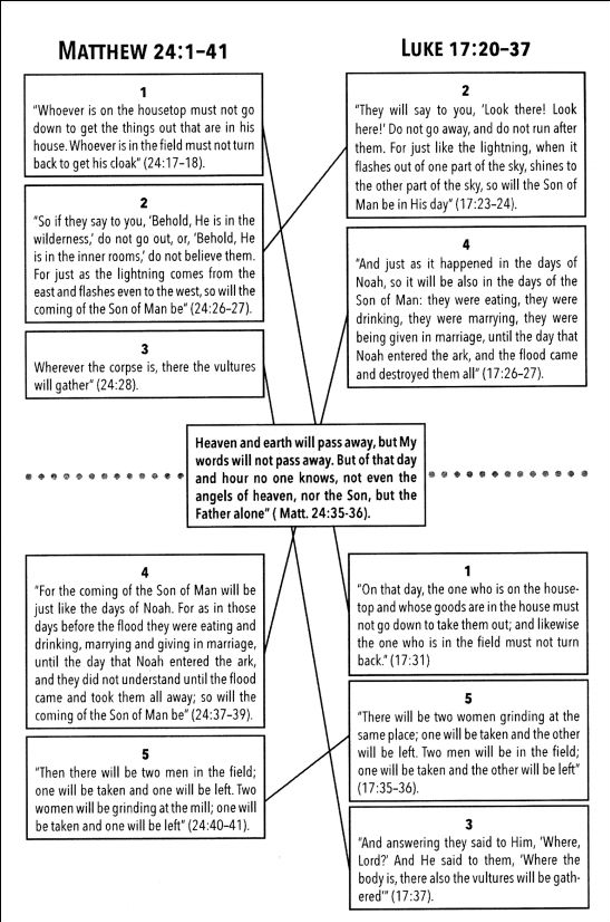
Buy NowTaking Matthew 24 as the standard, Luke places the Noah’s ark analogy (Matt. 24:37-39) before the events of Matthew 24:17-18 (“let him who is on the housetop not go down”), verse 27 (“for just as the lightning comes from the east”), and verse 28 (“wherever the corpse is, there the vultures will gather”). If the five prophetic events of Matthew 24 found in Luke 17:22-37 are numbered 1-2-3-4-5, Luke’s numbering would be 2-4-1-5-3.[2] Both chapters refer to the events of AD 70, as this chart shows.
Let’s get our heads and hearts out of the clouds. Follow Paul’s instructions to Timothy.
Just as Jannes and Jambres opposed Moses, so also these men oppose the truth. They are depraved in mind and disqualified from the faith. But they will not advance much further. Just as with Jannes and Jambres, their folly will be plain to everyone. You, however, have observed my teaching, my conduct, my purpose, my faith, my patience, my love, my perseverance, my persecutions, and the sufferings that came upon me in Antioch, Iconium, and Lystra. What persecutions I endured! Yet the Lord rescued me from all of them.Indeed, all who desire to live godly lives in Christ Jesus will be persecuted, while evil men and imposters go from bad to worse, deceiving and being deceived.” (2 Timothy 3:8–13)
Those evil men are long gone. Evil men and women still exist in the world today. Let’s embrace Paul’s action plan with vigor and hope.
[1] Larry Poston, “The Adult Gospel,” Christianity Today (August 20, 1990), 24-25.
[2] See the chart in Gary DeMar, Prophecy Wars: The Biblical Battle Over the End Times, updated ed.(Powder Springs, GA: American Vision Press, 2024), 307.