

Gary concludes his interview with Pastor Greg Chacon by dealing with questions about prophetic systems that have to add to the finished work of Christ.
People who get caught up in the latest end-time speculative prophecy story either have short memories of past predictions or no knowledge at all. Without having all the facts or a worksheet of past failed prophetic claims, it’s not hard to convince the uninformed, who are easily persuaded by some silver-tongued orator who claims to have some clear eye into the future based on special knowledge, that something in the heavens is a clear sign from God that the end is near.
If you talk to many Christians about Bible prophecy, most likely you will hear them claim that all the signs for some impending prophetic event are unfolding right before our eyes. When popular prophecy writers bring up anything that might appear in the heavens, people pay attention. You don’t have to spend a lot of time watching the History Channel and a show like “7 Signs of the Apocalypse” to be sensitive to events like an asteroid strike, a pole shift like the one depicted in the film 2012, and the Yellowstone National Park super volcano that some scientists claim has the potential to erupt with a force 2,000 times greater than the volcanic eruption of Mount St. Helens that occurred on May 18, 1980.
The Jewish feast days and festivals no longer have any relevance since Jesus has come and fulfilled them, as He did with all the Old Covenant types and shadows (Luke 21:22; 24:27, 44). This is carried over into the New Testament. James B. Jordan offers some helpful commentary on this type of language:
Anyone familiar with the Hebrew Scriptures would recognize immediately that what Jesus says about the sun, moon, and stars [in Matt. 24:29] is not to be taken to refer to the physical cosmos but to the political cosmos…. The prophets often see the “sun, moon, and stars” falling to the earth. One of the most frequently encountered mistakes in the interpretation of Biblical prophecy today is the notion that this always refers to the end of the world at the Second Coming of Jesus Christ. Actually, though, this expression always refers to the collapse of some particular nation.
When the sun, moon, and stars are high in the heavens giving off their light, God is pleased with the nations. When the sun and moon go dark and the stars fall, this is a sign of God’s displeasure and judgment. So-called blood moons are not in the picture in any of these predictive events. We see a similar motif in the New Testament. God describes Israel’s coming calamity in AD 70 when the Roman army razed the temple (Matt. 24:2) and destroyed the city using examples of national judgment borrowed from the Old Testament, which Jesus applied to first-century Israel.
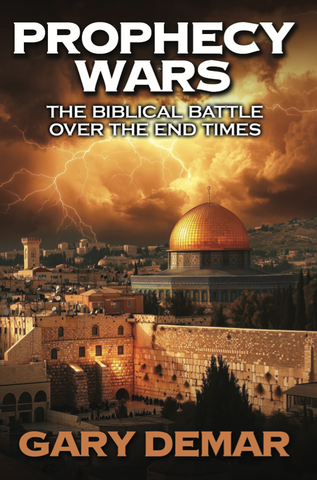
Prophecy Wars: The Biblical Battle Over the End Times
If you’re willing to take the Bible at its word, the study of prophecy can strengthen your faith, but if your trust is in man’s speculations, you will be disappointed every time. And that is why Bible prophecy is such a crucial area for apologetics. Skeptics of all stripes have condemned the Bible as inaccurate merely because various well-meaning Christians have been in error about the End Times.
Buy NowGary concludes his interview with Pastor Greg Chacon by dealing with questions about prophetic systems that have to add to the finished work of Christ. Dispensationalism has given most Christians an unhealthy allegiance to Israel and the belief that they must support whatever it decides politically. Modern prophecy advocates are trying to rebuild the first century with a new “Roman empire” and a third temple in Jerusalem. Eschatology has consequences, and good intentions can be used to promote evil agendas.