
Three years ago, I discovered a bulge in my left calf. I checked online to determine what it might be. Not much help. I went to the local Doc-in-the Box. From there, I made an appointment with an Orthopedic doctor. After several tries, he was stumped. He could have speculated, but he did not want to scare me. He got me an appointment with an Orthopedic Oncologist. A lot of “could be this or that.” At first, he thought it might be a hematoma after taking a biopsy. Within a few days, the results came back: a high-grade soft tissue sarcoma. Mine was an Undifferentiated Pleomorphic Sarcoma. The cells appear highly abnormal under a microscope, grow rapidly, and have a high risk of spreading (metastasizing) to distant sites, such as the lungs.
I had it removed. The next year, a CT scan revealed a cancerous nodule on my lung. I had it removed in a lung resection. I get an MRI of my left calf and a CT scan of my lungs every six months.
Who knows how long the Sarcoma grew in my calf? One day it wasn’t there, and the next day it was. But that’s not what happened. A few cancerous cells doubled: 2, 4, 8, 16, 32, 64, 128, 256, 512, 1024, 2048, etc. What wasn’t initially visible became visible because the cancer cells had replicated using my healthy muscle tissue as a base of operations for the takeover of my body. Survival outcomes vary significantly by stage: the five-year relative survival rate is approximately 81% for localized disease, 56% for regional spread, and 15-16% for distant metastatic sarcoma. Thus, the 6-month scans.
What’s true of cancer is also true of the spread of ideas, both good and bad.
Peter Guillquist asked: “Can the world be changed? Are the people of God even to expect such a thing? Isn’t the world utterly and hopelessly lost?” He answered:
The world can be changed. The Church has changed the world before, and it can do it again. The impact of the ancient Church altered the character of the massive Roman Empire. It didn’t make it perfect, mind you. But it did make the world more bearable—a better place for both believer and unbeliever to live. Consider the issues of just treatment for slaves, care of unwanted children, the poor, widows, and the sick and lame, as a few examples of areas where the historic Church has made a visible and powerful difference.[1]
This can’t happen if: (1) Christians believe there is no solution to fix anything except us and our families, (2) God’s law as revealed in Scripture is of no obligation for Christians (we’re under grace, not law), (3) God will rescue His church via something called the ‘rapture,’ a supernatural rescue mission from this world, and (4) Christians are unable to argue their case presuppositionally, from first principles.
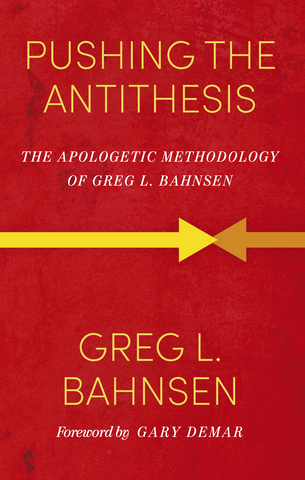
Pushing the Antithesis
Prior to his untimely death in 1995, Dr. Greg Bahnsen delivered a series of lectures on apologetics at American Vision's Life Preparation Conference. The week-long sessions, presented before high school and college students, set forth the basics of the Christian worldview and the biblical approach to defending the faith. These lessons have been distilled and turned into a one-of-a kind handbook on apologetics. Pushing the Antithesis consists of twelve chapters that include study questions, an answer key, a glossary of terms, and a comprehensive bibliography. If you want to be equipped to present the truth of the gospel in a compelling way, then Pushing the Antithesis is required reading.
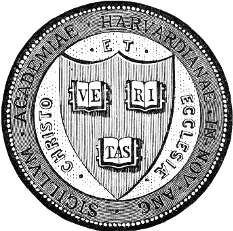
Buy NowHow did we get here? Like the spread of cancer, it took time. Harvard University was founded in 1636 by Puritan colonists with the explicit Christian mission to train clergy and promote the Christian faith. The institution’s original 1646 “Rules and Precepts” mandated that students “lay Christ in the bottom, as the only foundation of all sound knowledge and learning,” citing John 17:3 to declare that the main end of life and studies is to know God and Jesus Christ. This theological foundation was further solidified in 1692, when Harvard adopted the motto Veritas Christo et Ecclesiae (Truth for Christ and the Church), which appeared on the university seal until the mid-19th century, when the institution secularized and shortened the motto to simply Veritas.
The process of secularization began in the late 18th century, when Unitarianism and Emersonian ideals began to influence the college, putting reason on an equal par with revelation and separating the school of Christian ministry from the ‘secular’ curriculum that emphasized reason and humanism. By the early 1800s, the Unitarians had gained control, institutionalizing a greater emphasis on intellectual freedom and reducing the proportion of graduates entering the ministry.
“As George M. Marsden writes in The Soul of the American University, “the shift was not occurring ‘in the name of an attack on Christianity but under the banner of its expansion.’” Harvard was still ‘Christian,’ but it became just one acceptable religion among many, and it redefined Christianity. For example, Peter J. Gomes (1942-2011) was the Plummer Professor of Christian Morals at Harvard Divinity School and Pusey Minister at Harvard’s Memorial Church. Gomes was a homosexual. He devoted his life to “addressing the ‘religious case’ against gays.”
He maintained that “one can read into the Bible almost any interpretation of morality … for its passages had been used to defend slavery and the liberation of slaves, to support racism, anti-Semitism and patriotism, to enshrine a dominance of men over women, and to condemn homosexuality as immoral.” You see, “truth” is whatever suits you and how you determine what’s moral.
If moral relativism happened to Harvard, Yale, and Princeton, it could happen everywhere, and it has. A jury is struggling to decide whether a mother who strangled her three children should be found guilty of murder.
A father who strangled his FIVE children during ‘Schizophrenic Psychosis’ got the death penalty after a jury deliberated just TWO HOURS — Lindsay Clancy’s Massachusetts jury is deadlocked after days as feminists turn a child killer into a martyr.
German-Palestinian-American filmmaker Lexi Alexander pushed an X post appearing to cheer the death of Bank of America executive Erin Piacenti Tuesday, referencing accused UnitedHealthcare CEO assassin Luigi Mangione. (Source) Mangione, the suspect in the December 2024 shooting of UnitedHealthcare CEO Brian Thompson, has garnered a significant online following, particularly among young women, who have romanticized him as a “hot assassin” or a “Robin Hood” figure.
Do you remember this phrase? “It will never happen here.” It is happening here.
Comedian Cristina Mariani told this joke about atheist Neil deGrasse Tyson: “He has a sign in his yard that says, ‘Black Lives are matter.’” He doesn’t really have a sign that says this, but his worldview leads to it. If we’re all matter, then why does anyone or anything matter? In fact, that’s true of everything and everyone if atheism is true. You will hear atheists say that they don’t need God to be moral or have purpose.
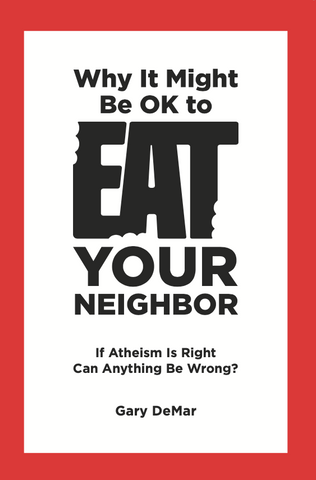
Why It Might be OK to Eat Your Neighbor
Love your neighbor, or Eat your neighbor? Atoms don’t have a conscience. They don’t love. They don’t regard anything as being their neighbor. The same is true of DNA. It’s been said that you can’t get blood out of a stone. Similarly, no matter how atheists try, they can’t account for moral standards that must be obeyed when there is no accounting for good or evil. Why It Might Be OK to Eat Your Neighbor repeatedly raises the issue of accounting for the conscience, good and evil, and loving our neighbor. It’s shocking to read what atheists say about a cosmos devoid of meaning and morality.
Buy NowAtheists are worldview thieves. Greg Bahnsen pointed out the following in his debate with George Smith sometime in 1991 on the Los Angeles radio station KKLA:
And that’s where we get back to the whole question of the atheist worldview and the Christian worldview. In terms of the atheist worldview, I would challenge George that he cannot give an account of the reasoning that he’s doing. An example that a seminary professor once used stuck with me for many years. Dr. [Cornelius] Van Til once said, “There’s no question that atheists count. Sometimes they count better than Christians. They can do their math very well. They do count, but they cannot account for their counting!” That is, in terms of their outlook on the world, what they profess to be true about knowledge and about reality—you know, the universals and absolutes of mathematics—would not make any sense whatsoever. And so, I do agree that George does reason, but I would suggest that he cannot, in terms of his worldview, make sense of the reasoning that he engages in.
[1] Peter E. Guillquist, Why We Haven’t Changed the World (Old Tappan, NJ: Fleming H. Revell, 1982), 21.