

Gary discusses Christian worldview, the pastorate, and current events.
Government consists of sovereignty (legitimacy to rule: Romans 13:1), representation (accountability to the rule of another: Exodus 18:17- 23), law (a moral code by which to rule: Romans 13:4), jurisdiction (authority to enforce sanctions in the name of the ruler: 1 Peter 2:13-14), and continuity (stability and longevity of government: Deuteronomy 28).
The Apostle Paul writes that “all authority [sovereignty] comes from God” (Romans 13:1) because only God is absolutely sovereign and omnipotent (1 Timothy 6:15-16; Revelation 4:8, 11). Rulers, therefore, only have limited authority to govern. God delegates this limited sovereignty to every government (family, church, and civil).
Nebuchadnezzar, ruler in Babylon and claimant of absolute and unlimited sovereignty, recognized the delegated nature of his governmental sovereignty when God made his “dwelling place with the beasts of the field” (Daniel 4:30-33). After being treated like an animal with no sovereignty (Genesis 2:18-20), Nebuchadnezzar repented affirming that God’s “dominion is an everlasting dominion, and His kingdom endures from generation to generation” (Daniel 4:34). It was after this that he was reinstalled to his rightful limited sovereignty under God’s absolute government: “My majesty and splendor were restored to me for the glory of my kingdom, and my counselors and my nobles began seeking me out; so I was reestablished in my sovereignty, and surpassing greatness was added to me” (v. 4:36). To be restored and reestablished assumes an initial installation and establishment.
Having sovereignty to govern does not mean that rulers, whether they are fathers and mothers in family government, elders in church government, or civil servants in civil government, always exercise their authority legitimately. It only means that the government is legitimate and must be obeyed unless there is biblical cause for disobedience.
The biblical philosophy of sovereignty and legitimacy in government explains why rebellion against duly constituted governments (family, church, and civil) is sin (Exodus 22: 28; Acts 23:5). “For rebellion is as the sin of divination, and insubordination is as iniquity and idolatry” (1 Samuel 15: 23).
Wherever Christians find themselves under the rule of a tyrant, they are to live under it, but not with resignation (Luke 20:19-25; 1 Timothy 2:1-3; Titus 3:1; 1 Peter 2:13-17). God has made non-revolutionary means available for the dissolution of tyrannical governments. In addition, God providentially works to overrule the works of men. Man proposes, but God disposes. “The king’s heart is like channels of water in the hand of the Lord; He turns it wherever He wishes” (Proverbs 21:1).
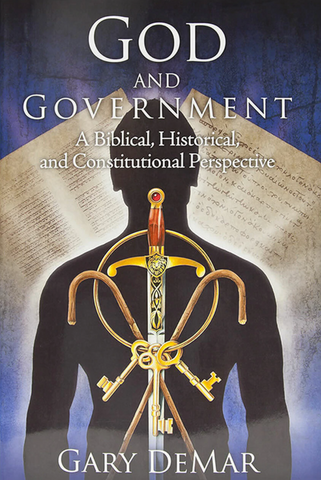
God and Government
With a fresh new look, more images, an extensive subject and scripture index, and an updated bibliography, God and Government is ready to prepare a whole new generation to take on the political and religious battles confronting Christians today. May it be used in a new awakening of Christians in America—not just to inform minds, but to stimulate action and secure a better tomorrow for our posterity.
Buy NowGary discusses Christian worldview, the pastorate, and current events. Psalm 23 talks about “the rod and the staff” as sources of comfort, but what exactly does this mean? These tools are used by a shepherd to guide, direct, and protect the sheep. How should these tools be used today?
Click here for today’s episode
Click here to browse past episodes of The Gary DeMar Podcast