
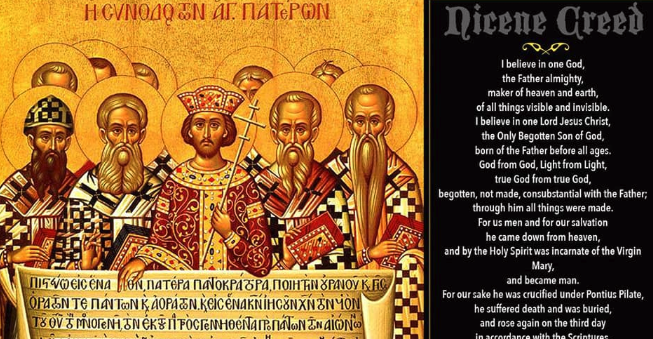
What Bible verses did the bishops who constructed the Nicene Creed use for “and [He] will come again with glory to judge the living and the dead”? All creeds should confess what Scripture says. To borrow from N.T. Wright, used in a different context, Christian theology should not try to “make theological bricks without the biblical straw.”[1] The language and the meaning of a text should come from that text and its parallels. The following is from Robert M. Bowman Jr.’s article “Shema to the Homoousios:[2] The Jewish Roots and New Testament Origins of the Nicene Creed.” Take note of the proof texts he gives for the statement “and [He] will come again with glory.”

In my conversation with Doug Wilson on the Three Questions Letter controversy, I noted that Matthew 16:27 and its parallel account in 8:38 have been used as proof texts for the Second Coming. But this cannot be, as many commentators point out, and I show in my book Prophecy Wars.

Prophecy Wars: The Biblical Battle Over the End Times
If you’re willing to take the Bible at its word, the study of prophecy can strengthen your faith, but if your trust is in man’s speculations, you will be disappointed every time. And that is why Bible prophecy is such a crucial area for apologetics. Skeptics of all stripes have condemned the Bible as inaccurate merely because various well-meaning Christians have been in error about the End Times.
Buy NowThe literal translation of 16:27 is as follows: “For the Son of Man is about to [mellō] come in the glory of his Father, with his angels/messengers, and then He will reward each according to his work.” Then there’s Mark 8:38-9:1.
“‘For whoever may be ashamed of Me and My words in this adulterous and sinful generation, the Son of Man also will be ashamed of him when He shall come in the glory of His Father, with the holy angels. And Jesus was saying to them, ‘Truly I say to you, there are some of those who are standing here who will not taste death until they see the kingdom of God when it has come with power.’”
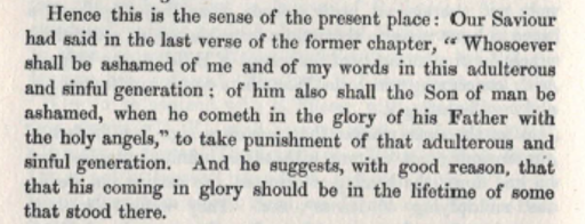
Jesus is not describing two comings separated so far by nearly 2000 years and counting. Would those who heard what Jesus said in Mark 8:38-9:1 and the parallel account in Matthew 16:27-28 have been able to distinguish between two different comings? Note the following from John Lightfoot’s commentary on the parallel account in Mark 8:38-9:1. Jesus “suggests with good reason,” Lightfoot writes, “that his coming in glory should be in the lifetime of some that stood there.”
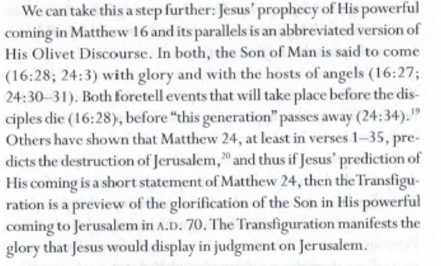
The following is from Peter J. Leithart’s book The Promise of His Appearing: An Exposition of Second Peter: “Both foretell events that will take place before the disciples die (16:28), before ‘this generation’ passes away (24:34).”
An impending judgment is a common theme in the New Testament, so it’s not unreasonable to assume that Jesus refers to an event that was tied to that generation.
• “because He has set a day on which He is about to judge the world [oikoumenē] in righteousness through a Man whom He has appointed, having furnished proof to all people by raising Him from the dead” (Acts 17:31).
• “who WILL RENDER TO EVERY MAN ACCORDING TO HIS DEEDS” (Rom. 2:6).
• “I fully testify, then, before God, and the Lord Jesus Christ, who is about to judge [the] living and dead at His appearing and His Kingdom” (2 Tim. 4:1).
• “In all this, they are surprised that you do not run with them in the same excesses of debauchery, and they slander you; but they will give an account to Him who is ready to judge the living and the dead. For the gospel has for this purpose been preached even to those who are dead, that though they are judged in the flesh as people, they may live in the spirit according to the will of God. The end of all things is near; therefore, be of sound judgment and sober spirit for the purpose of prayer” (1 Peter 4:1-7).
• “[I] is destined for people to die once, and after this judgment” (Heb. 9:27).
• FOR YET IN A VERY [ὅσον], VERY [ὅσον] LITTLE [μικρόν] WHILE, HE WHO IS COMING WILL COME AND WILL NOT DELAY. BUT MY RIGHTEOUS ONE WILL LIVE BY FAITH; AND IF HE SHRINKS BACK, MY SOUL HAS NO PLEASURE IN HIM (Heb. 10:37-39).
What about 2 Thessalonians 1:7-10?
For after all it is only right for God to repay with affliction those who afflict you, and to give relief to you who are afflicted, along with us, when the Lord Jesus will be revealed from heaven with His mighty angels in flaming fire, dealing out retribution to those who do not know God, and to those who do not obey the gospel of our Lord Jesus. These people will pay the penalty of eternal destruction, away from the presence of the Lord and from the glory of His power, when He comes to be glorified among His saints on that day, and to be marveled at among all who have believed—because our testimony to you was believed.
Keith Mathison states, the editor of the anti-full preterist book When Shall These Things Be?, “[t]here is a distinct parallel between the language of 2 Thessalonians 1:7-9 and Matthew 16:27-28, which describes a coming of the Son of Man for judgment within the lifetime of some of His disciples.”[3]
Paul is not describing some distant coming. Who was persecuting and afflicting the Thessalonians? “[F]or you also endured the same suffering at the hands of your own countrymen, even as they [the churches in Judea] did from the Jews…. With the result that they always fill up the measure of their sins. But wrath has come upon them to the utmost” (2:14-16; also Matt. 23:32; Acts 7:51-53). Paul had encountered similar hostilities in Thessalonica and had been driven out of the city along with Silas (Acts 17:1-9). Consider verse 5:
But the Jews, becoming jealous and taking along some wicked men from the marketplace, formed a mob and set the city in an uproar; and attacking the house of Jason, they were seeking to bring them out to the people.
If Matthew 16:27 and 2 Thessalonians 1:7 are proof texts for “He will come again with glory to judge the living and the dead,” then the fulfillment took place before that apostolic generation passed away. If the incarnation is the first coming of Jesus, then the Nicene “again” coming must be the one mentioned in Matthew 16:27, 24:30, and James 5:7-9.

A Beginner's Guide to Interpreting Bible Prophecy
For many Christians, interpreting Bible prophecy is a complicated task. As a result, they often turn to so-called Bible experts and complicated charts that include gaps in time, outrageous literal interpretations, and numerous claims that current events are prime indicators that the end is near. Many Christians are unaware that the same Bible passages have been used in nearly every generation as “proof” that the end or some aspect of the end (the “rapture”) would take place in their generation. They’ve all had one thing in common: They’ve all been wrong.
Buy Now[1] N. T. Wright, “Historical Paul and Systematic Theology: To Start a Discussion,” in Interpreting Paul: Essays on the Apostle and His Letters (Grand Rapids: Zondervan Academic, 2020), 99 (89-106). The essay appeared earlier in Biblical Theology: Past, Present, and Future, edited by Carey Walsh and Mark W. Elliott (Eugene, OR: Wipf and Stock, 2016), 147-64.
[2] “The ‘same in being, same in essence,’ from ὁμός (homós), ‘same’ and οὐσία (ousía), ‘being’ or ‘essence,’ used in the Nicene Creed for describing Jesus (God the Son) as ‘same in being’ or ‘same in essence with God the Father (ὁμοούσιον τῷ Πατρί/homoousion tō Patri). The same term is also applied to the Holy Spirit to designate Him as being ‘same in essence’ with the Father and the Son.”
[3] Postmillennialism: An Eschatology of Hope (Phillipsburg, NJ: Presbyterian and Reformed, 1999), 228.