
This is a continuation of this article from last week. It is an excerpt from American Vision’s new book, The Greatest and the Least: A Biblical Theology of John the Baptist, by Eric Rauch and Zach Davis.
Signs and Visions
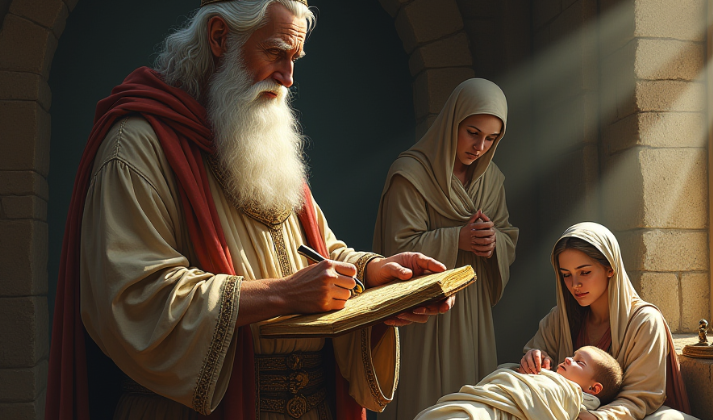
There were also several other visions given during this time. The first is when Mary and Joseph bring the baby Jesus to the temple to “offer a sacrifice according to the law” (Luke 2:22–24). We learn of a man named Simeon, who was promised that he would not die before seeing the Messiah with his own eyes. “Now there was a man in Jerusalem, whose name was Simeon, and this man was righteous and devout, waiting for the consolation of Israel, and the Holy Spirit was upon him. And it had been revealed to him by the Holy Spirit that he would not see death before he had seen the Lord’s Christ” (Luke 2:25–26).
Likewise, we read of Anna, who seems also to have knowledge of the Messiah’s appearance. “And there was a prophetess, Anna, the daughter of Phanuel, of the tribe of Asher. She was advanced in years, having lived with her husband seven years from when she was a virgin, and then as a widow until she was eighty-four. She did not depart from the temple, worshiping with fasting and prayer night and day. And coming up at that very hour she began to give thanks to God and to speak of him to all who were waiting for the redemption of Jerusalem” (Luke 2:36–38).
Of course, we can’t forget about the shepherds in the field, tending their flocks by night. “And an angel of the Lord appeared to them, and the glory of the Lord shone around them, and they were filled with great fear. And the angel said to them, “Fear not, for behold, I bring you good news of great joy that will be for all the people. For unto you is born this day in the city of David a Savior, who is Christ the Lord” (Luke 2:8–11).
Another vision that is often overlooked is the one given to the Magi. “Now after Jesus was born in Bethlehem of Judea in the days of Herod the king, behold, wise men from the east came to Jerusalem, saying, ‘Where is he who has been born king of the Jews? For we saw his star when it rose and have come to worship him.’… And being warned in a dream not to return to Herod, they departed to their own country by another way” (Matthew 2:1–2, 12). Similarly, Joseph receives two further visions to escape the wrath and jealousy of King Herod. “Now when they had departed, behold, an angel of the Lord appeared to Joseph in a dream and said, ‘Rise, take the child and his mother, and flee to Egypt, and remain there until I tell you, for Herod is about to search for the child, to destroy him.’ … But when Herod died, behold, an angel of the Lord appeared in a dream to Joseph in Egypt, saying, ‘Rise, take the child and his mother and go to the land of Israel, for those who sought the child’s life are dead’” (Matthew 2:13–14, 19–20).
It is interesting to note that no dreams or visions were given to King Herod or to the scribes and Pharisees. God was using the weak to shame the strong (1 Corinthians 1:27); He was delivering His message of what was coming through those who had no voice in the culture and society of first century Israel: young and old women, shepherds, and foreign mystics.
Names and Songs
Their names are also important. Both John and Jesus are given their names by Gabriel (Luke 1:13 and Matthew 1:21). John was an ordinary name with no family significance (Luke 1:59–63), while Jesus is the Greek form of Joshua, which means “Yahweh is salvation” in Hebrew.[4] It is interesting to note that John means “God is gracious” in Hebrew and could be connected to the name Jonah, which means “dove” in Hebrew.[5] At Jesus’ baptism, the Father states, “This is my beloved Son, with whom I am well pleased.” John (“God is gracious”), Jesus (“Yahweh is salvation”), the Father, and the Spirit (descending like a dove) are all present for this remarkable event that marked the beginning of Jesus’ earthly ministry (Matthew 3:13–17).
A final side note, although we don’t have the space or time to pursue it in this book. Take notice when people start suddenly breaking into song in the Bible. Although we often think of David as the scriptural songwriter, there are many other songs in the pages of both the Old and New Testaments. Moses and Miriam both compose songs in the book of Exodus and Moses sings again just before his death (Deuteronomy 32). Hannah responds with a prayer- song when she leaves her young son, Samuel, to minister with Eli (1 Samuel 2:1–10) and Deborah and Barak sing in Judges 5. In the NT, there are many songs accompanying the announcements and births of John and Jesus: Mary sings her Magnificat (Luke 1:46–55); Zechariah sings when his voice returns (1:68–79); the heavenly host sing to the shepherds at Jesus’ birth (2:14); Simeon sings over Jesus when he finally beholds Him at the temple (2:29–32); and in Revelation 5:9 and 14:3 there is a “new song” being sung. The lyrics to the songs are of course significant, but it seems obvious that songs and singing accompany specific times of deliverance in redemptive history and one of those musical times accompanies the births and ministries of John and Jesus.

The Greatest and the Least: A Biblical Theology of John the Baptist
John the Baptist was a polarizing figure in early first century Judea. He was the transitional figure providing a clear path and a smooth road from the covenant with Adam to the new covenant with the Second Adam. As the final and greatest prophet of the Old Testament, John embodied and fulfilled the very purpose of the Law: revealing Jesus as the Bringer of God’s Kingdom.
Buy Now
[4] “The name Jesus is a transliteration of the Greek form of the Hebrew name Joshua. The meaning of the Hebrew name is ‘Yahweh is salvation.’ The name was chosen by God and communicated to Joseph and Mary by an angel. The child was to be named Jesus because he was to ‘save his people from their sins’ (Mt 1:21; cf. Lk 1:31).”Lawrence O. Richards, New International Encyclopedia of Bible Words: Based on the NIV and the NASB, Zondervan’s Understand the Bible Reference Series (Grand Rapids, MI: Zondervan Publishing House, 1999), 360.
[5] “It has been suggested that, by New Testament times, the name Jonah was sometimes regarded as a Semitic equivalent of John. The names could at least be confused, for ‘John’ sometimes appears as a textual variant for ‘Jonah’ in manuscripts of the Septuagint.” Mark Allan Powell, “Echoes of Jonah in the New Testament,” Word and World (St. Paul, MN: Luther Seminary, Volume 27:2, Spring 2007), 158.