
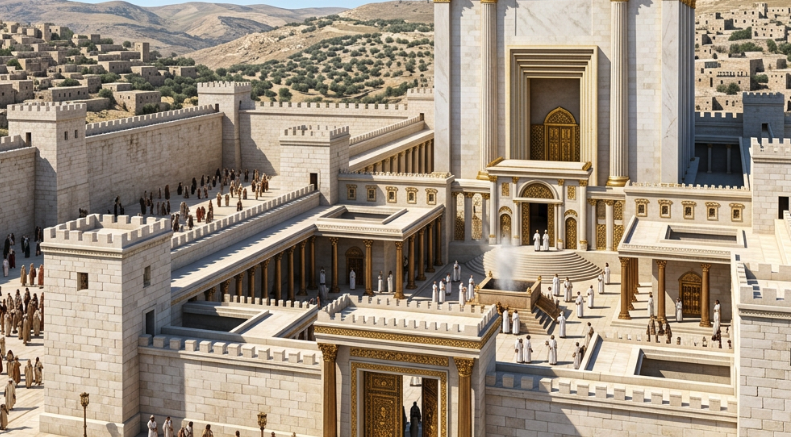
A battle is raging over the Temple Mount in Jerusalem. With the latest happenings in Iran, many Christians are excited about the prospects of doomsday because they will not be around to witness it. Gog and Magog, Zechariah 14, Jeremiah 49, Isaiah 21-22, and the mention of Elam, and, of course, “wars and rumors of wars” (Matt. 24). For the futurist scenario outlined by modern prophecy writers to occur, there must be a rapture of the church. We are assured (with no specific biblical evidence) that a pretribulational rapture is the next prophetic event in the dispensational system, in which Israel is said to take center stage. It is purported to set off a series of prophetic events leading up to the millennial reign of Christ, including the rebuilding of a fourth temple in Jerusalem after the destruction of the “tribulation temple.” It’s in the future post-rapture “tribulation temple” that the antichrist is to take his seat (2 Thess. 2:4), place a statue of himself for people to worship (Matt. 24:15; Rev. 13:14-15), and proclaim himself to be god (2 Thess. 2:4).

The Antichrist, Beasts, the Man of Lawlessness, and 666
The beasts, both sea and land, the mark on the hand or head, and the number 666 should be interpreted in light of the Old Testament, similar to the way Sodom (11:8), Egypt (11:8), Jezebel (2:20), Balaam (2:14), and Babylon (14:8; 16:19; 17:5; 18:2, 10, 21) are interpreted. Understanding the way the Old Testament uses and applies marks, it is not that difficult to determine what John is describing in Revelation 13. Whoever carried the mark of the beast would be protected by Satan, and whoever carried the mark of the Lamb would be protected by God. Those who identified with Rome against Jesus Christ died in the destruction of Jerusalem when Titus and his army swept in to destroy the temple and the city.
Buy NowIn 2018, Defense Secretary Pete Hegseth called for the building of a third Jewish temple on the site of Al-Aqsa Mosque in Jerusalem. You can tell from this video that it was some time ago. That was when he most likely did not know better. At least I hope so.
Tucker Carlson made a splash with this comment: “How could an American Christian or any Christian call for the building of a temple whose presence, whose inherent presence, denies Christ?” Good point, but Tucker does not understand dispensationalism. Dispensationalists believe that Jews are Christ deniers, but during the tribulation period, God is going to “purge” the Jews because of their unbelief. In his book Israel in Prophecy, John Walvoord writes.
“The purge of Israel in their time of trouble is described by Zechariah in these words: ‘And it shall come to pass, that in all the land, saith Jehovah, two parts therein shall be cut off and die; but the third shall be left therein. And I will bring the third part into the fire, and will refine them as silver is refined, and will try them as gold is tried’ (Zechariah 13:8, 9). According to Zechariah’s prophecy, two-thirds of the children of Israel in the land will perish, but the one-third that are left will be refined and be awaiting the deliverance of God at the second coming of Christ, which is described in the next chapter of Zechariah” (108).
But what futurists need to support this end-time scenario is a verse stating that there will be another rebuilt temple, one different from the one built after the exile and renovated (rebuilt) by Herod the Great beginning in 20 BC and finally completed around AD 64 and destroyed in AD 70. Notice how clearly the Old Testament records a decree to rebuild the post-exilic temple (2 Chron. 36:22-23; Ezra 1:1-4; 5:6-17). The foundation stone was laid (Ezra 3:10-12), and the temple was completed (6:13-18). There was even a letter sent to the authorities of the time to determine if there had been a “decree to rebuild this temple” (5:1-17; 6:1-12). There is nothing comparable in the New Testament.
Rebuilt-temple advocates Thomas Ice and Randall Price are forced to admit, “There are no Bible verses that say, ‘There is going to be a third temple.’”[1] Having made this revealing concession, they go on to claim, “there will be a Jewish Temple in Jerusalem at least by the midpoint of the seven-year tribulation period.”[2] Randall Price’s updated 700-page book on The Temple and Bible Prophecy still can’t produce a New Testament verse that explicitly states that another temple must be built to fulfill Bible prophecy.[3] Given that two Old Testament books (Ezra and Nehemiah) detail the rebuilding of the temple after the Jews returned from the Babylonian captivity, one would expect to find at least one verse in the New Testament addressing the rebuilding of another distant post-rapture temple.
Price and Ice are not alone in making their unsupported claim for another rebuilt temple. Merrill F. Unger, writing in 1955, made a similar assertion: “The temple will be rebuilt, for the ‘abomination of desolation’ (Matt. 24:15) ‘shall stand in the Holy Place,’ in the ‘Temple of God’ (Jewish Temple) rebuilt (II Thess. 2:4), with an ‘altar’ and ‘worshippers’ (Rev. 11:1), and an ‘outer court’ in the ‘Holy City’ (Jerusalem, cf. Rev. 11:2).”[4] The problem with Unger’s end-time scenario is that the temple built by Herod was still standing when these prophecies were given. Unger assumes that the mere mention of a temple in a prophetic passage must refer to a rebuilt temple to be constructed during the tribulation period following a pretribulational rapture, a nearly 2000-year delay.[5] If the temple is such a crucial piece of the end-time puzzle, why doesn’t the New Testament say something about it? The silence is deafening. Notice what Matthew 24:15 says, “When you see.” Who were the “you”? The people who were in Jesus’ audience!
Does the Bible predict that a third temple will be built, one following Solomon’s temple and the post-exile temple that was still standing in Jesus’ day and was destroyed in AD 70 by the Romans? Don Stewart and Chuck Missler insist, “The crucial issue boils down to how we interpret prophecy.” On this, all would agree. “There are two basic ways to interpret Bible prophecy,” Stewart and Missler write. “Either you understand it literally or you do not. If a person rejects the literal interpretation, then they are left to their own imagination as to what the Scripture means…. We believe it makes sense to understand the Scriptures as literally requiring the eventual construction and desecration of a Third Temple.”[6] If this is true, then produce a literal verse. The authors are careful to say only that another rebuilt temple is required. A third temple is required only if the Bible requires it and specifically states it. While dispensationalists require another temple for their prophetic system to work, as we will see, the New Testament says nothing about a rebuilt temple, not a single word.
Jesus’ completed redemptive work makes the need for a rebuilt temple unnecessary. His ministry begins with the declaration that He is our tabernacle (John 1:14), “the lamb of God who takes away the sin of the world” (1:29), “the temple” (John 2:19-21), and the “chief cornerstone” (Matt. 21:42; Acts 4:11; Eph. 2:20). By extension, believers are “as living stones . . . being built up as a spiritual house for a holy priesthood, to offer up spiritual sacrifices acceptable to God through Jesus Christ” (1 Peter 2:5). Those “in Christ” are the true temple of God (1 Cor. 3:16; 2 Cor. 6:16; Eph. 2:21; Rev. 21:22). Jesus and the people of God are the focus of the only temple that has any redemptive significance under the new covenant. To be “in Christ” is to be in the temple and all it stood for, “the renewed centre and focus for the people of God”[7] (Rom. 12:5; 1 Cor. 1:2, 30; Gal. 3:14, 28; 5:6). The New Testament references to the temple of stone only refers to its destruction (Matt. 24:1-2) never its physical reconstruction. It is highly significant that “Jesus never gives any hint that there will be a physical replacement for this Temple. There is no suggestion, either in the Apocalyptic Discourse [Revelation] or elsewhere, that this destruction will be but a preliminary stage in some glorious ‘restoration’ of the Temple.”[8]
The original temple was a shadow of things to come. It was designed to be a temporary edifice looking forward to the completed work of Jesus Christ (Isa. 66:1-3; cf. 1:11-13; Mal. 1:10-11). For dispensationalists to insist that another temple is needed to complete some type of covenantal obligation with the Jews goes against the entire New Testament and makes the “first covenant … faultless,” with “no occasion sought for a second” (Heb. 8:7). Let the Bible settle the issue.
Now the main point in what has been said is this: we have such a high priest, who has taken His seat at the right hand of the throne of the Majesty in the heavens, a minister in the sanctuary, and in the true tabernacle, which the Lord pitched, not man. For every high priest is appointed to offer both gifts and sacrifices; hence it is necessary that this high priest also have something to offer. Now if He were on earth, He would not be a priest at all, since there are those who offer the gifts according to the Law; who serve a copy and shadow of the heavenly things, just as Moses was warned by God when he was about to erect the tabernacle; for, “See,” He says, “that you make all things according to the pattern which was shown you on the mountain.” But now He has obtained a more excellent ministry, by as much as He is also the mediator of a better covenant, which has been enacted on better promises (Heb. 8:1-6).
The writer of Hebrews declares that Jesus entered “through the greater and more perfect tabernacle, not made with hands, that is to say, not of this creation” (9:11). Since Jesus completed His redemptive work, any new temple “made with hands” is little different from a pagan temple that has no inherent life or redemptive value (cf. Acts 17:24; 19:26; 2 Cor. 5:1). “[T]he description of the Jerusalem Temple as ‘made with hands’ … is a strong means of playing down its significance. This had been a way of belittling the pagan idols (e.g. Ps. 115:4; cf. Isa. 46:6); to describe the Temple in such a fashion was potentially incendiary.”[9] This is because “the author of Hebrews believed the Jerusalem Temple was but a ‘shadow’ of the reality now found in Christ (8:5).”[10] The “new covenant” had made the “old covenant” obsolete (8:13), including the temple and everything associated with it.
Ten Popular Prophecy Myths Exposed and Answered
Since the reestablishment of Israel in 1948, “end-time” prophetic speculation has been on the rise. Millions of books have been sold proclaiming countless false prophecies. Many Christians are beginning to take a second look at the biblical prophetic record. A seismic shift in biblical eschatology is taking place around the world because Christians, some for the first time, are willing to challenge what they have been taught based on what the Bible actually says.
Buy NowStewart and Missler have made it very simple for us to determine whether the Bible addresses the issue of a rebuilt temple. If the Bible is interpreted literally, the need for a third temple should be explicitly stated. What biblical evidence do they offer to support their claim that “the Bible, in both testaments, speaks of a Temple that has yet to appear”?[11] From the Old Testament, they cite Daniel 9:27, 11:31, and 12:11 for support, with only Daniel 9:27 significant to their case.
Since Daniel was written after Solomon’s temple had been destroyed by Nebuchadnezzar in 586 BC (2 Kings 25:8-9; Dan. 1:1-2) and before the second temple had been built by the returning exiles (Ezra 6:13-15), it stands to reason that the “sanctuary” whose “end will come with a flood” (Dan. 9:26) must refer to the second temple that had not been built at the time the prophecy was given. It was this post-exile rebuilt temple that was desecrated by Antiochus Epiphanes around 170 BC, but not destroyed. After a period of misuse and disuse, Herod the Great restored and enlarged this second temple, which was completed just a few years before it was destroyed in AD 70 by the Romans, as Jesus had predicted (Matt. 24:1-34). It was this temple that Zacharias served in (Luke 1:9), Jesus was taken to as an infant (2:27), was found by His parents teaching when He was 12-years old (2:41-51), had been under construction for forty-six years when Jesus prophesied that He would be its permanent replacement (John 2:20), Jesus cleansed of the money changers (Matt. 21:12), He predicted would be left desolate (Matt. 23:38; 24:2), whose veil was “torn in two from top to bottom” (Matt. 27:51), and that was finally destroyed by Titus in A.D. 70.
Is there any indication in the three passages from Daniel that we are to skip over what we know was a rebuilt temple, the temple that was standing in Jesus’ day, and look for another unmentioned third temple? Would Jews living in the first century have made the historical leap over the temple that was standing before them, and suppose Jesus was describing yet another temple when He never used the words new or rebuilt? As Ice and Price admit, the Bible says nothing about another temple. The passages from Daniel cited by Stewart and Missler and Ice and Price can easily find their fulfillment in the rebuilt temple of Ezra and Nehemiah’s day that was standing during the reign of Antiochus (Dan. 11:31; 12:11) and the second temple’s destruction in AD 70 (9:27).
[1] Thomas Ice and Randall Price, Ready to Rebuild: The Imminent Plan to Rebuild the Last Days Temple (Eugene, OR: Harvest House, 1992), 197-198.
[2] Ice and Price, Ready to Rebuild, 198.
[3] Randall Price, The Temple and Bible Prophecy: A Definitive Look at Its Past, Present, and Future (Eugene, OR: Harvest House, 2006). Price has three chapters on predictions in the New Testament about the temple, but he cites no verse that says anything about rebuilding the temple again (255-324).
[4] Merrill F. Unger, Great Neglected Bible Prophecies (Chicago: Scripture Press Books, 1955), 23.
[5] Unger disputes Carl Friedrich Keil’s contention that “the New Testament says nothing whatever concerning the rebuilding of the Jerusalem temple and the restoration of the Levitical worship.” Carl Friedrich Keil, Biblical Commentary on the Prophecies of Ezekiel, 2 vols. (Grand Rapids, MI: Eerdmans, 1950), 2:122. Quoted in Unger, Great Neglected Bible Prophecies, 23. Unger accuses Keil of following a spiritualizing methodology (23). Notice that the New Testament uses spiritual designations for the temple and its sacrifices under the new covenant: “spiritual house” and “spiritual sacrifices” (1 Pet. 2:15).
[6] Don Stewart and Chuck Missler, The Coming Temple: Center Stage for the Final Countdown (Orange, CA: Dart Press, 1991), 193.
[7] Timothy J. Geddert, Watchwords: Mark 13 in Markan Eschatology (Sheffield, England: JSOT, 1989). Quoted in Peter W. L. Walker, Jesus and the Holy City: New Testament Perspectives on Jerusalem (Grand Rapids, MI: Eerdmans, 1996), 9.
[8] Walker, Jesus and the Holy City, 8.
[9] Walker, Jesus and the Holy City, 10.
[10] Walker, Jesus and the Holy City, 208.
[11] Stewart and Missler, The Coming Temple, 194.