
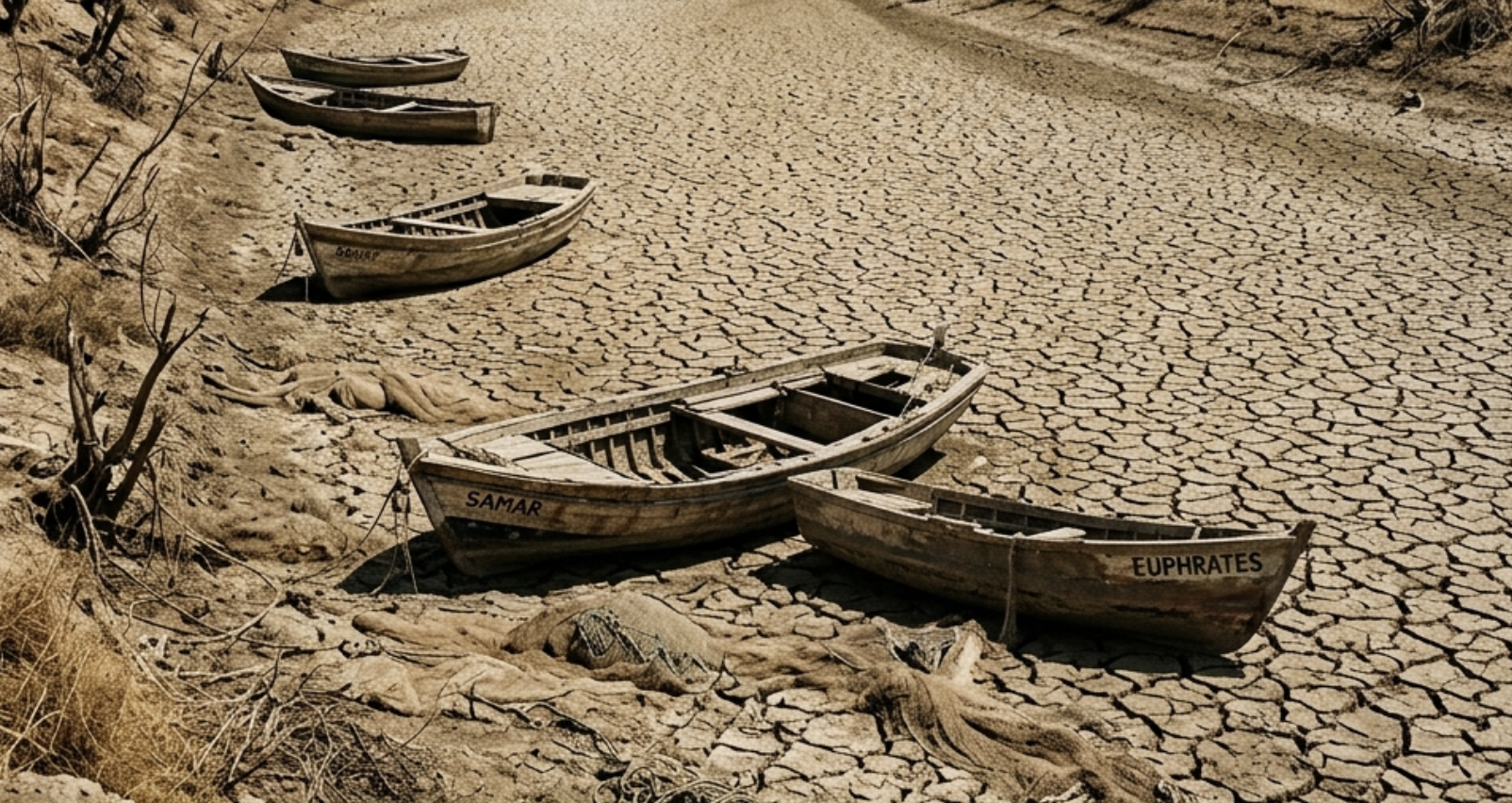
It’s being argued that the dried-up Euphrates is the marching route of a 200-million-man army from China on horseback (Rev. 9:13-21). The drying up of the Euphrates takes place after “the stars fell from heaven to the earth, as a fig tree casts its unripe figs … [a]nd the sky was split apart like a scroll when it is rolled up; and every mountain and island were moved out of their places” (Rev. 6:13-14). Every horse and everything else would have been killed! When we get to Revelation 12, we see a giant woman, a dragon, and a third of the stars thrown down to Earth (vv. 1, 4). Then there’s Revelation 13, where we’re told we’ll be microchipped. If these events are physically going to happen as written, by the time we get to chapter 16, Earth will be a burned-out cinder.
Why would China mount such a vast army after plagues and stellar phenomena had just wiped out a third of the earth’s population? The world would be in such chaos (if it still existed) that the last thing on anyone’s mind would be to round up 200 million horses (that don’t exist), soldiers, weapons, saddles, and enough food and water so they could make an impossible trek from China (16:12) to Israel.
David Chilton has a helpful discussion of Revelation 16:12 in his commentary The Days of Vengeance:[1]
Corresponding to the Sixth Trumpet (9:13-21), the Sixth Chalice is poured out upon the great river, the Euphrates; and its water was dried up, that the way might be prepared for the kings from the rising of the sun. As we saw on 9:14, the Euphrates was Israel’s northern frontier, from which invading armies would come to ravage and oppress the Covenant people. The image of the drying of the Euphrates for a conquering army is taken, in part, from a stratagem of Cyrus the Persian, who conquered Babylon by temporarily turning the Euphrates out of its course, enabling his army to march up the riverbed into the city, taking it by surprise. The more basic idea, of course, is the drying up of the Red Sea (Ex. 14:21-22) and the Jordan River (Josh. 3:9-17; 4:22-24) for the victorious people of God. Again there is the underlying note of tragic irony: Israel has become the new Babylon, an enemy of God that must now be conquered by a new Cyrus, as the true Covenant people are miraculously delivered and brought into their inheritance. As Carrington observes, the coming of the armies from the Euphrates “surely represents nothing but the return of Titus to besiege Jerusalem with further reinforcements”;[2] and it is certainly more than coincidental that thousands of these very troops actually did come from the Euphrates.[3]
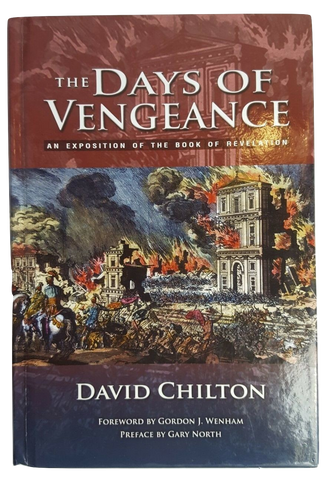
The Days of Vengeance: An Exposition on the Book of Revelation
David Chilton's extraordinary verse-by-verse exposition of Revelation is as welcome as a cool drenching rain upon a dry, thirsty ground. From the very beginning, cranks and crackpots have attempted to use Revelation to advocate some new twist on the Chicken Little Doctrine: "The Sky is Falling!" But, as David Chilton shows in this careful, detailed exposition, St. John's Apocalypse teaches instead that Christians will overcome all opposition through the work of Jesus Christ.
Buy NowKenneth Gentry adds historical details about what was taking place militarily at the time of Israel’s judgment, as described by Jesus in Matthew 24, Mark 13, and Luke 21.
What is more, the four angels from the Euphrates probably reflect something of the actual military circumstances involved, which included four Roman legions and also the prominent mention of the Euphrates. When Nero originally declared the war, he sent Vespasian “to take upon him the command of the armies that were in Syria,” where he “gathered together, the Roman forces” (J.W. 3:1:3 §7). The Euphrates River (Rev 9:14) touches Syria, where the Romans normally kept four brigades: “The huge stretch of territory between this end of Syria and the Euphrates was controlled by four brigades” (Tacitus, Ann. 4:5).
Regarding later actions in the Jewish War, Josephus mentions a great body of troops from the Euphrates who become a part of Titus’s forces when he takes over for his father Vespasian: “There followed him also three thousand drawn from those that guarded the river Euphrates” (J.W. 5:1:6 §44; cp. 7:1:3 §17). Thus, “at the siege of Jerusalem four legions were involved (the Fifth, Tenth, Fifteenth and Twelfth)”…. Josephus expressly mentions these four legions: “The [siege] works that belonged to the four legions were erected on the west side of the city” (J.W. 6:8:1 §376; cp. Tacitus, Hist.5:1:6 §41-42). According to Josephus (J.W. 5:1:6 §40–44).
*****
Not only is the Euphrates Israel’s ideal northern border, but it is also the extent of the power of Israel’s two most powerful kings, David (2Sa 8:3; 1Ch 18:3) and Solomon (2Ch 9:26). As the northern most boundary of Israel, as Beale notes (506), the Euphrates can serve as an apocalyptic image of God’s threatened judgment upon his covenant people by means of invading forces (Isa 7:20; 8:7-8; 27:12; Jer 1:14-15; 6:1, 22; 10:22; 13:20; Eze 38:6, 15; 39:2; Joel 2:20-25). This is because historically “from the River Euphrates had come Sennacherib and Nebuchadnezzar, destroyers of Samaria and Jerusalem; by now the Euphrates has become a mere symbol for the quarter from which judgment is to come on Jerusalem” (Carrington 165).[4]
Some additional interpretive factors to consider. First, Revelation was written about events that were “shortly” to “take place” (1:1) because “the time is near” (1:3; 22:10). Near for Revelation’s first readers, who made up the seven churches in Asia Minor (Rev. 2-3).
Second, there are hundreds of references to the Old Testament found in Revelation that are mostly used as symbols by taking their characteristics and character and applying them principally to the near events of John’s day: Jezebel (2:20), Sodom and Egypt (11:8), Babylon (17-18), Gog and Magog (20:7-9). Jerusalem, “the great city” where Jesus was crucified, is “mystically … called Sodom and Egypt” for typological reasons. Jerusalem is also described as “Babylon.” Jerusalem had taken on the characteristics of these Old Testament cities. We find something similar in Matthew 24:29, where Jesus applies the events of their generation (v. 34) to Babylon and other Old Testament nations under judgment (Isa. 13:10; 24:23; Ezek. 32:7; Amos 5:20). This is true of many allusions to the Old Testament found in the book of Revelation, and that would include the Euphrates River. Notice how stars are thrown down to the earth in Revelation (6:12; 8:12; 12:9). If these were actual stars, the earth would have been vaporized several times.

Left Behind: Separating Fact from Fiction
In Left Behind: Separating Fact From Fiction, Gary DeMar takes a critical look at the theology behind this popular fiction series and challenges readers to consider a different interpretation. With confidence based on years of biblical study, DeMar carefully examines eleven major components of the pre-tribulation rapture theology and offers clear, convincing alternatives to the interpretations of Bible prophecy presented in Left Behind.
Buy NowThird, if you believe in a pre-tribulational rapture, then nothing this side of the “rapture” has any prophetic significance. According to the pre-trib view, the so-called “rapture” could have happened at any time in the past 2000 years, whether the Euphrates was wet or dry.[5]
Fourth, numerous dams have been constructed along the Euphrates, affecting its flow. An increase in irrigation water use is also a contributing factor.
Abdul Razzaq al-Aliawi, an engineer and former director of Syria’s maintenance department for the Euphrates River, told Al-Monitor, “The Euphrates River bed witnessed six historical eras, including the Sumerian, Akkadian, Assyrian, Greek, Byzantine, in addition to the Islamic era.” Building dams in the first place, he said, was “an unjust decision” [because of the cemeteries that were there].[6]
Fifth, “The drop of the Euphrates and Tigris waters during the past three years [since 2020] has uncovered many archaeological sites that were submerged in the waters of the two rivers that cross through Syria, Iraq and Turkey.”[7] The discovery of these sites shows that the Euphrates’ flow has changed in the modern era due to dam projects. “Recent news articles have reported that the Euphrates River is indeed drying up. According to a study by the University of Arizona, the river’s flow has decreased by more than 60% over the past century due to dams and irrigation projects in Turkey, Syria, and Iraq.”[8]
[1] David Chilton, The Days of Vengeance: An Exposition of the Book of Revelation (Powder Springs, GA: American Vision, 1987), 407-408.
[2] Philip Carrington, The Meaning of the Revelation (London: SPCK, 1931), 265.
[3] See Josephus, The Jewish War, 3.1.3; 3.4.2; 5.1.6; 7.1.3.
[4] Kenneth L. Gentry, Jr., The Divorce of Israel: A Redemptive-Historical Interpretation of Revelation, 2 vols. (2024), 1:808-810.
[5] Gary DeMar, Ten Popular Prophecy Myths Exposed and Answered (Powder Springs, GA: American Vision, 2010), chap. 2 and Gary DeMar with Francis X. Gumerlock, The Rapture and the Fig Tree Generation (Powder Springs, GA: American Vision, 2020).
[6] Mohammed Hardan, “Falling Waters of Euphrates, Tigris Rivers Reveal Submerged Archaeological Sites,” Al-Monitor (August 27, 2022). Link here.
[7] Hardan, “Falling Waters of Euphrates, Tigris Rivers Reveal Submerged Archaeological Sites.”
[8] “Is The Drying Up of The Euphrates River the Fulfillment Of Bible Prophecy,” Encounter Today (January 31, 2023). Link here.