
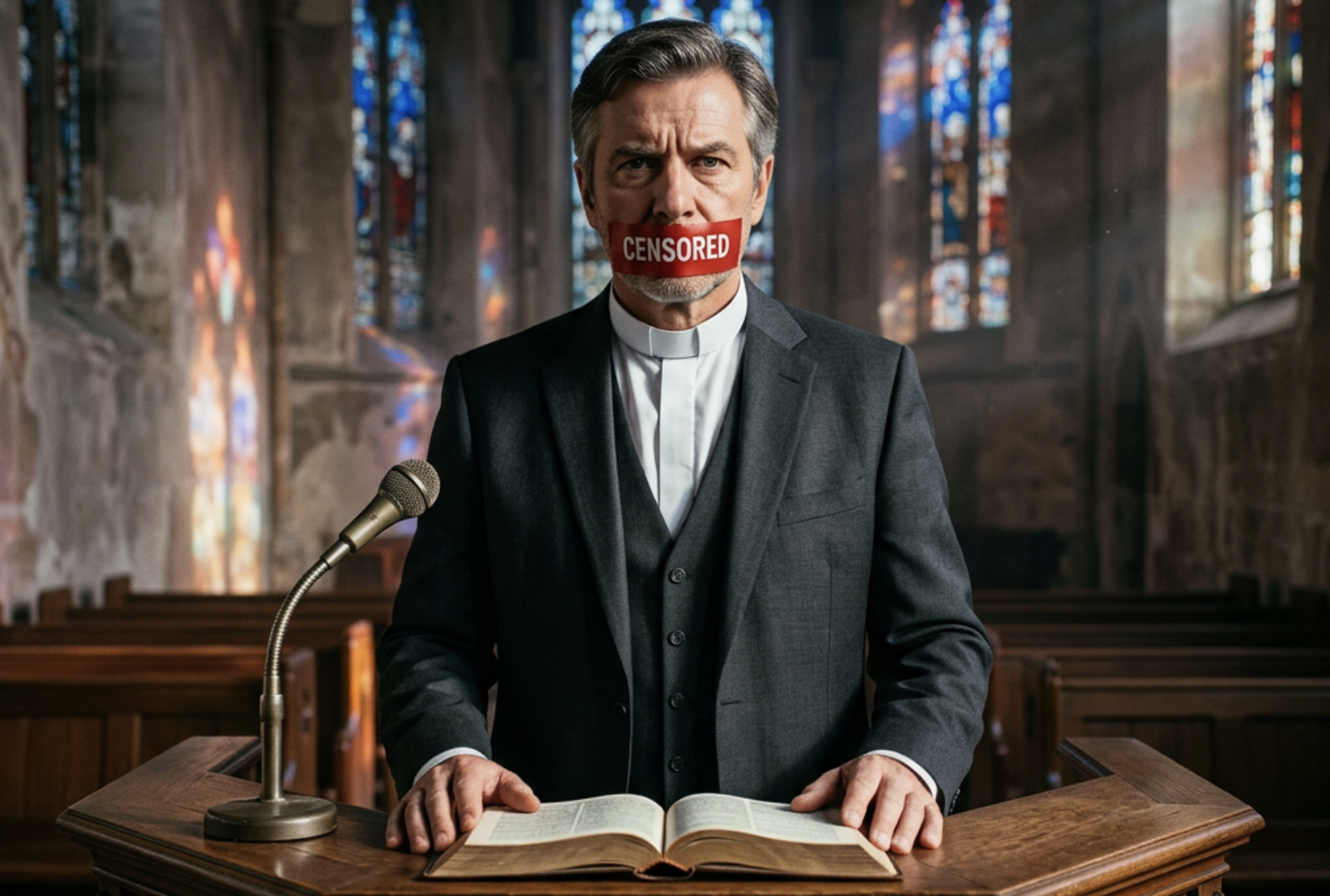
I heard a pastor say that the Session of the church where he was being considered as a pastor would not be permitted to preach on politics. He agreed with the restriction. This was troubling to me. No one can preach through the Bible and ignore politics. The Bible is filled with politics. There are two books of the Old Testament named Kings. The books of Joshua, Judges, Ruth, and First and Second Samuel include political content. Politics is a synonym for civil government that includes rulers as “civil servants.” They are described by Paul as “ministers [διάκονός/diakonos] of God (Rom. 13:4). There are ecclesiastical ministers and civil ministers. Civil ministers are under obligation to follow God’s law as it relates to civil affairs. ‘Caesar’ must also render unto God (Matt. 22:21).
Paul encountered the Roman government. He appealed to his Roman citizenship when he was jailed. Here was the Roman response when it was learned that Paul was a Roman citizen who had been beaten by government officials:
Now when day came, the chief magistrates sent their officers, saying, “Release those men.” And the jailer reported these words to Paul, saying, “The chief magistrates have sent word that you be released. So come out now and go in peace.”
I can hear a preacher saying, “Praise God! God worked a miracle here because of Paul’s attitude, and the Roman government let them ‘go in peace.’” Many Christians might argue that this is the way Christians should handle disputes with the government. Stay silent, keep your head down, and take what the civil magistrates dish out. Notice what Paul said to the civil officials:
But Paul said to them, “After beating us in public without due process—men who are Romans—they threw us into prison, and now they are releasing us secretly? No indeed! On the contrary, let them come in person and lead us out.” The officers reported these words to the chief magistrates. And they became fearful when they heard that they were Romans, and they came and pleaded with them, and when they had led them out, they repeatedly asked them to leave the city. They left the prison and entered the house of Lydia, and when they saw the brothers and sisters, they encouraged them and departed. (Acts 16:35-40)
Our ‘Caesar’ is the Constitution. There are numerous protections in our Constitution that were fought for by Christians. Christian pastors in the colonial era and following preached politics from their pulpits. Colonial-era preaching was the primary vehicle for political education and revolutionary ideology in America, with ministers delivering approximately 8 million sermons over the colonial period.
Religious and political themes were deeply intertwined, as clergy viewed the Bible as the ultimate authority for civil government and societal order. Ministers such as Jonathan Edwards, John Witherspoon, and George Whitefield used the pulpit to challenge British authority, framing political liberty as a divine mandate. See Alice M. Baldwin’s book titled The New England Pulpit and the American Revolution: When American Pastors Preached Politics, Resisted Tyranny, and Founded a Nation on the Bible. Commenting on the classic paraphrase of “life, liberty, and property,” Baldwin declared,
No one can fully understand the American Revolution and the American constitutional system without a realization of the long history and religious associations which lie behind these words; without realizing that for a hundred years before the Revolution men were taught that these rights were protected by divine, inviolable law.
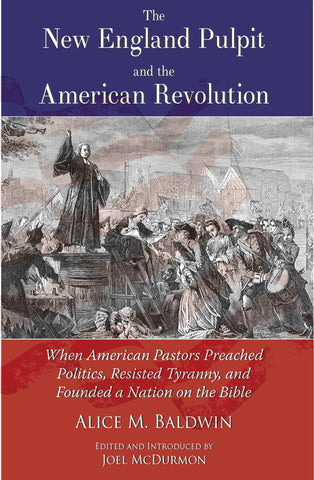
The New England Pulpit and the American Revolution
Dr. Baldwin illustrates how the preachers of the early American era thought and practiced just the opposite as today. Mountains of research in colonial sermons, tracts, pamphlets, and other publications, reveals how the pulpits of colonial America rang constantly on all aspects of the public square: good rulers, good laws, good forms of government, and the blessings of liberty. We especially hear of those choice values of biblical order that became the battle cries of American independence.
Buy NowAlso see the two-volume series Political Sermons of the American Founding Era: 1730-1805, published by the Liberty Fund. Volume I is a collection of sermons written between 1730-1805 by people such as Jonathan Mayhew, John Wesley, Moses Mather, John Witherspoon, Richard Price, Jonathan Edwards, and Noah Webster. John Wingate Thornton (1818-1878) stated, “To the Pulpit, the Puritan Pulpit, we owe the moral force which won our independence.”
Of the several vehicles for expounding political theology available to American ministers, the most venerable were the election sermons preached for 256 years in Massachusetts and 156 years in Connecticut. The practice began in Vermont in 1778 and in New Hampshire in 1784 in the sermon by Samuel McClintock…. These were sermons preached annually to the governor and legislature after the election of officers. To be chosen for the task was an honor, and the sermons were published and distributed to each official with an extra copy or two for the ministers of the official’s home district…. [V]ery few of the sermons preached were published; thus Samuel Dunbar, an Old Light minister from Stoughton, Massachusetts, wrote out some eight thousand sermons during his long career but published only nine of them. (Source)
No one can claim that political preaching and exhortation were exclusive to the Old Covenant when we read the following from 2 Timothy 3:16-17.
All Scripture is God-breathed and beneficial for teaching, for rebuke, for correction, for training in righteousness; so that the man of God may be fully capable, equipped for every good work.
The Bible addresses all areas of life. No exceptions. Training our senses to discern good and evil requires practice based on God’s Word (Heb. 5:11-14), but if pastors ignore politics, I guarantee you that Christians will get their ‘sermons’ elsewhere. I suspect many of them do. In addition, secularists and Islamists have no problem preaching politics from their pulpits, and there are many of them. No ‘rapture’ will save us from the consequences of silent pulpits.
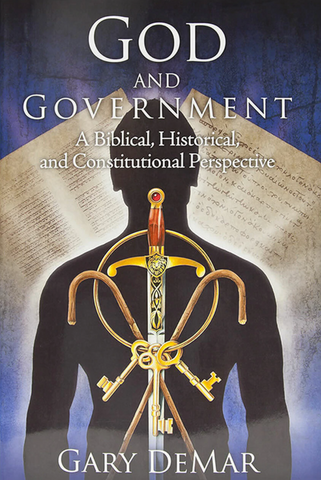
God and Government
With a fresh new look, more images, an extensive subject and scripture index, and an updated bibliography, God and Government is ready to prepare a whole new generation to take on the political and religious battles confronting Christians today. May it be used in a new awakening of Christians in America—not just to inform minds, but to stimulate action and secure a better tomorrow for our posterity.
Buy Now