
If there was ever a distorted version of American history, it is Warren Throckmorton’s recounting of our nation’s religious history in his book The Christian Past That Wasn’t: Debunking the Christian Nationalist Myths that Hijack History. Part of the distortion comes from the fact that there is no neatly packaged starting point for the past. Certainly, specific events can be documented: the signing of the Declaration of Independence, the “Shot Heard Around the World,” the bombing of Pearl Harbor, and the events of 9/11. But there are histories that lead up to these dated events, and subsequent consequences that follow them. Throckmorton is engaged in a bit of historical trimming, selecting, and “massaging” of the historical data to fit a desired outcome.[1]
Our constitutional Founders inherited a nation founded by Christians and built, to use a phrase from John Adams, on “the general principles of Christianity,” even though not every religious believer at that time held to every tenet of Christian orthodoxy.[2] Part of the problem with Throckmorton’s argument is that he views America’s founding as a determined fixed point in time, and he picks the point most convenient for his argument. The colonists who established the first colonial governments that later became the states that formed the national government would object to the late date of America’s founding. In fact, there are still remnants of that early religious founding circulating in documents, buildings, and ceremonies that organizations like the ACLU and Americans United for Separation of Church and State have made their living trying to eradicate.
There was a worldview before 1787 that did not pass into oblivion when the Constitution was finally ratified in 1791, with the addition of the Ten Amendments. Many state constitutions were explicitly Christian, and all were generally religious. None of this changed with the ratification of the Constitution. In fact, today the 50 state constitutions mention God using various designations, such as “Supreme Ruler of the Universe,” “Creator,” “God,” “Divine Goodness,” “Divine Guidance,” “Supreme Being,” “Lord,” “Sovereign Ruler of the Universe,” “Legislator of the Universe,” and “Almighty God” as the most common and most biblical phrase (Gen. 17:1; 28:3; 35:11; 43:14; 48:3; etc.). (The claim has been made that West Virginia is the exception. This is not the case.[3]) For example, the Preamble to the Constitution of Pennsylvania, where Throckmorton taught at Grove City College, includes the following: “WE, the people of the Commonwealth of Pennsylvania, grateful to Almighty God for the blessings of civil and religious liberty, and humbly invoking His guidance, do ordain and establish this Constitution.” He is correct that these religious precepts have changed over time. This is a fact not in dispute. His book, however, is misnamed. It should be titled “The Christian Past that Was.”
If we begin with 1620, the arrival of the Separatist Puritans at Plymouth, and add 150 years to that date, we come to 1770. Before Plymouth, Jamestown was founded in 1607. Let’s see if Throckmorton’s thesis holds up. Beginning in 1774, Congress appointed chaplains for itself and the army. It sponsored the publication of a Bible. Christian morality was adopted by the armed forces, and public lands were made available to promote Christianity among the Indians. John Adams, representing Massachusetts, and George Washington, representing Virginia, were present at these early congressional meetings. On March 16, 1776, “by order of Congress” a “day of Humiliation, Fasting and Prayer” where people of the nation were called on to “acknowledge the overruling providence of God” and bewail their “manifold sins and transgressions, and, by a sincere repentance and amendment of life, appease his righteous displeasure, and, through the merits and mediation of Jesus Christ, obtain his pardon and forgiveness.”
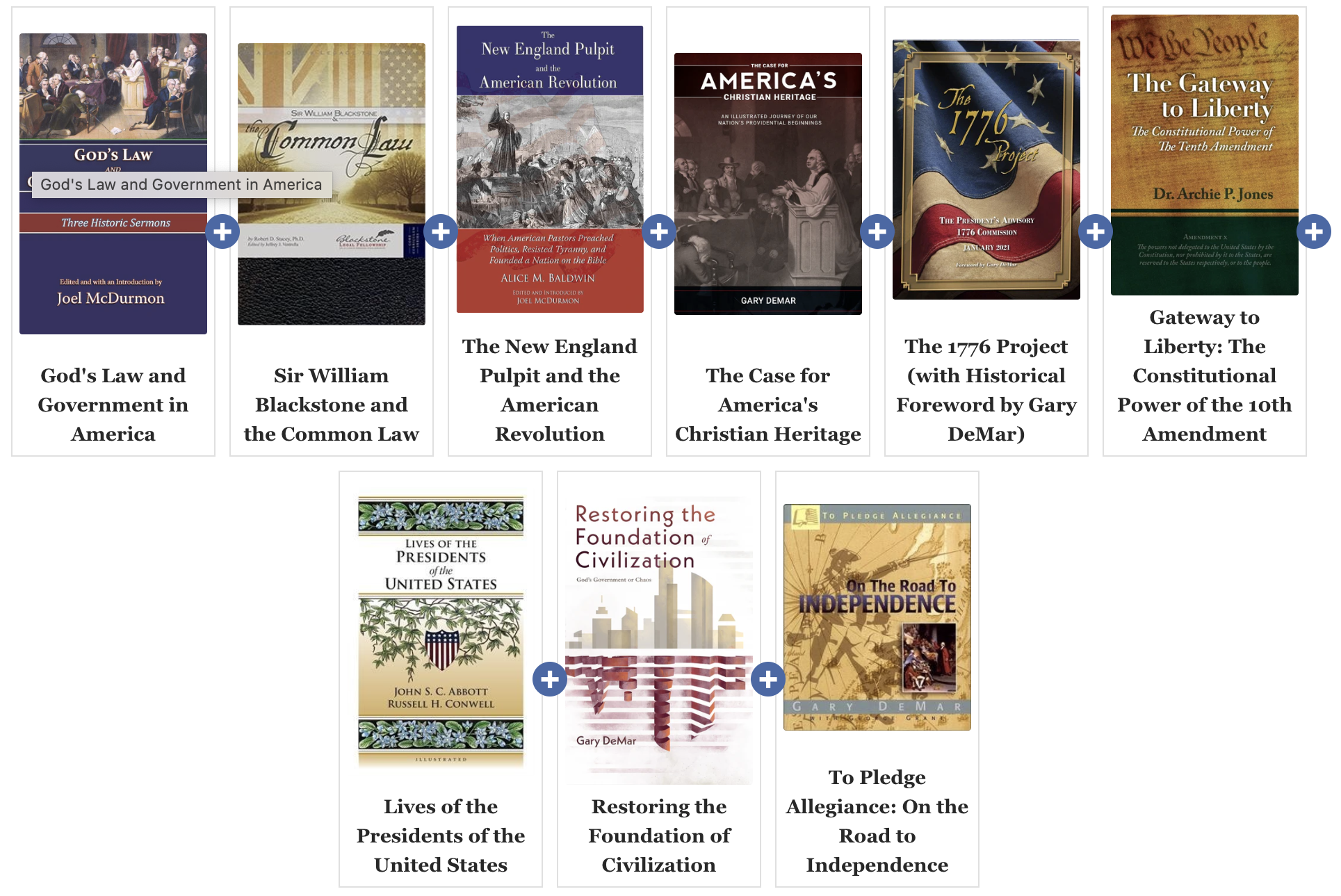
America's 250th Celebration Pack
Learn the real history!! To mark the historic 250th Anniversary of America's official declaration of separation from the tyrannical overreach of King George, American Vision is making these important books available for one great price! More than 45% off!! Each is an education in history, culture, and biblical worldview, but together they form a rock-solid foundation for proper thinking about America's incredible founding and early development.
Buy NowCongress set aside December 18, 1777, as a day of thanksgiving so the American people “may express the grateful feelings of their hearts and consecrate themselves to the service of their divine benefactor”[4] and on which they might “join the penitent confession of their manifold sins … that it may please God, through the merits of Jesus Christ, mercifully to forgive and blot them out of remembrance.” Congress also recommended that Americans petition God “to prosper the means of religion for the promotion and enlargement of that kingdom which consists in righteousness, peace and joy in the Holy Ghost.”[5] Keep in mind that these two proclamations precede (1774) and follow (1777) the drafting of the Declaration of Independence, of which the Constitution refers to: “Done in convention by the unanimous consent of the states present the seventeenth day of September in the year of our Lord one thousand seven hundred and eighty seven and of the independence of the United States of America the twelfth.”
• “We hold these truths to be self-evident, that all men are created equal, that they are endowed by their Creator with certain unalienable Rights, that among these are Life, Liberty and the pursuit of Happiness.”
• “We, therefore, the Representatives of the united States of America,” appeal “to the Supreme Judge of the world for the rectitude of our intentions….”
• “with a firm reliance on the protection of divine Providence, we mutually pledge to each other our Lives, our Fortunes and our sacred Honor.”
Historians are correct that there were traditional Christians and deists among the Founders. “Around the time of the American Revolution,” Robert Royal, president of the Faith and Reason Institute, writes that “a significant minority of the founders and the other colonists had been influenced by a moderate deism of the British sort that also retained strong elements of Christianity. Few, however, were deists properly speaking; most were out-and-out Christians.”[6] The deists shaped their moral worldview from Christianity, picking and choosing what they liked and disliked and then constructing a hybrid religious model. Benjamin Franklin Morris’ book The Christian Life and Character of the Civil Institutions of the United States is an antidote to such thinking.
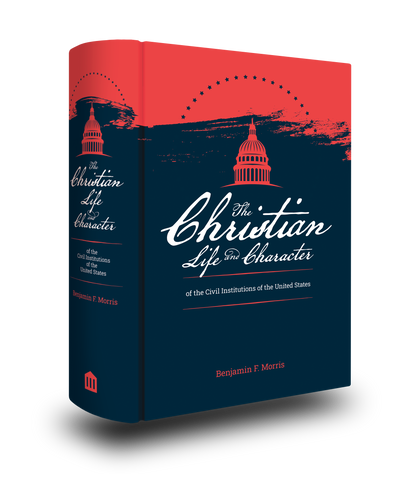
Christian Life and Character
Benjamin Franklin Morris' book has been out of print for over 100 years. If you can find an original copy, it's only because you have looked in the deep recesses of university libraries where the volume is likely collecting dust on dimly lit library shelves. Organizations like the ACLU and Americans United for Separation of Church and State have done their best to ignore the content of the massive compilation of original source material found in this book. If Americans ever become aware of the facts assembled by the author in this historic encyclopedia of knowledge, arguments for a secular founding of America will turn to dust. Reprinted by American Vision for the first time in over 140 years in 2007, we can't keep this book in print!
Buy NowThrockmorton mentions Benjamin Franklin in the Introduction to his book. Franklin underwent a religious pilgrimage throughout his long life. There is little doubt that in his early years, he was quite the religious skeptic, but never an atheist. At the Pennsylvania Convention of 1776, “Franklin, who presided, was apparently unable to stop the Convention from incorporating a constitutional provision stating that every representative was to declare his belief in the divine inspiration of the Bible.”[7] This, in itself, shows that there was a strong relationship between the Christian religion and civil government, and that Franklin’s views were in the minority.
Franklin read the writings of English deists as a young man, but “later experience and reflection caused him to retreat somewhat from the thoroughgoing deism of his early life…. Indeed, Franklin’s views on providence and prayer were quite inconsistent with the deistic conception of an absentee God who does not and who could not, in consistency with the perfection of his work of creation and his impartial nature, interfere in the affairs of men.”[8]
He states in his Autobiography, “I never doubted, for instance, the existence of the Deity; that he made the world, and govern’d it by his Providence; that the most acceptable service of God was the doing good to man; that our souls are immortal; and that all crime will be punished, and virtue reward, either here or hereafter.”[9] Franklin became disenchanted with much of what passed for Christianity in his day. He recalls waiting expectedly for comments from a minister who took as his text, “Finally, brethren, whatever is true, whatever is honorable, whatever is right, whatever is pure, whatever is lovely, whatever is of good repute, if there is any excellence and if anything worthy of praise, dwell on these things” (Phil. 4:8). Franklin commented, “And I imagin’d, in a sermon on such a text, we could not miss of having some morality.” Instead of deriving moral application from the text, the minister went on to call for ceremonial and ecclesiastical works. Franklin went on to comment, “these might be all good things; but as they were not the kind of good things that I expected from that text, I despaired of ever meeting with them from any other, was disgusted, and attended his preaching no more.”[10] Franklin’s disappointment wasn’t with the text, but an unfounded application of the text.
As Throckmorton points out, it was Franklin who addressed the Constitutional Convention by reminding those in attendance of “a superintending Providence” in their favor that brought them to their unique place that would make history.[11] He cited Psalm 127:1 to establish his point: “Unless the LORD builds the house, they labor in vain who build it.” He went on to say something non-deistic. He saw “proofs” that “God rules in the affairs of men,” and without God’s “concurring aid, we shall succeed in this political building no better than the builders of Babel” (Gen. 11:1-9).[12]
Throckmorton uses Franklin’s appeal and the refusal of most of the Constitutional delegates to follow his admonition to pray as proof that our nation did not have a Christian past. It proves the opposite. His appeal to our nation’s vibrant Christian past was evident in an appeal to recent history.
In the beginning of the contest with G. Britain, when we were sensible of danger we had daily prayer in this room for the Divine Protection. — Our prayers, Sir, were heard, and they were graciously answered. All of us who were engaged in the struggle must have observed frequent instances of a Superintending providence in our favor. To that kind providence we owe this happy opportunity of consulting in peace on the means of establishing our future national felicity. And have we now forgotten that powerful friend? Or do we imagine that we no longer need His assistance?
Over time, our nation has drifted, first by placing natural law on an equal footing with special revelation, second by adopting religious pluralism as a governing principle, and third by concluding that materialism is the basis of all reality. The conclusions of Throckmorton’s work will lead us into oblivion. The issue is not the “separation of church and state,” as he claims. That ship has sailed. (See my book God and Government). What worldview will fight the extremes of materialism and the ongoing expansion of Islam? Religious pluralism is the vehicle for Islam to dominate the once-Christian West. Even Jefferson and Adams saw the danger in the 18th century. See my book The Case for America’s Christian Heritage.
[1] Walter Gratzer, The Undergrowth of Science: Delusion, Self-Deception and Human Frailty (Oxford, NY: Oxford University Press, 2000), vii.
[2] In a June 28, 1813, letter to Thomas Jefferson, John Adams stated that the general principles on which the fathers achieved independence were the general principles of Christianity, alongside the general principles of English and American liberty, which were also founded on Christian principles going back to Magna Carta (1215).
Adams clarified that these “general principles” served as the unifying moral framework for the religiously diverse Continental Congress, which included Roman Catholics, Presbyterians, Methodists, and Deists. He argued that despite their theological differences, all members were educated in these core Christian tenets and united by a shared belief in liberty. Adams further avowed that he believed these general principles of Christianity were “as eternal and immutable as the existence and attributes of God,” asserting that they formed the essential foundation for the nation’s independence and moral order.
[3] See “God in the State Constitutions”. The West Virginia Preamble of 1872 reads, “Since through Divine Providence we enjoy the blessings of civil, political and religious liberty, we, the people of West Virginia, reaffirm our faith in and constant reliance upon God.” In 1960, the voters of the state of West Virginia ratified the following Preamble to their state’s Constitution: “Since through Divine Providence we enjoy the blessings of civil, political and religious liberty, we, the people of West Virginia, in and through the provisions of this Constitution, reaffirm our faith in and our constant reliance upon God, and seek diligently to promote, preserve, and perpetuate good government in the State of West Virginia for the common welfare, freedom, and security of ourselves and our posterity.” Robert Bastress, The West Virginia State Constitution (Westport, CT: Greenwood Press, 1995), 27.
[4] In another context, “divine benefactor” would be viewed as a deist ascription to an unnamed deity. It’s obvious that in this context the Christian God is in view.
[5] The proclamation can be found in Gary DeMar, America’s Christian History (Powder Springs, GA: American Vision, 2005), 252.
[6] Robert Royal, The God that Did Not Fail: How Religion Built and Sustains the West (New York: Encounter Books, 2006), 206. Emphasis added. For some helpful comments on the “unpopularity of deism” in the colonies, see Herbert M. Morais, Deism in Eighteenth Century America (New York: Russell & Russell, [1934] 1960), 91-98.
[7] Herbert M. Morais, Deism in Eighteenth Century America (New York: Russell & Russell, [1934] 1960) 91.
[8] John Orr, English Deism: Its Roots and Its Fruits (Grand Rapids, MI: Eerdmans, 1935), 211.
[9] Benjamin Franklin, Autobiography, ed. John Bigelow (Philadelphia: J. B. Lippincott, 1868), 211.
[10] Franklin, Autobiography, 212–213.
[11] See www.loc.gov/exhibits/religion/vc006642.jpg

[12] After the Convention, Franklin’s recommendation for an “officiate” (chaplain) was acted upon on April 9, 1789. Two chaplains were appointed, one to the House of Representatives and one to the Senate, with a salary of $500 each, with no thought of violating the Constitution.