
I received an email about “the younger generation, millennials, genZs, etc., are not interested in the end times” but are attracted to the Roman Catholic Church. This is not a new phenomenon, and it’s not only the younger generations. The RCC is safer. A single authority speaks for the church and its members. For the most part, everyone is operating with the same playbook. There aren’t any debates about baptism or church government. Mother Church has spoken. It’s a more tangible religion. There’s a lot to see and experience—smells and bells, as some describe it. They claim that the RCC is the historical church. Protestantism, as admitted, is new, although that was never the intention. All the claims made by RCC apologists have their qualifications.
I was raised in the Roman Catholic Church. My Catholic upbringing included Catholic school through fifth grade and serving as an altar boy through my early teens. My first dose of a foreign language was Latin, a prerequisite for being an altar boy in the 1950s and 1960s. I still remember some of the altar prayers I had to say. Mea culpa, mea culpa, mea maxima culpa. “Through my fault, through my fault, through my most grievous fault.”
After becoming a Christian in 1973, I began to question several fundamental Catholic doctrines after reading the Bible. It was sola scriptura—Scripture alone—not the Bible plus anything else that led me to reconsider what I had been taught as a child about Catholicism. The doctrines that lined up with the Bible, I retained. Those doctrines that could not be supported by an appeal to the Bible, I rejected. Roman Catholics and Protestants affirm the Nicene Creed, so there was a lot to retain. Again, sola scriptura was the reference point. It remains my point in my correspondence with those who signed the Three Questions Letter. “In a September blog post responding to Stephen Wolfe, Douglas Wilson invited anyone who would debate the merits of his proposed memorials on antisemitism and ‘ethnic balance’ to ‘come at it with an open Bible…[and] make an argument grounded in Scripture.’”[1] Exactly. You can’t do this in a debate with Roman Catholics. This isn’t to say that Protestants are right about everything. If they were, they would all agree. The RCC makes agreeing easy.
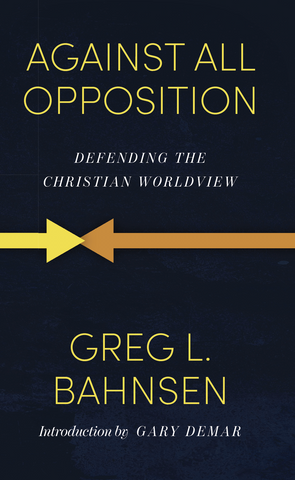
Against All Opposition: Defending the Christian Worldview
The starting point is the God of the Bible. The Bible begins with this foundational presupposition: “In the beginning God created the heavens and the earth” (Gen. 1:1). Against All Opposition lays out the definitive apologetic model to help believers understand the biblical method of defending the Christian faith.
Buy NowThe doctrine of sola scriptura has been questioned by several former Protestants who have embraced the teachings of the Roman Catholic Church. Once the doctrine of sola scriptura is rejected, a Pandora’s Box of doctrinal additions can be opened. Protestants have their own Pandora’s Box of traditions not based on Scripture alone. As one Catholic writer asserts, “Scripture has been and remains our primary, although not exclusive, source for Catholic doctrines.”[2] This is the nature of the dispute. While Protestants believe Scripture is the “exclusive” source for doctrine and life, the Catholic Church asserts that extra-biblical tradition plays an almost equal role.
A book by former Protestants, Scott and Kimberly Hahn, drew attention when it was first published in 1983. The Hahns have become effective apologists for the Roman Catholic position. Scott, a former Presbyterian minister, and his wife consider their embrace of Catholicism as a homecoming. In fact, the title of their first book is Rome Sweet Home: Our Journey to Catholicism.[3]
After reading Rome Sweet Home, I came away bewildered. I could not believe how poorly the Hahns argued for Catholic dogma. (Scott does very good work in other areas.) For example, Kimberly tells the story of how she questioned whether to say the Rosary, a belabored recitation of the “Hail Mary” and other prayers. She had always thought the practice was “vain repetition” (Matt. 6:7). After some instruction by a nun, Kimberly saw the error of her ways. The nun told Kimberly that we are like children when we pray. (There’s no basis in the Bible for nunneries or priests that do not marry, or for that matter, priests.) While I might have tolerated my children saying the same thing repeatedly when they first learned to talk, I wouldn’t for long.
The Bible tells us that we are to “grow in respect to salvation” (1 Peter 2:2; also Eph. 4:15). Consider the passages that speak about maturity:
• “For everyone who partakes only of milk is not accustomed to the word of righteousness, for he is a babe. But solid food is for the mature, who because of practice have their senses trained to discern good and evil” (Heb. 5:13-14).
• “Therefore, leaving the elementary teaching about the Christ, let us press on to maturity, not laying again a foundation of repentance from dead works and of faith toward God” (Heb. 6:1).
• “When I was a child, I used to speak as a child, think as a child, reason as a child; when I became a man, I did away with childish things” (1 Cor. 13:11).
While we are God’s children, we are not encouraged to act childishly. Anyway, why pray the “Hail Mary,” with its unbiblical line “Holy Mary Mother of God pray for us sinners now and at the hour of our death”?[4] I mean, if you’re going to say a prayer repeatedly, why not use the one Jesus taught His disciples to pray? Why not the Lord’s Prayer? When Jesus’ disciples asked Him to teach them to pray, He didn’t teach them the “Hail Mary.”
No biblical justification can be found for praying the Rosary. But this does not matter to Catholics since they have tradition on their side. The real debate, however, is whether sola scriptura is a doctrine that is taught in the Bible. Does the Bible teach that the Bible alone is the Christian’s “only rule of faith and obedience”? Where else would you go?
One of the things that sent Scott Hahn over the edge into considering Roman Catholic doctrine was a question a student asked him about sola scriptura. Here is how Scott recounts the confrontation:
“Professor Hahn, you’ve shown us that sola fide [faith alone] isn’t scriptural—how the battle cry of the Reformation is off-base when it comes to interpreting Paul. As you know, the other battle cry of the Reformation was sola scriptura: the Bible alone is our authority, rather than the Pope, Church councils or Tradition. Professor, where does the Bible teach that ‘Scripture alone’ is our sole authority?”[5]
What was Scott’s response? “I looked at him and broke into a cold sweat.” He writes that he “never heard that question before.” This encounter shook Scott. He writes that he “studied all week long” and “got nowhere.” Then he “called two of the best theologians in America as well as some of [his] former professors.”[6] I admit that if I got the answers that Scott received from these unnamed “two best theologians in the country,” I also would give up the doctrine of sola scriptura. The same often results when trying to nail down some of the best theologians on eschatology. In most cases, that’s the last place you would want to go.
What amazes me is that a seminary-trained scholar like Scott Hahn had to make these calls. Demonstrating sola scriptura from the Bible is not very difficult. Jesus used the Bible to counter the arguments of Satan. Scripture was quoted, not extra-biblical tradition (Matt. 4:1-10 and Luke 4:1-12). The same can be said of His debates with the religious leaders. He asked them, “Did you never read in the Scriptures?” (Matt. 21:42). Appeal is not made to any ecclesiastical body, the priesthood, or tradition (Mark 7:1-13).
The Sadducees, who say there is no resurrection, hoped to trap Jesus with a question that seems to have no rational or biblical answer. Jesus, with all the prerogatives of divinity, could have manufactured a legitimate and satisfactory answer without an appeal to Scripture. He did not. Instead, he tells them, “You are mistaken, not understanding the Scriptures, or the power of God” (Matt. 22:29). Here we find Jesus rejecting ecclesiastical opinion—as represented by the Sadducees—in favor of sola scriptura.
To whom does Abraham appeal in the story of the Rich Man and Lazarus? Does he point to tradition? He does not. Ecclesiastical authority? Abraham answers, “They have Moses and the Prophets; let them hear them” (Luke 16:29). The rich man is not satisfied with this response. “No, Father Abraham, but if someone goes to them from the dead, they will repent!” (16:30). A miracle will surely convince my brothers! Abraham’s appeal, however, is to Scripture: “But he said to him, ‘If they do not listen to Moses and the prophets, neither will they be persuaded if someone rises from the dead’” (16:31). Keep in mind that “Moses” is a synecdoche, a figure of speech in which a part is made to represent the whole or vice versa, that is, the Revelation given to Moses.
Apologetics 101
Apologetics 101 is an in-depth study of defending the Christian faith. The Greek word apologia simply means "defense," and apologetics is the art and act of giving a defense. Christian Apologetics then is the art and act of defending the Christian faith, not a proof of God in general. The Christian apologist must be ready to answer truth claims about the Bible, not claims about Hinduism, Islam, or any other false religion. The Bible makes the bold claim that Jesus is the ONLY way, and the Christian apologist must set his sights on the Bible alone, not on a defense of arbitrary theism
Buy NowOn the road to Emmaus, Jesus presents an argument to explain His death and resurrection: “And beginning with Moses and with all the prophets, He explained to them the things concerning Himself in all the Scriptures” (Luke 24:27). No mention is made of tradition. If you want eternal life, what are you to search for? The Bible says, “You search the Scriptures, because you think that in them you have eternal life; and it is these that bear witness of Me” (John 5:39).
The Pharisees, who were notorious for distorting the Word of God by means of their “tradition” (Mark 7:8), still could speak the truth if they stuck with sola scriptura. Jesus said, when the “scribes and the Pharisees” sit “in the chair of Moses,” that is, when they are faithful in their use of Scripture, “do and observe” what they tell you (Matt. 23:2-3). When Paul “reasoned” with the Jews, what revelational standard did He use? “And according to Paul’s custom” he “reasoned with them from the Scriptures” (Acts 17:2). Paul, who claimed apostolic authority (Rom. 1:1; 11:13; 1 Cor. 9:1; Gal. 1:1), did not rebuke the Berean Christians when they examined “the Scriptures daily, to see whether these things” he was telling them were so (Acts 17:11). Notice that the Bereans were equal to Paul when it came to evaluating doctrine by means of Scripture.
Paul continually argued in terms of sola scriptura: “For what does the Scripture say?” (Rom. 4:2). Roman Catholic doctrine would add, “and Church tradition as expressed in the magisterium.” Paul “opposed” Peter, the supposed first Pope, “to his face” over a doctrinal issue (Gal. 2:11), demonstrating that “a man is not justified by the works of the Law but through faith in Christ Jesus” (2:16).
When church leaders met in Jerusalem to discuss theological matters, they appealed to Scripture. Their deliberations had to “agree” with “the words of the Prophets” (Acts 15:15). The book of Acts is filled with an appeal to sola scriptura: the appointment of a successor to Judas (1:20); an explanation of the signs at Pentecost (2:14-21); the proof of the resurrection of Jesus (2:30-36); the explanation for Jesus’ sufferings (3:18); the defense of Stephen (7); Philip’s encounter with the Ethiopian and the explanation of the suffering Redeemer (8:32-35): “Philip opened his mouth, and beginning with this Scripture [Isa. 53] he preached Jesus to him” (Acts 8:35). In the book of Acts the appeal is always to Scripture (10:43; 13:27; 18:4-5; 24:14; 26:22-23, 27; 28:23). There was no appeal to an extra-biblical tradition.
But what of those verses that discuss the validity of tradition? These were troubling to the Hahns, especially 2 Thessalonians 2:15: “So then, brethren, stand firm and hold to the traditions which you were taught, whether by word of mouth or by letter from us.” No church council was called to place its imprimatur on these Old Testament books. The Old Testament canon—Scripture—was not the product of the Old Testament church. “The church has no authority to control, create, or define the Word of God. Rather, the canon controls, creates and defines the church of Christ.”[7]
Once the completed written revelation was in the hands of the people, an appeal was always made to this body of material as Scripture. Scripture plus tradition is not a consideration. In fact, Jesus condemns the Pharisees and scribes because they claimed that their religious traditions were on an equal par with Scripture (Mark 7:1-13). The Roman Catholic answer to this is self-refuting: “Jesus did not condemn all traditions; he condemned only erroneous traditions, whether doctrines or practices, that undercut Christian truths.”[8] Precisely. How does one determine whether a tradition is an “erroneous tradition”? Sola scriptura! The Catholic Church maintains that the appeal must be made to the Church whose authority is based on Scripture plus its own traditions. But this is begging the question. How could anyone ever claim that a tradition is erroneous if the Catholic Church begins with the premise that Scripture and tradition, as determined by the Catholic Church, are authoritative? Who’s interpreting the interpreters?
[1] Re-Considering Doug Wilson’s “Covenant with Hagar” Wilson, Douglas. “The Case of Owen and the Memorials.” Blog and Mablog (blog). 09/25/2023. Link here.
[2] Bob Moran, A Closer Look at Catholicism: A Guide for Protestants (Dallas, TX: Waco, 1986), 60.
[3] San Francisco, CA: Ignatius Press, 1983.
[4] This line is not found in the Bible. Most of the “Hail, Mary” is a patchwork of Scripture verses that describe Mary and her special calling (Luke 1:28, 30, 48). The angel Gabriel is not uttering a prayer, nor does he encourage anyone to turn his words into a prayer.
[5] Hahn, Rome Sweet Home, 51.
[6] Hahn, Rome Sweet Home, 52.
[7] Greg L. Bahnsen, “The Concept and Importance of Canonicity,” Antithesis 1:5 (September/October 1990), 43.
[8] Karl Keating, Catholicism and Fundamentalism: The Attack on “Romanism” by “Bible Christians” (San Francisco, CA: Ignatius Press, 1988), 141.