

Please help us meet a $15K matching challenge here
In this first part of a conference talk, Gary discusses the worldview implications of eschatology and why they’re so important.
While it is true there is an attempt by the ungodly to dominate culture, and some are successful for a season, the fact is, that over time “they will not make further progress” (2 Timothy 3:9); their fling with ungodliness is only temporary (cf. Rom. 1:18–32). Christians can be optimistic even if the actions of the ungodly increase in their own day. If Christians remain faithful in influencing their world with the gospel and applying a Christian worldview to every area of life, the world can and will change. History and God’s providential care are on our side.
Paul, however, does not allow Christians to remain passive as the ungodly self-destruct. Timothy has followed Paul’s “teaching, conduct, purpose, faith, patience, love, perseverance, persecutions, [and] sufferings” (2 Tim. 3:10–11), and he calls on us to do the same. While the ungodly expend capital from their contrary and corrupted worldview on present-oriented living, the Christian is to develop future-oriented spiritual capital to replace the bankrupt culture of secularism, humanism, materialism, relativism, and hedonism.
Notice that the characteristics of the ungodly are all self-directed and short-lived, summarized by the phrase “lovers of pleasure rather than lovers of God” (2 Tim. 3:4). Sin has its pleasure for a short period of time: “He who loves pleasure will become a poor man; he who loves wine and oil will not become rich” (Prov. 21:17). The love of pleasure is no investment in the future.
The characteristics of the godly are directed toward the future, foregoing the lure of present pleasures for future blessings. Teaching, conduct, purpose, faith, patience, love and perseverance take time and energy from the present but result in lasting rewards. Moreover, even persecutions and sufferings should not deter future-oriented Christians because “out of them all the Lord” delivers His people (2 Tim. 3:11).
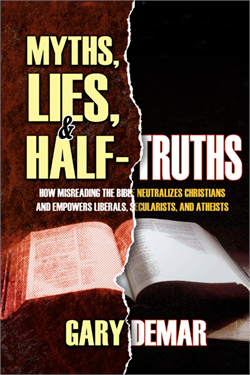
Myths, Lies, and Half-Truths
Like the Bereans of Paul’s day (Acts 17:11), Christians should check the veracity of all opinions against the only reliable standard of authority that God has placed in our hands: the Bible. This may mean a change in belief systems for some. There is no novelty in this. God confronted Peter directly about the inclusion of Gentiles into the household of faith (10:9–16). Paul confronted Peter “to his face” on a similar matter (Gal. 2:11–14). There are times when we all need to be knocked off our horse of mistaken opinions (Acts 9:4). “Testing” is a biblical mandate (2 Cor. 13:5; 1 John 4:1).
Buy NowIn this first part of a conference talk, Gary discusses the worldview implications of eschatology and why they’re so important. Believing something is one thing, but acting in terms of that belief has daily consequences. Morality, ethics, and social action all stem from a person’s ultimate commitment to what they believe about the future.