
Predictions about the end times have a long history, as Francis X. Gumerlock points out in his book The Day and the Hour: Christianity’s Perennial Fascination with Predicting the End of the World. The events we see today have recurred throughout the centuries.
“In 1712, William Whiston, [Isaac] Newton’s successor as professor of mathematics at Cambridge, had predicted that a comet would soon destroy the world. In November 1750, the third volume of Whiston’s memoirs recalled the second woe of Revelation 11:13 to predict the fall of a tenth part of London, the death of seven thousand men, ‘and the remnant so affrighted that they gave glory to the God of heaven.’”[1]
The Lisbon earthquake of 1755 led many people to conclude that the event was the prelude to the end of the world.
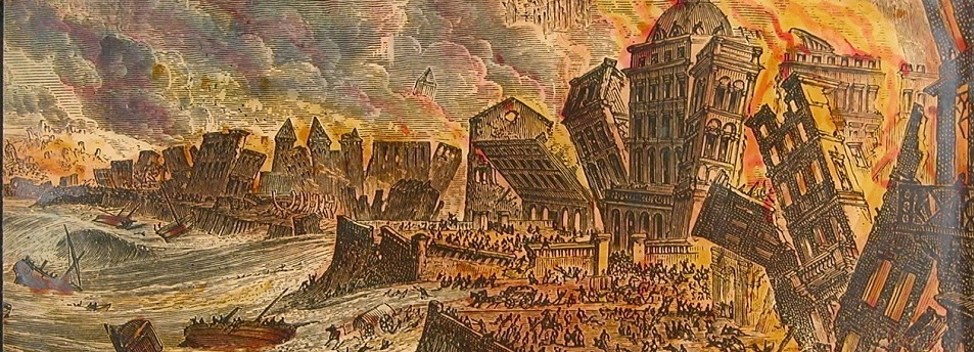
“In February 1763, when the Peace of Paris ended the Seven Years’ War, a pious Methodist, George Bell, prophesied the end of the world for February 28. John Wesley [1703-1791], who had surmounted any early belief in the imminent coming of Christ, had to preach to show the ‘utter absurdity of the supposition that the world was to end that night.’ Yet many were afraid to go to bed and wandered about the fields ‘persuaded that if the world did not end, at least London would be swallowed up by an earthquake,’ as Lisbon had been only eight years before.”[2]
The Day and the Hour
By exposing these erroneous predictions made century after century, The Day and The Hour encourages an approach of "cautious ignorance" concerning the date of the final coming of Christ and related events, and magnifies the truth of Christ's words that the day and the hour is indeed unknown. This fascinating chronicle of predictions will rivet the attention of any student of Bible prophecy, regardless of your eschatological position.
Buy NowNews of earthquakes in our day holds prophetic significance for many Christians “because we are to such an extent ‘strangers to the past,’ [thus] we easily read into the events and circumstances of our own day a distinctiveness and uniqueness that may not actually be there.”[3]
Plagues
Two historic plagues ravaged the Roman Empire: the Antonine Plague (AD 165–180) and the Cyprian Plague (249-262 A.D.). The plagues killed roughly a quarter to a third of the population, including three of its emperors.
The Plague of Justinian reached the Byzantine capital of Constantinople in AD 541 and was soon claiming up to 10,000 lives per day—so many that unburied bodies were eventually stacked inside buildings or left in the open.
The Black Death in 1347 was a virulent strain of plague that invaded Europe from the East, most likely via Italian sailors returning home from Crimea. This “Black Death” would eventually spend half a decade tearing across the continent. The populations of whole towns were wiped out, and it was said that the living spent most of their time burying the dead in mass graves. “We see death coming into our midst like black smoke,” the Welsh poet Jeuan Gethin wrote, “a plague which cuts off the young, a rootless phantom which has no mercy or fair countenance.” …The Black Death finally subsided in the West around 1353, but not before it killed as many as 50 million people—more than half the population of Europe.
The Italian Plague of 1629-1631 was one of the most calamitous outbreaks of bubonic plague. It began in 1629, when troops from the Thirty Years’ War carried the infection into the Italian city of Mantua. … In Milan and Venice, city authorities quarantined the sick in “pesthouses” and burned their clothes and possessions to prevent the spread of infection. The Venetians even banished some of their plague victims to a pair of islands in a nearby lagoon. These harsh measures may have helped contain the scourge, but it still killed some 280,000 people, including over half the residents of Verona. The Republic of Venice, meanwhile, lost nearly a third of its population of 140,000.
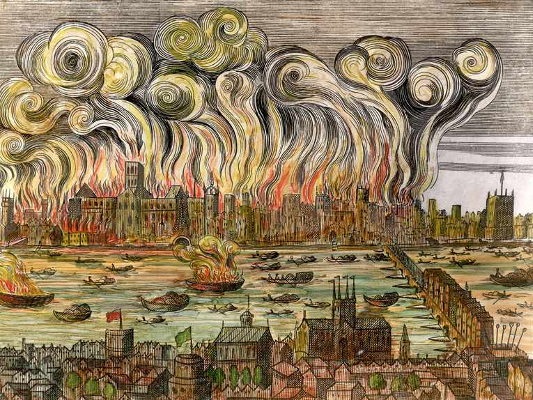
The Great Plague of London hit between 1665 and 1666. … At its peak in September 1665, some 8,000 people were dying each week. … “Never did so many husbands and wives die together,” a pastor named Thomas Vincent wrote, “never did so many parents carry their children with them to the grave.” (His account of the plague in God’s Terrible Voice in the City by Plague and Fire, 1667, is graphic; seven in his own household died.)
As the sickness spread, London’s authorities tried to contain the infected by quarantining them in their homes, which were marked with a red cross. Somewhere between 75,000 and 100,000 people eventually perished before the outbreak died down in 1666. Later that same year, London was visited by a second major tragedy when the Great Fire of 1666 torched much of its city center.
The Great Plague of Marseille, which began in 1720, was Western Europe’s last major outbreak of medieval plague…. People died by the thousands, and the piles of bodies on the streets grew so large that convicts were conscripted to dispose of them. In nearby Provence, “plague walls” were even built to try to … contain the infection, but it still spilled over into southern France before finally disappearing in 1722. By then, it had killed roughly 100,000 people. (History.com)
Between 1918 and 1920, a deadly outbreak of influenza affected over a third of the world’s population and ended the lives of 20–50 million people. Of the 500 million people infected in the 1918 pandemic, the mortality rate was estimated at 10% to 20%, with up to 25 million deaths in the first 25 weeks alone. (Mphonline.com)
Signs in the Heavens
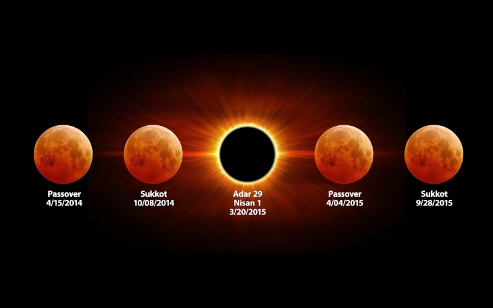
Blood Moons: Prophecy prognosticators claimed that a tetrad of blood moons in 2014 and 2015 were a prelude to some unnamed prophetic event. See my article “Will Four Blood Moons Usher in the Second Coming?” for an introduction to the topic. So-called Blood Moons and Blue Moons are common occurrences and have nothing to do with Bible prophecy. The same is true of lunar and solar eclipses.
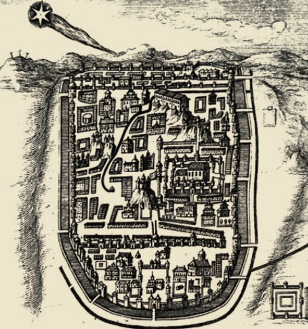
Comets (e.g., Halley’s Comet): “Halley’s returns to the inner Solar System have been observed and recorded by astronomers since at least 240 BC.”
Jupiter Effect
In 1982, the planets would be in a straight-line formation perpendicular to the sun. This alignment — an event that occurs every 179 years according to Gribbin and Plagemann in The Jupiter Effect — supposedly exerts an uncommon gravitational pull on the planets.
Hal Lindsey saw eschatological significance in the Jupiter Effect. He wrote in 1980, “This alignment causes great storms on the sun’s surface, which in turn affect each of the planets. The sun storms will not only affect our atmosphere, as was previously mentioned, but they will slow down the Earth’s axis slightly.” This slowdown, according to Lindsey and his “author-experts,” would mean putting “a tremendous strain on the Earth’s faults, touching off earthquakes.” This new wave of earthquakes was to bring about great floods because dams have been built over fault lines. In addition, we were to see “nuclear power plant meltdowns at facilities built on or near the Earth’s faults.”[4] What happened? Nothing.
Astrophysicist John R. Gribben, one of the authors of the best-selling book The Jupiter Effect, admitted in his 1999 book The Little Book of Science that “[t]here is no Jupiter effect” and “I’m sorry I ever had anything to do with it.”[5]
Left Behind: Separating Fact from Fiction
What difference does it make what we believe about the end times anyway? DeMar shos how our point-of-view regarding end-times prophecies affects the way we live each day. In addition, DeMar answers skeptics who use failed end-times predictions to disprove the Bible. Giving us a different perspective on the end times, this approach to the Bible can revolutionize the life of the church.
Buy Now[1] Eugene Weber, Apocalypses: Prophecies, Cults, and Millennial Beliefs Through the Ages (Cambridge, MA: Harvard University Press, 1999), 100-101.
[2] Weber, Apocalypses, 102.
[3] Carl Olof Jonsson and Wolfgang Herbst, The “Sign” of the Last Days—When? (Atlanta, GA: Commentary Press, 1987), x.
[4] Hal Lindsey, The 1980s: Countdown to Armageddon (King of Prussia, PA: Westgate Press, 1980), 31.
[5] John Gribben, The Little Book of Science (New York: Barnes & Noble, 1999), 39.