

John Bevere claims “we are closer to the return of Jesus than most believers realize.” Anyone can say this who believes the future physical return of Jesus is closer, whether it’s next week or the next millennium. Bevere considers closer to mean really close, like any day now, while he dismisses the biblical insistence that the coming of Jesus was “near” for that first-century generation (Matt. 24:33; James 5:7-9; Rev. 1:1, 3; 22:6, 10). He’s written The King Is Coming: It’s Time to Prepare for the Return of Christ, which was released on March 3, 2026, to make his case. All the usual suspects are promoting it. As a result, it’s an ‘Instant New York Times Bestseller’ and a ‘USA Today Bestseller.’
John Bevere should know better than to make claims about the timing of prophetic events, even if they are less than definite. He’s 66 years old, so he’s been around long enough to know how others made similar claims—from The Late Great Planet Earth to the multi-volume Left Behind series, and many, many, many more that go back centuries.

The Day and the Hour
Throughout Christian history, bizarre fringe groups and well-meaning saints alike have been fully convinced that events in their lifetime were fulfilling Bible prophecy. In The Day and The Hour, Gumerlock spans two thousand years of conjecture on the last days, disclosing the dreams and delusions of those who believed that their sect was the 144,000 of Revelation 7; that the 1290 days of Daniel 12 had expired in their generation; that the "Man of Sin" of II Thessalonians 2 was reigning in their time; that a Rapture of the saints, a Great Tribulation, a Battle of Armageddon were just around the corner; or that a Millennial Kingdom was about to dawn.
Buy NowTo cover themselves, the prognosticators always throw in “no man knows the day and the hour.” It’s all about the “signs.” They, too, have been appealed to as well. Pretribbers can’t point to signs since the ‘rapture’ is a “signless event.” But prophecy “experts” can’t sell books without appealing to signs!
John Bevere is 66 years old. He should know better. In 1970, Hal Lindsey claimed it would all come to an end sometime before 1988. The Late Great Planet Earth sold tens of millions of copies. Chuck Smith and others worked off the same 1948 + 40 years = 1988 timetable. My library is filled with books and articles going back hundreds of years by people who claimed that some form of the end was near in their time because all the signs were in place. During the Iraq War, John Walvoord’s son repurposed his father’s book, Armageddon, Oil and the Middle East Crisis (1974, 1976, 1990), for the fourth time in 2007, retitled Armageddon, Oil, and Terror. These were all bestsellers. They are outdated and only good for kindling.
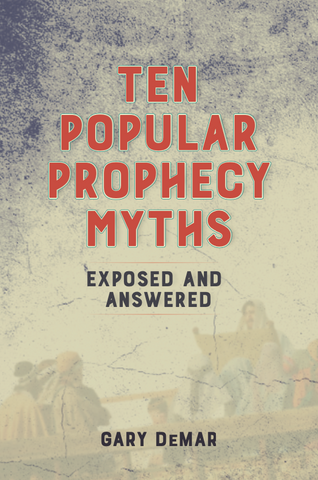
Ten Popular Prophecy Myths Exposed and Answered
Since the reestablishment of Israel in 1948, “end-time” prophetic speculation has been on the rise. Millions of books have been sold proclaiming countless false prophecies. Many Christians are beginning to take a second look at the biblical prophetic record. A seismic shift in biblical eschatology is taking place around the world because Christians, some for the first time, are willing to challenge what they have been taught based on what the Bible actually says.
Buy NowA similar view was held by Charles Dyer in his book The Rise of Babylon: Is Iraq at the Center of the Final Drama? first published in 1991 (revised in 2003). Dyer linked Saddam Hussein with Nebuchadnezzar. An image on the back cover of the first edition of The Rise of Babylon included the following text: “SADDAM HUSSEIN and the ancient world conqueror Nebuchadnezzar. Not only do they look alike, but their mission is the same—to control the world. And the symbol of this world domination is an ancient city…”

How did that work out? Any new book will be titled Is Iran at the Center of the Final Drama? What’s the difference between a ‘q’ and an ‘n’ among prophetic friends?
H. Charles R. Taylor wrote, “What you are starting to read probably is my final issue of Bible Prophecy News, for Bible prophecy fulfillments indicate that Jesus Christ our Lord will most likely return for us at the Rapture of the Church before the Fall 1992 issue can be printed.” There is nothing new in Bevere’s book except a massive advertising campaign. It’s all been said before with the same result. Bevere is taking prophetic texts used to describe events that were near to the first readers (e.g., Matt. 24-25), ignoring the context (the destruction of the temple: 24:3), the audience (the use of the second person plural “you,” which referred to those in Jesus’ audience), and the timing (“this generation” always refers to the generation to whom Jesus was speaking).
In an interview, Bevere referred to the parable of the Ten Virgins to support some of his claims. Bevere is in good company because even non-dispensationalists get the timing wrong on specific passages. This is especially true when it comes to the parables in Matthew 24-25. Even partial preterist Kenneth Gentry applies these parables to a future physical coming of Jesus. I cover his arguments in chapter 15 of my book Last Days Madness.

Last Days Madness
In this authoritative book, Gary DeMar clears the haze of "end-times" fever, shedding light on the most difficult and studied prophetic passages in the Bible, including Daniel 7:13-14; 9:24-27; Matt. 16:27-28; 24-25; Thess. 2; 2 Peter 3:3-13, and clearly explaining a host of other controversial topics.
Buy NowA line of evidence offered by those who believe that events following Matthew 24:35 refer to the personal and physical return of Jesus is the meaning given to “delays” (24:48: chronizei), “after a long time” (25:19: polyn), and the “delay” (chronizontos) of the bridegroom (25:5). For some commentators, these examples indicate that different events are in view, one near (the destruction of Jerusalem that took place in AD 70) and one distant (a future physical coming of Christ). This is the view of Stephen F. Hayhow.
Both parables, the parables of the virgins (vv. 1-13), and the parable of the talents (vv. 14-30), speak of the absence of the bridegroom/master, who is said to be “a long time in coming” (v. 5) and “After a long time the master of the servants returned…” (v. 19). This suggests, not the events of A.D. 70 which were to occur in the near future, in fact within the space of a generation, but a distant event, the return of Christ.[1]
Notice that the evil slave says, “My master is not coming for a long time,” literally, is “delayed” (Matt. 24:48). The evil slave then proceeds to “beat his fellow-slaves and eat and drink with drunkards” (24:49). But to the surprise of the “evil slave” the master returned when he least expected him (24:50). The master did not return to cut the evil slave’s distant relatives into pieces (24:51); he cut the evil slave into pieces. The evil slave was alive when the master left and when the master returned. In this context, a “long time” must be measured against a person’s lifetime. For example, in John 5:5-6, “a certain man” had been at the Pool of Bethesda for “thirty-eight years in his sickness.” This is described as a “long time,” about a biblical generation!
The same idea is expressed in the parable of the “talents.” A man entrusts his slaves with his possessions (25:14). The master then goes on a journey (Matt. 25:15). While the master is gone, the slaves make investment decisions (25:16-18). We are then told that “after a long time the master of those slaves came and settled accounts with them” (25:19). In this context, “a long time” is no longer than an average lifetime. The settlement is made with the same slaves who received the talents. In every other New Testament context, “a long time” means nothing more than an extended period of time (Luke 8:27; 23:8; Acts 8:11; 14:3, 28; 26:5, 29; 27:21; 28:6), but nothing like 2000 years. The delay of the bridegroom is no different from the “long time” of the two previous parables. The bridegroom returns to the same two groups of virgins (25:1-13). The duration of the delay must be measured by the audience. Bevere’s book is just another pop-prophecy screed that will end up in the dustbin with other prophetic “sure thing” books.
[1] Stephen F. Hayhow, “Matthew 24, Luke 17 and the Destruction of Jerusalem,” Christianity and Society 4:2 (April 1994), 4. Robert Young on the Parable of the Ten Virgins writes, “THEN], that is, when the things mentioned in the preceding chapter are taking place among the unbelieving Jews in Palestine, the rule of the reign of the heavens shall be exercised on the believing ones in a manner similar to the way in which ten virgins were treated by the bridegroom they professed to honour” (Concise Critical Comments on the Holy Bible, 25).