

Gary interviews his friend Bob Cruickshank about a few recent articles he has written about the “antichrist.”
The word “antichrist” appears only in John’s epistles (1 John 2:18, 22; 4:3; 2 John 7). John’s description of antichrist is altogether different from the modern image. John’s antichrist is
• Anyone “who denies that Jesus is the Christ” (1 John 2:22).
• Anyone who “denies the Father and Son” (1 John 2:23).
• “Every spirit that does not confess Jesus” (1 John 4:3).
• “Those who do not acknowledge Jesus Christ as coming in the flesh. This is the deceiver and the antichrist” (2 John 7).
None of what John writes relates to the modern doctrine of the antichrist. John’s antichrist doctrine is a theological concept related to an apostasy that was fomenting in his day. John did not have a particular individual in mind but rather individuals who taught that Jesus Christ is not who the Bible says He is:
In one word, “Antichrist” meant for John just denial of what we should call the doctrine, or let us rather say the fact, of the Incarnation. By whatever process it had been brought about, “Christ” had come to denote for John the Divine Nature of our Lord, and so far to be synonymous with “Son of God.” To deny that Jesus is the Christ was not to him therefore merely to deny that he is the Messiah, but to deny that he is the Son of God; and was equivalent therefore to “denying the Father and the Son”—that is to say, in our modern mode of speech, the doctrine—in fact—of the Trinity, which is the implicate of the Incarnation. To deny that Jesus is Christ come—or is the Christ coming—in flesh, was again just to refuse to recognize in Jesus Incarnate God. Whosoever, says John, takes up this attitude toward Jesus is Antichrist.[1]
Is this interpretation possible? Aren’t we supposed to look for a future apostasy out of which the antichrist will arise? As the New Testament makes clear, apostasy was rampant almost from the church’s inception. The apostasy about which John wrote was operating in his day. Paul had to counter a “different gospel” that was “contrary” to what he had preached (Gal. 1:6-9). He had to battle “false brethren” (2:4, 11-21; 3:1-3; 5:1-12). He warned the Ephesian church leadership that “men will arise, speaking perverse things, to draw away the disciples after them” (Acts 20:28-30). There would be wolves among the sheep (20:29). Theological insurrection came from within the Christian community.
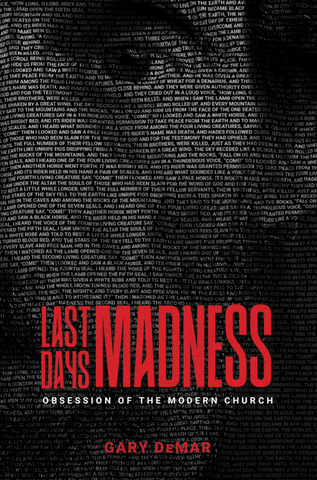
Last Days Madness
In this authoritative book, Gary DeMar clears the haze of "end-times" fever, shedding light on the most difficult and studied prophetic passages in the Bible, including Daniel 7:13-14; 9:24-27; Matt. 16:27-28; 24-25; Thess. 2; 2 Peter 3:3-13, and clearly explaining a host of other controversial topics.
Buy NowGary interviews his friend Bob Cruickshank about a few recent articles he has written about the “antichrist.” Bob points out that most modern writings and teachings about the “antichrist” almost never use the actual Bible verses where the word appears. What results is a high-tech, science-fiction amalgamation of a figure completely contrary to the actual biblical context.
Click here for today’s episode
Click here to browse all episodes of The Gary DeMar Podcast
[1] Benjamin B. Warfield, “Antichrist,” in Selected Shorter Writings of Benjamin B. Warfield, John E. Meeter, ed. (Nutley, NJ: Presbyterian and Reformed, 1970), 1:360-361.