

In the 1950s, the John C. Winston Company, later to become part of Holt, Rinehart and Winston, published “Adventures in Science Fiction,” a series of juvenile hardcover novels that made up a collection of thirty-six books.
Some of the world’s greatest science fiction writers got their start with the series: Arthur C. Clarke (best known for 2001: A Space Odyssey), Ben Bova, Lester Del Rey, Donald Wollheim, and Poul Anderson. The books originally sold for $2.00. Today, depending on condition, scarcity, and the author, a first edition/first printing with a dust jacket can bring a high price. For example, Ben Bova’s The Star Conquerors is the rarest of all the Winston Juvenile books published. A first edition/first printing copy is offered for sale on several sites for more than $1000. An autographed copy is for sale for $2000.
In addition to the wonderful stories, the books are worth collecting for the cover art. While the books are dated in terms of technology (the use of computers is minimal and email was non-existent), the stories reflect the moral worldview of post-World War II America trying to find its footing. Civil religion was in vogue. In 1954, in response to the Communist threat of the times, President Eisenhower encouraged Congress to add the words “under God” to the original Pledge Allegiance that was written by socialist Francis Bellamy and published in The Youth’s Companion on September 8, 1892. Bellamy’s daughter objected to the addition.
“In God We Trust” and “One Nation Under God” are not indicators of a Christian worldview since most Americans do not trust God, since they generally vote for more government, and the question remains about what God we are under, given the fact that killing unborn babies and redefining what sex and marriage are hardly indicators of being under the God of Scripture.
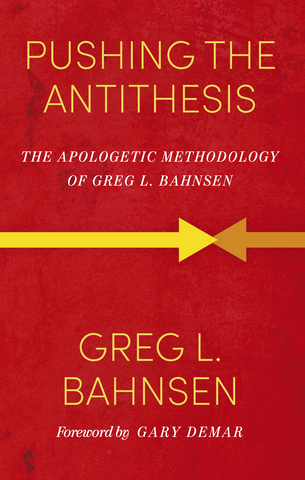
Pushing the Antithesis
Dr. Greg L. Bahnsen believed that to deal with the academics of the day and their arguments against the Christian faith, it is necessary to do battle with them at the highest levels of scholarship using their intellectual tools against them. He could quickly analyze and give direct and compelling answers to all their objections. Prior to his untimely death in 1995, Dr. Bahnsen delivered a series of lectures on apologetics at American Vision's Life Preparation Conference. These lectures have been transcribed and edited with summary points, study questions, and much more in Pushing the Antithesis.
Buy NowA young person reading these books would find a great deal of borrowed capital worldview wisdom sprinkled throughout the 200+ pages of these fascinating science fiction novels like I did. One scene caught my attention in the 1956 novel The Lost Planet by Paul Dallas, a story about how two teenagers try to stop a war between their home planets. The scene takes place just before the teenager from Earth boards a spaceship and travels to the distant planet of Poseida, which is partially underwater.
In a discussion after a Christmas dinner, the topic turns to defending Earth “against an aggression from space,” brought up by General Watkins. He then describes the proper tactic.
As he spoke, the general seemed to become preoccupied with thoughts of the military situation, and he absently deployed salt and pepper shakers with knives and forks on the table, setting up in front of him an imaginary military problem in the field. “It is a basic truism,” he continued, “that wherever possible the best defense is a good offense. Now if we are attacked,” and he brought a piece of silverware in toward the plate that was obviously representing Planet Earth, “not only do we defend the point under immediate attack but,” and here several pieces were quickly moved from the plate Earth to the butter dish from which the attack had originated, “we immediately counterattack at the source of the aggression. After all, if you cut off the head, you have no need to fear the arms.”[1]
Dallas has the General making a crucial point about fighting and winning against an enemy combatant that applies to ideological conflicts. Defending the Christian worldview against unbelieving thought requires understanding that every worldview has a central guiding principle that serves as its foundational operational assumption about the nature of reality.
This means that we must begin where the Bible begins: “In the beginning God…” (Gen. 1:1). God is not a probability argument that we reason to, making us the foundational principle and ultimate authority. God is the operating presupposition from which we reason.
We should never forget that opposing worldviews also have a fixed starting point from which they reason. Such a standing place—a pou sto—is inescapable. The goal is to rock the foundation of opposing worldviews. Instead of blasting away from a battleship by way of particulars, our efforts to undermine unbelieving autonomous thinking are better done by a submarine. Damage the hull, and the ship with all its particulars sinks.
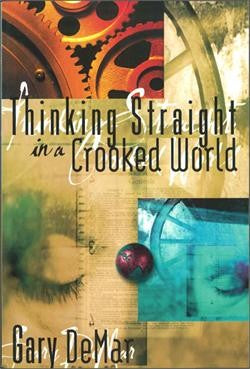
Thinking Straight in a Crooked World
The nursery rhyme "There Was a Crooked Man" is an appropriate description of how sin affects us and our world. We live in a crooked world of ideas evaluated by crooked people. Left to our crooked nature, we can never fully understand what God has planned for us and His world. God has not left us without a corrective solution. He has given us a reliable reference point in the Bible so we can identify the crookedness and straighten it.
Buy NowNumerous starting points are put forward as the foundational basis for unbelieving thought. Here’s a sample of some of them:
• Rationalism: reason rules
• Mysticism: unknown forces rule
• Hedonism: pleasure rules
• Relativism: we get to make up our own rules
• Post-modernism: there are no rules
• Pragmatism: it’s a rule only if it works
• Materialism: only matter matters
• Monism: all is one so there is nothing to argue about
And if specific philosophical systems like the above are not enough to establish an authoritative starting point, then there is the appeal to any number of self-proclaimed or institutionally sanctioned experts: a brilliant college professor, the writings of a Zen Master, the directives of a cult leader, the latest scientific studies, the writings or revelations of self-appointed religious leaders, statistical analysis, opinion polls, the Constitution of the United States, psychics, fortune tellers, frequently quoted philosophers, newspaper and magazine editors, judges, television news anchors, Oprah, the high-minded opinions of Hollywood actors, or even alien life forms.
Even some atheists hope against hope that someone (other than a personal God) is “out there” to give meaning to the cosmos. Abandoning pure materialism, some are proposing that “an invisible force is at work” in the ever-evolving universe.[2] The materialists have become mystics. Maybe it’s from watching too much Star Wars. Of course, when the ever-changing worldviews of a splintered secularism fail to live up to their claims of ultimacy, the university is quick to shut out competitive debate. Speech codes abound. Contrary opinions are suppressed. Outside speakers are hooted off the stage if they ever make it on campus in the first place. The entrenched university worldview—no matter how discredited—must be protected at all costs, even though it’s a philosophical house of cards.
So-called experts, no matter what their field of study or how much information they gather, are finite in knowledge and fallible in practice. Put simply, they don’t know everything, and they make mistakes. For every group of experts who claim to know something authoritatively, there are always other groups of experts who claim they can dispute the findings of the first group of experts. The Bible describes it this way: “The first to plead his case seems just, until another comes and examines him” (Pr. 18:17).
Christopher Cerf and Victor Navasky, after compiling thousands of expert opinions and declarations about innumerable subjects over thousands of years, summarize their findings:
Our research has yielded (and we have systematically catalogued and footnoted for the first time) thousands of examples of expert misinformation, disinformation, misunderstanding, miscalculation, egregious prognostication, boo-boos, and occasional just plain lies. And based on our preliminary findings we can say with some confidence that the experts are wrong without regard to race, creed, color, sex discipline, specialty, country, culture, or century. They are wrong about facts, and they are wrong about theories, they are wrong about dates, they are wrong about geography, they are wrong about the future, they are wrong about the past, and at best they are misleading about the present, not to mention next week.[3]
In brief, “Just because most of the authorities in a field are shouting in unison that they know the truth, it ain’t necessarily so.”[4]
[1] Paul Dallas, The Lost Planet (Philadelphia, PA: The John C. Winston Company, 1956), 2–3.
[2] Charles W. Petit, “From big bang to big bounce,” U.S. News & World Report (May 6, 2002), 59.
[3] Christopher Cerf and Victor Navasky, “Introduction to the Original (1984) Version,” The Experts Speak: The Definitive Compendium of Authoritative Misinformation, rev. ed. (New York: Villard, [1984] 1998), xxvii.
[4] William R. Fix, The Bone Peddlers: Selling Evolution (New York: Macmillan, 1984), xix.