
Gary revisits one of his favorite topics: movies! Rick Welch invited Gary back to his Burros of Berea podcast a few weeks ago to discuss more Christmas films.
Many Christians seem to believe that thinking is an act of unbelief. They do not even begin to understand how the Bible might apply, for example, to science, economics, politics, law, or education. They might have opinions about these topics but no formulated, thought-out biblical worldview. Their opinions are not rooted in any biblical framework of thinking. The same is true when abstract philosophical concepts are brought up for discussion. It just doesn’t seem to be “spiritual” to discuss philosophy, even though the word means “the love of wisdom.” And as any student of the Bible knows, wisdom is a prized possession (Prov. 2:2; 3:13). The Bible objects to a “philosophy” that is based upon “the traditions of men” (Col. 2:8). The Christian’s faith does not rest on “the wisdom of men” (1 Cor. 2:4) or “the appearance of wisdom in self-made religion” (Col. 2:23). There are two types of wisdom: wisdom that is “from above” (James 3:13, 17) and that which is “earthly, natural, and demonic” (3:15). The Christian should develop a biblical philosophy, a love for wisdom that acknowledges that God is the source of all true knowledge.
Engaging the Mind
The mind is like the body. When it isn’t pushed into service, it does as little as possible to function. But when concentrated critical thinking is demanded, an untrained, atrophied mind behaves like an out-of-shape body—it falters under the demands of rigorous mental activity. Getting the mind into mental shape is no less difficult than getting the body into top physical condition. Progress is slow and often imperceptible. Incremental change is not very rewarding, but it’s the only way to achieve long-term success. Building a “renewed mind” will take time and discipline, but the rewards will be worth it. The best place to start is at the beginning. The Bible tells us that “because of practice” our senses will be “trained to discern good and evil” (Heb. 5:14). Such training will help us to distinguish straight thinking from twisted thinking.
Four Foundation Stones
Worldviews are constructed like houses. A foundation must first be laid before the walls can go up. Four of the most basic foundation stones are principles dealing with material reality (physics), questions touching on the different types of things that exist (metaphysics), how we attain knowledge (epistemology), and ways in which right and wrong are determined (ethics). Every worldview, whether theistic or atheistic or any variety of the two, includes these four components. They are necessarily interrelated. Discussions of everything from the origin of man to what happens after death must take place within these four realms.
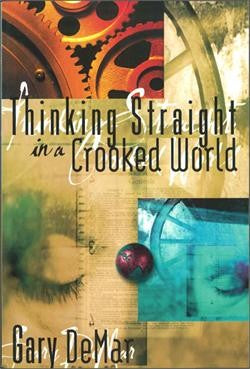
Thinking Straight in a Crooked World
The nursery rhyme "There Was a Crooked Man" is an appropriate description of how sin affects us and our world. We live in a crooked world of ideas evaluated by crooked people. Left to our crooked nature, we can never fully understand what God has planned for us and His world. God has not left us without a corrective solution. He has given us a reliable reference point in the Bible so we can identify the crookedness and straighten it. Gary DeMar shows the power of biblical thinking and the desperate need for it in the church today. Thinking Straight in a Crooked World is designed to identify the bends in the road of ideas and repair them with biblical, straight thinking.
Buy NowGary revisits one of his favorite topics: movies! Rick Welch invited Gary back to his Burros of Berea podcast to discuss Christmas films and the two discuss many festive movies that might be unfamiliar to most listeners. Gary loves older movies from the Golden Age of Film and highlights and analyzes some of his favorites.