

Gary discusses recent comments from some leftists about “taxing rich people”—like Jeff Bezos and Elon Musk—at a higher rate.
The Bible is the standard for every aspect of life. It tells us a great deal about economics. And it tells us that God’s law alone is the standard of right and wrong, of justice and injustice. We might therefore expect that the Bible would have much to say about how to discern exactly when a profit rises above a “fair” level. But it does not. From this fact there are two possible conclusions. Either God was waiting for Marx or [Ronald] Sider to come along and do it for Him, or there is no such thing as an unjust profit. For the remainder of this chapter, I am assuming that the latter option is correct.
The issue of profits centers on the problem of production. How does the entrepreneur know where to channel investments? Or, to put it another way, How can the wants of consumers be satisfied? The entrepreneur attempts to anticipate and meet constantly changing future consumer demands by directing the various factors of production in such a way as to make them provide what the people want in the most efficient and profitable way. If he fails to forecast the market correctly, he will suffer losses. If his decision is correct, he will make a profit. The profit is the tangible sign of success in serving consumer wants. A large profit means the entrepreneur has been very successful. He has not wasted resources, which are now released to the market to serve other consumer preferences.
It is commonly assumed that profits are arbitrary—that the entrepreneur says, “Well, let’s see. Costs of production amounted to such-and-such; I will add on a profit of X percent and make a lot of money.” But the entrepreneur cannot control demand. If the demand for his product is low, he will suffer losses. The entrepreneur does not “set” a profit. He does not know the future. The price (and hence the profit) will be determined by consumer demand in relation to the supply. If many consumers want the product, they will bid up the price in order to get the product. The profit comes from consumers who outbid other consumers in competition for it. The fact that profits are high means that many consumers are bidding, and this means that the entrepreneur has correctly discerned their needs. He makes a profit in direct relationship to how well he has satisfied their desires. Remember this law: consumers compete against consumers, while sellers compete against sellers. It follows that the man who makes the highest profit is the man who is best serving the public.
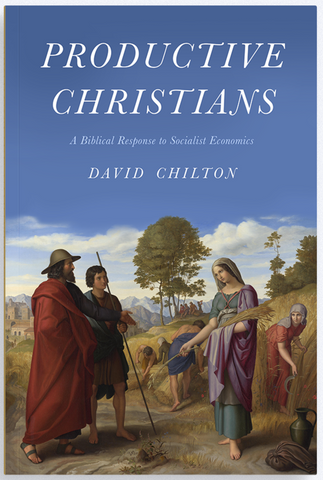
Productive Christians in an Age of Guilt Manipulators
Socialism has a perennial appeal, and Christians seem to be particularly susceptible to its allure. The modern evangelical resurgence of interest in social justice, critical race theory, gender equity, and woke idealism are clear evidence of this. But, for all its aspirations for justice, equality, and fairness, the rhetoric of socialism is typically marked only by high sounding moralisms stuffed with cliché, guilt, pity, bluster, and resentment. What is worse is that history demonstrates that this rhetoric has had disastrous results whenever it has been translated into economic or political policy. Socialism has proven itself to be the sort of ideology that could produce a shortage of salt water in the Pacific.
Buy NowGary discusses recent comments from some leftists about “taxing rich people”—like Jeff Bezos and Elon Musk—at a higher rate. This is such an illogical idea, for many reasons, as Gary makes clear. People rarely think beyond their own situation and are driven by envy to “get those rich people.”