

Bible Prophecy Under the Microscope-Episode 106
Gary begins a response to an individual who says he left partial preterism for dispensationalism.
What did the church in Philadelphia think Jesus meant when He told them, “I am coming soon [ταχύς]; hold fast what you have, so that no one will take your crown”? (Rev. 3:11) Who is Jesus addressing? A local church in Asia Minor. He told them to “hold fast.” It was their “crown” that was in jeopardy of being taken. A passage like this has meaning for every generation, but we don’t know how to apply it until we determine what it meant to the people to whom it was first written, something that would happen “soon” for them.
With these numerous proximate time indicators in the book of Revelation and the rest of the New Testament, how is it possible to believe they mean something different from their obvious meaning when compared to how they are used elsewhere in the New Testament? Brock Hollett’s answer is something he calls the “Prophetic Perspective” where two mountain ranges look to be near but in reality there’s a valley of great distance between them. There’s nothing in the text that intimates that this is the process by which these events are to be interpreted. Where does this type of speculation end?
The Great Tribulation mentioned by Jesus in Matthew 24:21 happened before the generation to whom He spoke passed away. He was not speaking about a near and far fulfillment since the use of “this” in “this generation” (24:34) refers to what’s near. John said that he was a “fellow partaker in the tribulation and kingdom” (Rev. 1:9; also 2:22; 7:14), a kingdom that John the Baptist said was “near”: “The time is fulfilled, and the kingdom of God has come near; repent and believe in the gospel” (Mark 1:15; also Gal. 4:4; Eph. 1:10; 1 Tim. 2:6; Titus 1:3). John the Baptist said the following to the Pharisees and Sadducees: “You brood of vipers, who warned you to flee from the wrath to come? [μελλούσης/about to come]” (Matt. 3:7). This was not a wrath in the distant future. It was a wrath on their generational horizon (1 Thess. 1:10; 2:13–16), a wrath that could be avoided (1 Thess. 5:9).
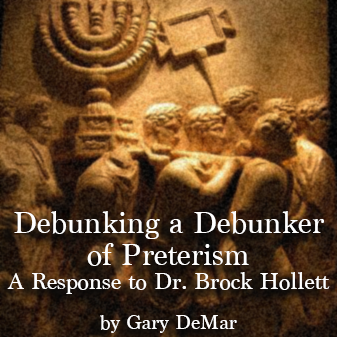
Debunking a Debunker of Preterism
Former preterist Brock Hollett wrote a book titled Debunking Preterism. In it he claims that God spoke to his heart one night, and he repented of his preterism. He wrote Debunking Preterism to set forth what he claims is a "proper biblical eschatology." In his brief 50-page response to Dr. Hollett's book, Gary DeMar shows that nothing in Debunking Preterism is new, novel, or even proper eschatology. Dr. Hollett, like most futurists, looks for ways to ignore the time statements and impending-judgment language in what the Bible says will "soon" befall Jerusalem in the first century.
Buy NowGary begins a response to an individual who says he left partial preterism for dispensationalism. Gary rehearses his own path to preterism and how the Bible is what led him there. Reading the NT in the context of the OT, in addition to the historical context of first century Israel in subjection to Rome (not to mention the traditions of the Judaizers), has to be taken into account when reading the letters of the NT and the four Gospels.
Click here for today’s episode
Click here for all episodes of Bible Prophecy Under the Microscope