
Bible Prophecy Under the Microscope-Episode 114
Gary addresses misconceptions about preterism, replacement theology, and the future of Israel, emphasizing biblical exegesis and historical context.
Joel McDurmon’s work is original. He goes where few commentators have gone before. As he shows in page after page of tightly argued points, there is a unity to the prophetic message of the gospels and the rest of the New Testament. It’s about new wine in new wine skins. Everything about the old covenant was planned obsolescence. Jesus was always in view, from the first promise of a savior in Genesis 3:15 to the revelation that “the testimony of Jesus is the spirit of prophecy” in Revelation 19:10.
So much of modern-day prophecy commentary is an attempt to rebuild what was never meant to be rebuilt. The Jews who met Jesus face to face should have known this from everything their Scriptures had told them about the coming redeemer (Luke 24:27, 44). Instead, like today, there is said to be significance in a new stone temple, a revitalization of a strip of land, and the division of the people of God, one chosen because of blood ties (John 1:13; 8:33) and the other by adoption (Rom. 8:14-16). The parables, as Joel makes abundantly clear, serve to show that the breaking down of the dividing wall was on the horizon for them and the world with the result that there would be “one new man” in Christ (Eph. 2:11-22). The destruction of Jerusalem and the dismantling of the temple’s stones were a foregone conclusion because Jesus had always been the reality over the shadow (John 2:19). (from the Foreword by Gary DeMar)
[In this book] I have also not consulted commentaries or other men’s interpretations except in a few rare circumstances. I realize this opens me to the criticism that I should have consulted the wisdom of other scholars, but of course had I filled the book with footnotes and references to the works of other men, I would then be liable to the charge that I should have stuck to the pure words of Scripture. I think the honest and charitable reader will see that this latter is what I have done. It was my goal to look purely to the words of Scripture in the original texts, studied in their verse-by-verse context, in order to understand what Jesus meant throughout these sections of Scripture. Perhaps more than any other field, the study of Bible prophecy suffers from assumptions built on conjectures papered-over with proof texts pulled from context fused with current events and professionally-produced paranoia. There are a few exceptions providing detailed exegesis, and I pray the reader will find this book helpful among those few. (Author’s Preface)
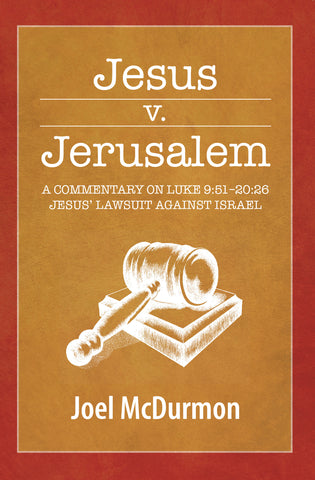
Jesus v. Jerusalem: Jesus' Lawsuit Against Israel
Most people don’t realize that many, if not most, of Jesus’ parables were intended not as general morality tales, but as particular pronouncements of coming judgment and change. Jesus was warning Jerusalem to repent and to accept its new King (Jesus), or else fall under the ultimate condemnation of God. In fact, much of Jesus’ teaching in the Gospels pertains primarily to that pre-AD 70 crowd, and without reading it in this light, we misunderstand it. And when we misunderstand it, we misapply it.
Buy NowGary addresses misconceptions about preterism, replacement theology, and the future of Israel, emphasizing biblical exegesis and historical context. He refutes charges of antisemitism and clarifies the biblical portrayal of Jerusalem and Israel’s role in prophecy.