
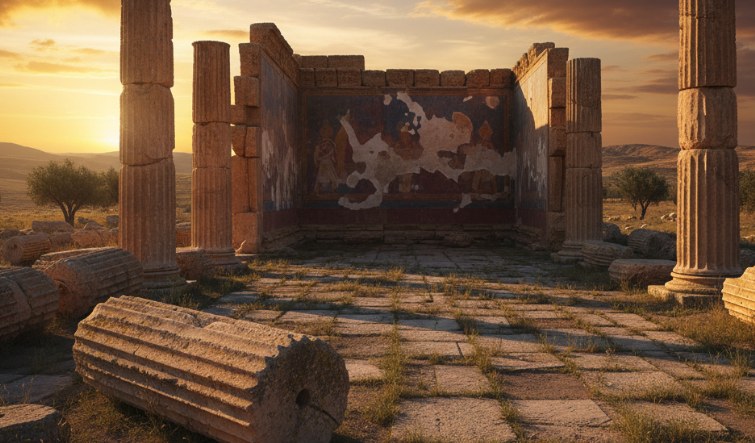
“Therefore, when you see the ABOMINATION OF DESOLATION which was spoken of through Daniel the prophet, standing in the holy place—let the reader understand—” (Matthew 24:15).
“When you see the abomination of desolation standing in the holy place.”
Joel Richardson claims that Matthew 24:15 has not been fulfilled. The temple was still standing when Jesus issued this dire prediction. To be fulfilled sometime in the future (our future) requires another rebuilt temple. The NT never mentions that the temple would be built again. Not a single verse. This point alone negates Richardson’s future abomination of desolation belief.
The goal in interpreting the Bible is to be familiar with a text and its context. The Bible can be made to say anything if verses are separated from their context and strung together with other verses separated from their context:
• “Judas went out and hanged himself” (Matt. 27:5).
• “Go and do likewise” (Luke 10:37).
• “Whatever you do, do quickly” (John 13:27).
• Because “there is no God” (Ps. 14:1).
Myths. Lies, and Half-Truths
In order to demonstrate the validity of Christianity as a religion for all of life, it is necessary to demythologize the misrepresentations that have been nurtured by a bewildering number of unorthodox theologies. These “cherished myths” have had the effect of neutralizing the Word of God as it relates to this world. Christianity has often been accused of being too “otherworldly” in that it has failed to offer viable political, economic, judicial, and social programs for the world order.
Buy NowJoel Richardson does this repeatedly in every podcast I’ve seen of his.
First: Audience Relevance
The solution to the “when” of the abomination of desolation, is asking, To whom is Jesus speaking? Who were the plural “you”? Jesus made it clear that the “you” were the people who asked the question. “When will these things be?” (Matt. 24:3). They were the audience. They were the “you.” It’s so obvious that a person must make up stuff to get around this fact. It’s indisputable that abomination of desolation was a first-century event.
How would those who first heard what Jesus said have interpreted “you”? If you were in that audience, and heard what Jesus said, what would you have thought? If Jesus had a distant future audience in view, He would have said “when they see the abomination of desolation.” But He did not. The “you” was them. This point alone should end the debate.
Second: The Historical Setting
What comes before 24:15?
Wars and rumors of wars. There were wars and rumors of wars before that generation passed away. Look at the historical record of that time.Earthquakes are mentioned in Acts 16:25-28 and in the historical record of that time.A famine is mentioned in Acts 11:28 and in the historical record at that time.False prophets (1 John 4:1).The gospel going to the whole *oikoumenē*. The gospel has been preached to all the nations at that time, “being proclaimed throughout the whole world” (Rom. 1:8; 10:18-21; 16:25-26; 1 Tim. 3:16; Col. 1:6, 23).I cover all these points in my books ***[Wars and Rumors of Wars](https://store.americanvision.org/products/wars-and-rumors-of-wars)*** and ***[Last Days Madness](https://store.americanvision.org/products/last-days-madness)***. John Bray also deals with them in his book ***[Matthew 24 Fulfilled](https://store.americanvision.org/products/matthew-24-fulfilled)***.
What comes after?
Homes with flat roofs. When’s the last time you were on your roof? Flat roofs were common in Israel in Jesus’ day (Mark 2:4).The importance of cloaks. “The man working in the field is not to bother going back for anything, not even his cloak. The cloak is the one thing that is so precious and needful that it cannot be taken as a pledge during the nighttime hours but has to be returned each night to its owner (Ex. 22:26-27).” Why would anyone today go back for his or her cloak?Sabbath still operating. Where? Mostly in Israel and places like New York City like the [Eruv](https://en.wikipedia.org/wiki/Eruv). A Sabbath day’s journey was still in use in the first century (Acts 1:12).Escape on foot to the mountains outside Judea. It was a local judgment, not a worldwide event.
We know the temple was destroyed just like Jesus said it would be (Matt. 24:2) before their generation passed away (v. 34), a fact that is attested by history that no one disputes. “‘Do you not see all these things? Truly I say to you, not one stone here shall be left upon another, which will not be torn down’” (24:2). Jesus was discussing what stood right before their eyes; the temple that was “there.” Their question was prompted by what Jesus said in Matthew 23:38: “Your house will be left to you desolate.” That’s why Jesus’ disciple asked about the temple. “You mean this temple that is being rebuilt greater than its former glory? (Luke 21:5)
Richardson then drags the antichrist into the context: “what the antichrist will do in the last days,” he says. There is no mention of “the antichrist” in Matthew 24, and that includes verse 15 unless the apostate priesthood were the antichrists as defined by John (1 John 3:18, 22; 4:1-3; 2 John 7). Again, there is no mention of a rebuilt temple, something that’s required for Richardson’s interpretation to work. The NT only mentions the destruction of the temple before their generation passed away (v. 34), never its rebuilding.
Richardson mentions R.C. Sproul, Kenneth Gentry, and me in his podcast about the abomination of desolation. Here’s what Richardson says about Sproul and Gentry.
Sproul wrote the following in his book The Last Days According to Jesus, “The Roman armies brought their standards into the temple area…. These standards were objects of idolatrous worship and thus constituted the abomination of desolation.” Kenneth Gentry wrote something similar: “The Roman armies with their idolatrous standards stand in the holy place fulfilling the abomination of desolation.”
Richardson does not mention my comments on the subject, even though I include 15 pages on the topic in chapter 8 of my book Last Days Madness. I do not agree with Sproul and Gentry, and neither does preterist James Jordan in his commentary, Matthew 23-25: A Literary, Historical, and Theological Commentary: “But there is absolutely no way that the phrase ‘abomination of desolation’ can refer to a gathering of armies. More likely, Luke’s account is speaking of the gathering of Roman armies a few years after the abomination of desolation was set up.”
Matthew 23-25: A Literary, Historical, and Theological Commentary
Those who first read Matthew’s gospel only would have had as an interpretive reference what we describe as the Old Testament. They were living the history that Jesus said would take place before their generation passed away. They would have immediately noted the Old Testament parallels with the abomination of desolation (Matt. 24:15; Dan. 9:27), the judgment on Sodom and fleeing to the mountains to escape the coming conflagration (Matt. 24:16; Gen. 19:17), false prophets (Matt. 24:24; Jer. 14:14), signs in the sun, moon, and stars (Matt. 24:29; Isa. 3:10; 24:33; Ezek. 32:7; Amos 5:2; 8:9; etc.), the Son of Man coming on the clouds of heaven (Matt. 24:30; Dan. 7:13), and so much more.
Buy NowRichardson needs to do more research if he’s going to be faithful critic of what he claims preterists believe.
Why would God destroy the temple for something the Roman armies did? The abomination that resulted in desolation must have been something those who had access to the Holy of Holies did. That would have been the priesthood. Any sacrifice that was done by the priests would have been an abomination. James Jordan’s four-part article on the Abomination of Desolation also includes an exposition of Daniel 9:24-27 that Jesus references in Matthew 24:15. Here’s what Jordan says about Daniel 11:31.
[W]e need to ask who were the “forces from him” that desecrated the sanctuary and set up the desolating sacrilege? They were the reigning High Priests Jason and Menelaus, who apostatized to Greek religion, and who invited Antiochus to help them take over Jerusalem for their purposes (Josephus, Antiquities 12:5:1). In the same way, the apostate High Priests between A.D. 30 and 70 cooperated with the Romans to suppress the Christian faith and to maintain their own Sadducean combination of Greek philosophy and apostate Judaism…. Antiochus defiled the Temple, but this is only the aftermath of what the Jews had already done. Antiochus could not really defile the Temple, because he was not one of God’s peculiar people and he had no legal access to it. His defiling the temple is not the abomination of desolation, therefore.
Jordan’s article is superb. Joel Richardson should take some time off from his highly inaccurate podcasts and read it.
What took place in the lead up to the destruction of the temple had happened when the priests committed the “desolating sacrilege,” beginning in Ezekiel 8:5-18 and continues through chapter 11. I believe that’s why Jesus said, “let the reader understand” in Matthew 24:15. Jewish readers in Jesus’ day would have understood. “We’ve heard this language before.” It had happened before, and it wasn’t Nebuchadnezzar; it was the priesthood. There’s was more going on than the Roman armies or an end-time antichrist which the New Testament never mentions. The abomination was local and came from the priesthood. Read Matthew 23. It’s all there. That’s why Jesus described Jerusalem as Sodom and Egypt in Revelation 11:8.
Jordan succinctly explains who brought the abomination that resulted in the desolation of the temple: “As a result of my studies in Leviticus, I have come to the conclusion that the abomination of desolation spoken of in Daniel 9 and Matthew 24 is none other than apostate Judaism, and that the Man of Sin spoken of in 2 Thessalonians 2 is the apostate High Priest of Israel.”