

Gary discusses the decline of the evangelical vote in recent elections, exploring the reasons behind this trend and the implications for Christian political engagement.
If Jesus’ kingdom is “not of this world,” so the argument goes, then how can Christians claim to have a responsibility to be involved in kingdom work? Since God’s kingdom is exclusively in the future and in heaven, as some assert, there can be no earthly manifestation of God’s works other than redeeming the lost out of this world for heaven. God’s kingdom has nothing to do with this world until He personally reigns on this earth in the “millennium,” is the refrain of many. There is more to God’s kingdom than an exclusively heavenly reign or even a literal thousand-year rule of Christ on the earth.
Some Christian writers are so extreme in their insistence that God’s kingdom does not touch on earthly things that they are even denying that Jesus’ millennial reign is the kingdom of God. Dave Hunt, a proponent of an any-moment rapture, wrote that “the millennial reign of Christ, far from being the kingdom, is actually the final proof of the incorrigible nature of the human heart.”[1] Hunt later retracted this statement,[2] but his further writings on the same subject leave a clear impression: No aspect of God’s kingdom can manifest itself in a world where sinners still have bodies of flesh and blood.
While [the kingdom] does have an earthly manifestation during the millennium, the kingdom will not be realized in its eternal fullness—which “flesh and blood cannot inherit” (1 Corinthians 15:50)—except in the new indestructible and incorruptible universe that will be created after the present one is destroyed.[3]
Dave Hunt and others appeal to John 18:36 (“My kingdom is not of this world”) to establish that the kingdom is essentially (exclusively?) heavenly.[4] David Wilkerson quotes this passage favorably and adds, “That settles it for me, as it should for all believers who tremble at His Word.”[5] We must, as Wilkerson says, take Jesus’ words with the utmost seriousness and veracity. The question is, what does Jesus’ statement mean? What is settled by a recitation of a single verse? Satan knew the Bible as well as anyone. He was quick to quote it when it suited him. Of course, his favorite tactic was to quote it out of context to support his twisted worldview. The Bible is not a series of incantations that can be repeated to bring about miraculous results. The Bible was written in book and letter form. The context of every sentence is important.
What does Jesus mean when He tells Pilate that His kingdom is not of this world? Does He mean that His kingdom is like the invisible ether that scientists a century ago believed pervaded outer space? Does He mean that His kingdom has no effect on the course of history? Quoting the verse without explanation does little to enhance our understanding of the exchange of words between the prosecutor and the accused. A man on trial for murder who said in a police statement, “Yes, I killed the man,” is not necessarily guilty of murder no matter how many times the prosecutor repeats the words back to the accused. Who did he kill and why? Was it in self-defense?
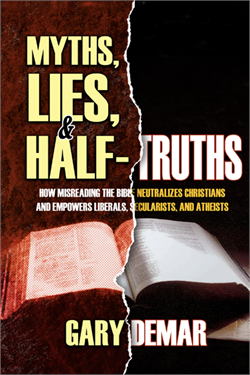
Myths, Lies, and Half-Truths
Like the Bereans of Paul’s day (Acts 17:11), Christians should check the veracity of all opinions against the only reliable standard of authority that God has placed in our hands: the Bible. This may mean a change in belief systems for some. There is no novelty in this. God confronted Peter directly about the inclusion of Gentiles into the household of faith (10:9–16). Paul confronted Peter “to his face” on a similar matter (Gal. 2:11–14). There are times when we all need to be knocked off our horse of mistaken opinions (Acts 9:4). “Testing” is a biblical mandate (2 Cor. 13:5; 1 John 4:1).
Buy NowGary discusses the decline of the evangelical vote in recent elections, exploring the reasons behind this trend and the implications for Christian political engagement. He also delves into the historical context of Christian involvement in politics, the role of government in wealth redistribution, and the responsibilities of Christians in shaping political discourse.
[1] From a taped interview with Peter Lalonde and Dave Hunt, “Dominion and the Cross,” Tape #2 of Dominion: The Word and New World Order, distributed by the Omega-Letter, Ontario, Canada, 1987. Emphasis added. There is a similar quotation in Dave Hunt, Beyond Seduction: A Return to Biblical Christianity (Eugene, OR: Harvest House, 1987), 250.
[2] In a letter to me (January 16, 1988), Hunt writes to clarify his position: “It is true that you have found a quote or two in which I was careless with my language.” In this same letter, Hunt states that the future earthly millennium is “the temporary earthly manifestation of God’s kingdom promised to Israel that becomes the final proof of the incorrigible nature of the human heart.”
[3] Dave Hunt, Whatever Happened to Heaven? (Eugene, OR: Harvest House, 1988), 255.
[4] Dave Hunt and T. A. McMahon, The Seduction of Christianity (Eugene, OR: Harvest House, 1985), 224.
[5] David Wilkerson, “The Laodicean Lie!,” fourth page. Published by World Challenge, P.O. Box 260, Lindale, Texas 75771.