

Since John is told the events revealed to him were to take place “soon” (1:1) “for the time is near” (1:3), Revelation is about events that were to happen soon for those living in John’s day, in particular, in events leading up to and including the end of the Old Covenant represented outwardly by the temple and Israel’s capital city, Jerusalem. The Old Covenant was replaced with a better covenant in the person and work of Jesus Christ, who embodies all that the Old Covenant could only represent in temporal (stones) and fallen elements (human priests). Jesus is the lamb of God who takes away the sin of the world (John 1:29), the temple built without hands (John 2:13-22; see Mark 14:58; 15:29; Acts 6:14),[1] the fulfillment of the Davidic kingship (Acts 2:22-36), and “a high priest, who has taken His seat at the right hand of the throne of the Majesty in the heavens, a minister in the sanctuary and in the true tabernacle, which the Lord pitched, not man” (Heb. 8:1-2). The Old Covenant was always planned obsolescence. With the coming of the true tabernacle in the Person and work of Jesus (John 1:14), the Jews should have used it as a museum or torn it down and used its stones for other habitable structures (see Num. 21:8-9; 2 Kings 18:1-7; John 3:14).
There is another component to consider in the interpretive process: audience relevance. How would John’s audience have understood the prophecy? Even today, prophecy preachers turn to the time indicators in Revelation and argue that Jesus is coming soon. But if “soon” means near to the time when we hear a prophecy enthusiast say that Jesus’ coming is “soon,” then why didn’t “soon” mean “soon” to Revelation’s first readers?
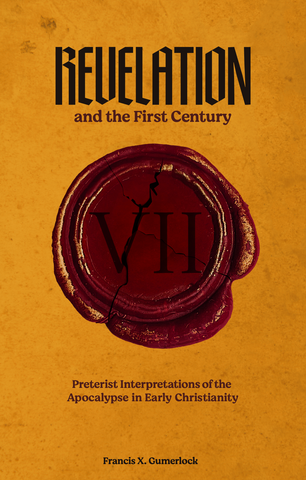
Revelation and the First Century
This book provides selections from ancient and medieval commentaries on the book of Revelation, writings composed long before the seventeenth century. Many of these selections are translated into English here for the first time. All of the selections reflect the fact that some Christians in ancient and medieval times interpreted visions in the book of Revelation in a preterist fashion.
Buy NowDave Hunt’s book How Close Are We? includes the following subtitle: “Compelling Evidence for the Soon Return of Christ?” What did Mr. Hunt want his readers to understand by the word “soon”? He certainly didn’t have nearly 2000 years in the future in mind when he wrote his book in 1993.
On the Brink is the title of a prophetic work written by Daymond R. Duck. In the introduction, Duck states that his book contains “300 Points of Light on the Soon Return of Jesus.”[2] Duck wants his readers to believe that Jesus’ coming will take place soon, and by “soon” he means “near,” and by “near” he means this generation, and by “this generation” he means this one here and now. Why didn’t “soon” and “near” mean “soon” and “near” to those who read these time words in the first century?
Put yourself in the first century, reading or hearing these passages about the soon or near coming of Jesus. Would they have believed that this coming was far off, or would they have thought it was near? They would have thought it was near. How do we know this? Because people today believe Jesus’ coming is near, they read about “near,” “soon,” and “quickly” in the last chapter of Revelation and believe it applies to them!
In 1926, Oswald J. Smith wrote Is the Antichrist at Hand? The following copy appears on the cover:
The fact that this book has run swiftly into a number of large editions bears convincing testimony to its intrinsic worth. There are here portrayed startling indications of the approaching end of the present age from the spheres of demonology, politics and religion. No one can read this book without being impressed with the importance of the momentous days in which we are living.”
Smith identified the antichrist as Benito Mussolini. John Warwick Montgomery writes that after Mussolini’s death in 1945, “Smith himself tried to buy up all the remaining copies of the book to destroy them.”[3]
Chuck Smith published The Soon to be Revealed Antichrist in 1976. Note the date. What did Chuck Smith mean by “soon”? While he said we can’t know who the antichrist is, he did say, “God is giving us many signs that we are nearing the last days — the stage is being set.” Smith also stated that “we are living in the last generation, which began with the rebirth of Israel in 1948 (see Matt. 24:32-34).”[4] We can infer from these comments what Smith meant by “near.”
What did these authors intend for their audience to understand with words like “at hand,” “soon,” and “close”? Does anybody think these books would have sold well if they carried a title like “We Don’t Know When the Antichrist Will be Revealed”? The authors deliberately chose temporal adverbs to keep readers on the edge of their seats, knowing that “soon,” “close,” and “at hand” or “near” mean “soon,” “close,” and “at hand” and “near.”
I wrote Is Jesus Coming Soon? The answer is, Jesus came soon after He told His disciples that He would return within a generation of His earthly ministry based on what He told them in Matthew 24: “This generation will not pass away until all these things take place” (v. 34), and that included His judgment coming (v. 27) and His ascension where He took His seat at His Father’s right hand (v. 30). Chuck Smith appealed to these same passages to persuade his 1976 reading audience that they were “nearing the last days” and “this generation” is their generation. So why didn’t Jesus’ audience interpret these same words and phrases in the same way and apply them to their time? They did, and that’s the point.

Is Jesus Coming Soon?
The date-setting frenzy persists. The prophecy pundits continue to be wrong again and again. How many of these prophecies have failed in your lifetime? Daily on Christian radio and television and the endless stream of prophecy books, we get pumped up with even more "evidence" that Jesus is now "at the door." World events are matched with prophecies as definitive proof that the end is "near." Again, we wait and hope. It's a familiar cycle: time nullifies each prediction, our hopes are deflated, and our trust level smashed. No more! The truth is out!
Buy NowWhile Dave Hunt offered what he believed was “compelling evidence for the soon return of Christ,” he claimed that “the early church believed that Christ could come at any moment.” In a chapter describing what he believed is the New Testament doctrine of “imminency,” Chuck Smith wrote,
From even a cursory reading of the New Testament there can be no doubt that it was considered normal in the early church to expect Christ at any moment. Paul greeted the Christians at Corinth as those who were “waiting for the coming of our Lord Jesus Christ” (1 Corinthians 1:7) — again language that requires imminency. He urged Timothy to “keep this commandment without spot, unrebukable, until the appearing of our Lord Jesus Christ” (1 Timothy 6:14).[5]
What we find missing regarding the issue of timing related to the coming of Jesus is a discussion of verses that deal with the timing of Jesus’ return. The Bible does not state that Jesus can come “at any moment” over several millennia. The New Testament makes it clear that Jesus’ coming was “near,” close at hand, for those living in the first century. Here are some examples:
• “Be patient, therefore, brethren, until the coming of the Lord. Behold, the farmer waits for the precious produce of the soil, being patient about it, until it gets the early and late rains. You too be patient; strengthen your hearts,for the coming of the Lord is at hand. Do not complain, brethren, against one another, that you yourselves may not be judged; behold, the Judge is standing right at the door” (James 5:7-9).
• “The end of all things is at hand; therefore, be of sound judgment and sober spirit for the purpose of prayer” (1 Peter 4:7).
• “The Revelation of Jesus Christ, which God gave Him to show to His bond‑servants, the things which must shortly take place” (Rev. 1:1).
• “Blessed is he who reads and those who hear the words of the prophecy, and heed the things which are written in it; for the time is near” (Rev. 1:3).
• “And he said to me, ‘These words are faithful and true’; and the Lord, the God of the spirits of the prophets, sent His angel to show to his bond‑servants the things which must shortly take place” (Rev. 22:6).
• “And behold, I am coming quickly. Blessed is he who heeds the words of the prophecy of this book” (Rev. 22:7).
• “And he said to me, ‘Do not seal up the words of the prophecy of this book, for the time is near’” (Rev. 22:10).
• “Behold, I am coming quickly, and My reward is with Me, to render to every man according to what he has done” (Rev. 22:12; cf. Matt. 16:27).
• “He who testifies to these things says, ‘Yes, I am coming quickly.’ Amen. Come, Lord Jesus” (Rev. 22:20).
These verses, and others like them, clearly state that Jesus’ return was “near,” that He was coming “quickly.” Dispensationalists like to claim that Jesus could come at “any moment” to “rapture” His church. There is no such doctrine in Scripture. “That James does not expect the period to be long is clear when he says the parousia of the Lord (cf. 5:7) is near.”[6]
In the closing chapter of Revelation John was told, “Do not seal up the words of the prophecy of this book, for the time is near” (Rev. 22:10). The first readers of Revelation would have read words like “soon,” “near,” “quickly,” and “at hand” and most likely would have assumed that the time was near for them. This contrasts with what was told to Daniel hundreds of years before: “But as for you, Daniel, conceal these words and seal up the book until the time of the end; many will go back and forth, and knowledge will increase” (Dan. 12:4; also 8:26, 10:14). A. Berkeley Michelson writes:
Everyone who interprets a passage of the Bible stands in a present time while he examines a document that comes from a past time. He must discover what each statement meant to the original speaker or writer, and to the original hearers or readers, in their own present time.[7]
This is easier said than done, since there is always the temptation to interpret Scripture through our own reference point. We are comfortable with the familiar and not so competent with the way other people write and think.
[1] Notice that the Jews were thinking in literal terms.
[2] Daymond R. Duck, On the Brink: Easy-to-Understand End-Time Bible Prophecy (Lancaster, PA: Starburst Publishers, 1995), 9.
[3] John Warwick Montgomery, “Prophecy, Eschatology, and Apologetics,” Looking into the Future: Evangelical Studies in Eschatology, ed. David W. Baker (Grand Rapids, MI: Baker Academic, 2001), 366.
[4] Chuck Smith, The Soon to be Revealed Antichrist (Costa Mesa, CA: Maranatha House Publishers, 1976), 3.
[5] Dave Hunt, How Close Are We?: Compelling Evidence for the Soon Return of Christ (Eugene, OR: Harvest House, 1993), 248.
[6] Peter Davids, Commentary on James (NIGTC) (Grand Rapids, MI: Eerdmans, 1982), 184.
[7] A. Berkeley Michelsen, Interpreting the Bible (Grand Rapids, MI: Eerdmans, 1985), 55.