
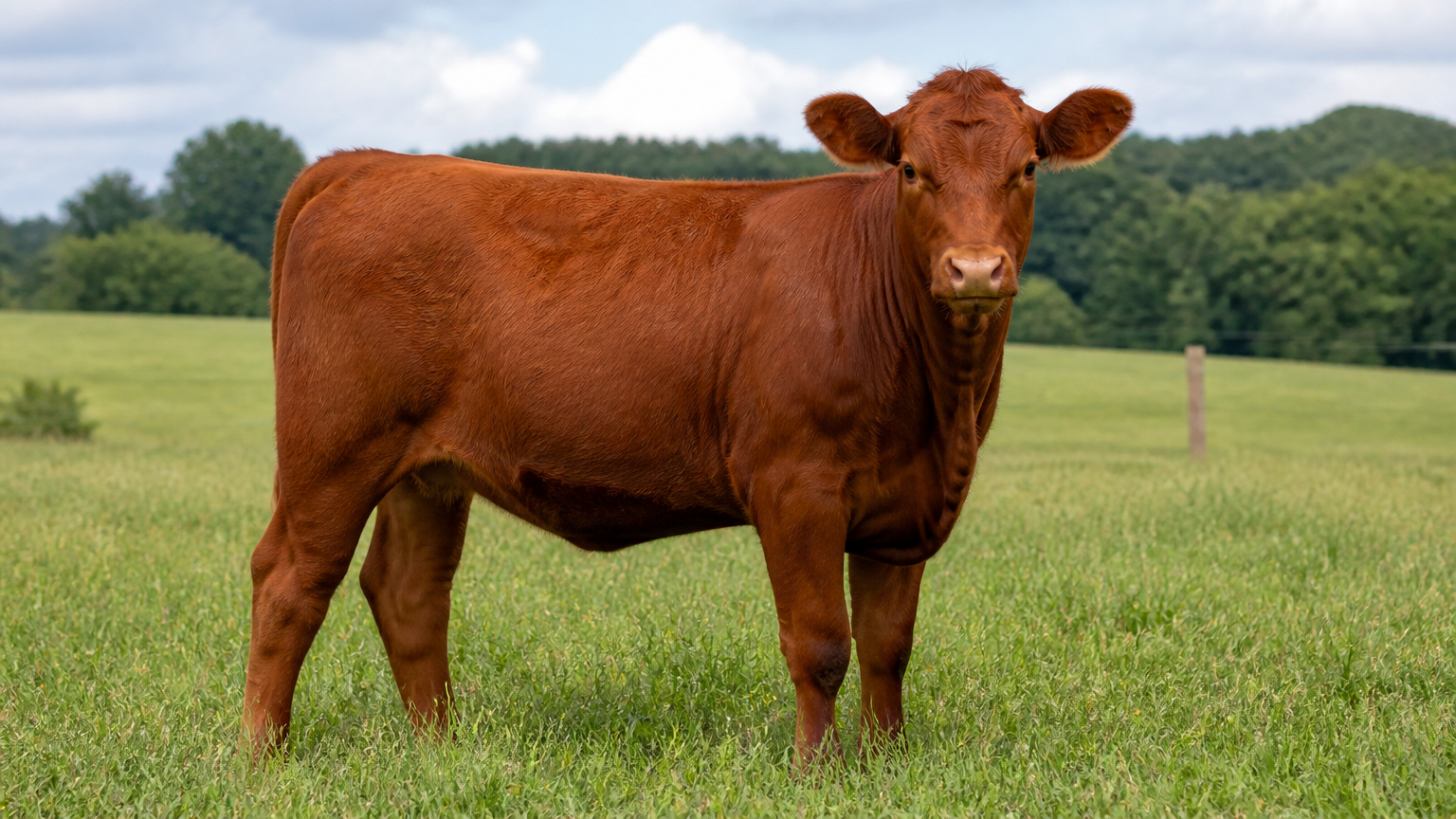
Red heifer stories are in the news. “The delivery of five red heifers to Israel has sparked a worldwide debate about its significance in biblical prophecy, particularly among Christians who believe a third temple will be built during the End Times,”[1] of which the New Testament says nothing. You will search the New Testament with a fine-tooth comb, and you won’t find any mention of another temple being built or the necessity for animal sacrifices to be performed.
The red heifer claim isn’t new. Here’s a story from 2018:
Last week in Jerusalem a baby cow was born. Watch the adorable infant scamper around her mother in a short video released on YouTube by the Temple of Israel, below. Why is this worth your attention? Because—according to some Jewish and Christian scholars—this tiny red calf may be ushering in the end of the world.
The reddish-colored female calf was reportedly born in Israel on August 28 [2018] and is being raised in accordance with the Jewish laws of the Torah, according to the Temple Institute. (CBN)
This is more about Jewish mythology than biblical theology. Even CBN News, a network that is heavily invested in end-time speculation, ended its article on the topic with this comment: “Meanwhile, there’s a verse about that heifer and purification in the New Testament of the Bible, and it’s all about salvation.” The author then quotes Hebrews 9:13-14. The sacrifice of the red heifer is about Jesus, and Jesus is the endpoint of its fulfillment. Christian interest in the red heifer sacrifice is an affront to the finished redemptive work of Jesus Christ.
The Bible details the red heifer in Numbers 19. An “unblemished” red heifer, that is, a cow of a reddish color, with “no defect” that had never worn a yoke, was to be taken outside the camp and sacrificed. Water was added to the ashes and applied to anyone who had contact with a dead body. This sacrifice required a cow, a female, to highlight its life-giving element.
The Hope of Israel and the Nations
The reader and student of the Bible must first understand the content of the New Testament writings in terms of how those in the first century would have understood it. The New Testament is written against the background of the Old Testament. The shadows of the Old were fulfilled in the reality of the New. All the rituals and ceremonies were fulfilled in Jesus. The same is true of the temple, land, blood sacrifices, the nature of redemption, the resurrection of the dead, the breaking down of the dividing wall dividing Jews and Gentiles, and so much more. The New Testament's emphasis is on the finished work of Jesus and its application, not only to that Apostolic generation but to the world today.
Buy NowThese laws point to Jesus and His redemptive work and the end of the Old Covenant that was in full display when Jerusalem was sacked by the Romans in AD 70 and the temple system destroyed. Christian Zionists, mostly of the dispensational type, have teamed up with the Temple Institute in Jerusalem to breed red heifers.
The key American figure in all this is Byron Stinson, a small-scale rancher, trucking company owner and Christian Zionist from Glen Rose, Texas. Beginning in the 2000s, he developed a relationship with Temple Institute members during regular visits to Israel, and eagerly offered up his network of evangelical ranchers, who possessed mighty herds of red-haired Angus cattle that are unknown in the Middle East due to the climate. (Source)
There are other elements involved in the sacrifice, but nothing is said about the red heifer being a prophecy of the return of the Messiah. The sacrifice of the red heifer, like all the animal sacrifices, pointed to Jesus as their fulfillment. It’s not a prophecy; it’s a “type of Christ” with Jesus as the “antitype,” the fulfillment. As Jesus said during his crucifixion—hanging on a tree (Deut. 21:22-23; Acts 5:30; Gal. 3:13)—“It is finished” (John 19:28-30).
Here’s the important part of how the sacrifice of the red heifer points to Jesus: It is the only sacrifice that took place “outside the camp” (Num. 19:3, 9). Like the red heifer, Jesus was slain “outside the gate” (Heb. 13:12), that is, “outside the camp” (13:13).
They took Jesus, therefore, and He went out, bearing His own cross, to the place called the Place of a Skull, which is called in Hebrew, Golgotha (John 19:17).
Consider how the book of Hebrews relates all animal sacrifices, including that of the red heifer, to the finished work of Jesus as the Messiah:
For if the blood of goats and bulls and the ashes of a heifer sprinkling those who have been defiled sanctify for the cleansing of the flesh, how much more will the blood of Christ, who through the eternal Spirit offered Himself without blemish to God, cleanse your conscience from dead works to serve the living God? For this reason, He is the mediator of a new covenant, so that, since a death has taken place for the redemption of the transgressions that were committed under the first covenant, those who have been called may receive the promise of the eternal inheritance (Heb. 9:13-15).
The Bible couldn’t be clearer. Jesus is the fulfillment of the red heifer sacrifice. In fact, all the Old Covenant was in anticipation of Jesus as He Himself stated:
• Then beginning with Moses and with all the prophets, [Jesus] explained to them the things concerning Himself in all the Scriptures” (Luke 24:27).
• Now Jesus said to them, “These are My words which I spoke to you while I was still with you, that all things which are written about Me in the Law of Moses and the Prophets and the Psalms must be fulfilled” (Luke 24:44; cp. 21:22).
Notice that all sacrificial animals were to be “unblemished” and “without defect.” This requirement is not unique to the red heifer sacrifice:
Whatever has a defect, you shall not offer, for it will not be accepted for you. When a man offers a sacrifice of peace offerings to the Lord to fulfill a special vow or for a freewill offering, of the herd or of the flock, it must be perfect to be accepted; there shall be no defect in it (Lev. 22:20-21; also, Deut. 15:21; 17:1; Mal. 1:8, 14; Heb. 9:14; 1 Pet. 1:19).
Like so much of rabbinic oral tradition (Mark 7:1-13), several additional requirements have been added to the red heifer biblical inspection:
• The heifer must be three years old and perfect in its redness. Even its hooves must be red.
• The presence of even two hairs of any other color will render it invalid.
These requirements are not found in Numbers 19. They have been passed down via oral tradition.
There’s a legend that only “nine red heifers had been slain between the time of Moses and the destruction of the Temple” in AD 70.[2] It’s a legend. What many people don’t know is that today’s red heifer breeding is artificial, “using imported frozen embryos of red Angus cows implanted into … domestic cows.” This artificial procedure negates the entire sacrificial history of Israel before the coming of Jesus as the Messiah. The red heifer sacrifice was common in Israel, as were other sacrifices that required the same level of scrutiny.
Given the fact that Jesus is the fulfillment of all the sacrifices required under the Old Covenant, there is no need for a red heifer sacrifice today. For any Christian to suggest that there is significance to a red heifer today is to deny the “it is finished” (John 19:30) sacrifice of Jesus and the purpose of the book of Hebrews. Jews who want to revive the red heifer ordinance are no different from Jews who rejected Jesus as the once-for-all sacrifice fulfillment of all the types under the Old Covenant.
What about the argument that the red heifer sacrifice is to be “a lasting ordinance both for the Israelites and for the aliens living among them” and “a perpetual statute”? (Num. 19:10, 21). It’s obvious that it hasn’t been for nearly 2000 years. That’s because the perpetuity of the red heifer sacrifice (like all the sacrifices) was fulfilled in Jesus, as the book of Hebrews states.
The Greatest and the Least
Without John the Baptist, there is no Jesus. Without the voice in the wilderness, there is no voice from heaven: “This is my beloved Son in whom I am well-pleased” (Matthew 3:17). John was the transitional figure providing a clear path and a smooth road from the covenant with Adam to the new covenant with the Second Adam. As the final and greatest prophet of the Old Testament, John embodied and fulfilled the very purpose of the Law: revealing Jesus as the Bringer of God’s Kingdom.
Buy Now[1] Michael Foust, “Red Heifers Arrive in Israel: Is it a Signal of the 3rd Temple, End Times?,” Christian Headlines (September 19, 2022).
[2] Cambridge Bible for Schools and Colleges.