

Each Columbus Day (or is it now ‘Indigenous Peoples’ Day’ commemorating the bloodlust of the Aztecs and Incas?), Christopher Columbus is hammered for his voyages of exploitation of native peoples. See the first chapter in Mary Grabar’s Debunking Howard Zinn: Exposing the Fake History That Turned a Generation Against America and Jeff Fynn-Paul’s Not Stolen: The Truth About European Colonialism in the New World. In the 1997 film Good Will Hunting, Matt Damon’s character recommends Zinn’s book A People’s History of the United States as a “real history book” that will “knock you on your ass,” contrasting it with traditional academic texts.
J. Soprano from HBO’s The Sopranos does his homework at the kitchen counter. He tells his parents that his history teacher compared Christopher Columbus to Slobodan Milošević. His father, Tony, fumes, “Your teacher said that?” A. J. responds, “It’s not just my teacher—it’s the truth. It’s in my history book.” The camera pans to A. J. holding a copy of A People’s History.
Nothing could be further from the truth. It’s Zinn’s “history” that has corrupted millions of young people who are most likely some of the crazies voting for Communists and Islamists.
The Case for America's Christian Heritage
America’s Christian heritage is writ large in its state Constitutions, charters, laws, symbols, and repeated stated reliance on the overruling providence of God. It’s not enough, however, to relive history. There’s much work before us to reset the foundation stones of a firm reliance on Divine Providence. We need to heed the words of Benjamin Franklin who quoted Psalm 127:1 during the drafting process of the Constitution: “except the Lord build the house they labor in vain that build it,” and “that without His concurring aid we shall succeed in this political building no better, than the Builders of Babel.” The principles that were true and necessary centuries ago for building nations are equally true and necessary today
Buy NowMany history books get a lot of history wrong, and we are left with the consequences. Consider the claim that Christians taught that the earth was flat because that’s what the Bible teaches. That couldn’t be further from the truth, yet the claim often appeared in our history books. In the eleven-volume Our Wonder World, first published in 1914, the editors offered the following undocumented claims: “All the ancient peoples thought the earth was flat, or, if not perfectly flat, a great slightly curving surface,” and “Columbus was trying to convince people that the earth was round.”[1]
Even as recently as 1961, the Encyclopedia Britannica perpetuated the myth that Columbus’s voyage was about proving the earth was round: “Before Columbus proved the world was round, people thought the horizon marked its edge. Today we know better.” The people knew better in Columbus’s day.
A 1983 textbook for fifth graders reported that Columbus “felt he would eventually reach the Indies in the East. Many Europeans still believed that the world was flat. Columbus, they thought, would fall off the earth.”[2] A 1982 text for eighth graders said that Europeans “believed … that a ship could sail out to sea just so far before it fell off the edge of the sea…. The people of Europe a thousand years ago knew little about the world.”[3]
The late evolutionist Stephen Jay Gould admitted that Christians did not believe the earth was flat. “Virtually all major Christian scholars affirmed our planet’s roundness. The Venerable Bede referred to the earth as orbis in medio totius mundi positus (an orb placed in the center of the universe).”[4] Roger Bacon (1220-1292) and Thomas Aquinas (1225-1274) also believed that Earth is round.
Prominent scholars like John D. Bernal (1901-1971), in his four-volume Science in History (1954), and Daniel J. Boorstin (1914-2004), prize-winning author and Librarian of Congress from 1975 to 1987, propagated the myth without any historical substantiation. Boorstin spills a great deal of ink inventing a history of flat-earth beliefs that he traces to an obscure sixth-century monk, Cosmas Indicopleustes, a 6th-century Greek merchant, traveler, and later a monk from Alexandria, Egypt, who, according to medieval scholar Jeffrey Russell, “had no followers whatever: his works were ignored or dismissed with derision throughout the Middle Ages.”[5]
Earlier attempts to present Columbus as a scientific iconoclast can be found in two standard nineteenth-century anti-Christian works pitting science against religion. John William Draper claims Christians had no interest in scientific discovery. Instead, “they originated in commercial rivalries, and the question of the shape of the earth was finally settled by three sailors, Columbus, De Gama, and, above all, by Ferdinand Magellan.”[6]
While Columbus and other informed sailors who regularly sailed beyond the horizon believed in “the globular figure of the earth,” such an idea was, “as might be expected . . . received with disfavor by theologians.”[7] A similar argument appears in Andrew D. White’s A History of the Warfare of Science with Theology in Christendom.[8]
The “shape of the earth” was not in question in Columbus’s day. “Columbus, like all educated people of his time, knew that the world was round….”[9]
The myth is widely held that scholars of the Renaissance believed that the Earth was flat and Columbus had to prove them wrong by sailing west to “India.” Makes a great story, except that it’s categorically false. Since the dawn of recorded history, people realized that the Earth was a sphere. Aristotle came to this conclusion through geometry; Roman scholars were also clear on this point. Documented accounts take note of how the mast of a ship stays visible after the body disappears over the horizon. Even ancient sailors had to be aware of the Earth’s curve. (JSTOR)
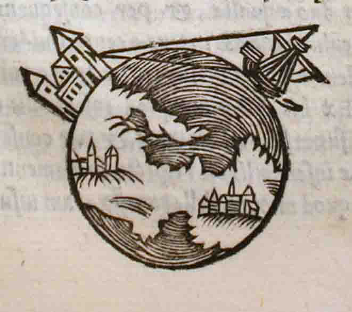
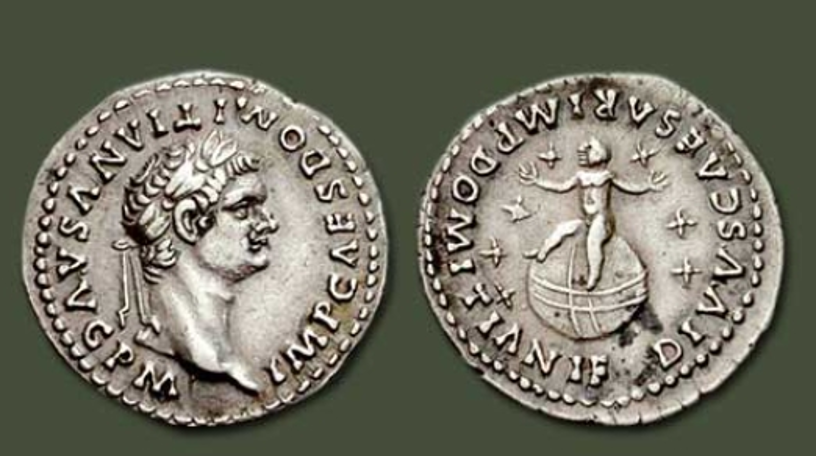
The image above is from a 1550 edition of a reproduction of the work On the Sphere of the World, originally written around 1230. Below is a coin struck during the reign of Domitian around AD 82-83 that depicts Earth as a globe.
The Flat-Earth Culprit
How and when did the flat-earth myth get started? The earliest claim that “the myth that a flat earth was part of Christian doctrine in the Middle Ages appears to have originated with Sir Francis Bacon (1561-1626), who wrongly claimed that geographers had been put on trial for impiety after asserting the contrary.”[10]
He revised this claim in his 1620 book Novum Organum. Contrary to Bacon’s original claim, “no major church council declared heretical either the roundness of earth or the antipodes.”[11]
But the myth entered popular history and textbooks when Washington Irving published his three-volume History of the Life and Voyages of Christopher Columbus (1828). Irving, best known for “The Legend of Sleepy Hollow” and “Rip Van Winkle,” used his fiction-writing skills to invent a supposed confrontation between Columbus and churchmen who claimed the Bible taught the earth was flat. No such encounter ever took place. Samuel Eliot Morison, a noted Columbus biographer, describes Irving’s story as “misleading and mischievous nonsense, … one of the most popular Columbian myths.”[12]
Irving’s fictionalized account of Columbus describes him as being “assailed with citations from the Bible and the Testament: the book of Genesis, the psalms of David, the orations of the Prophets, the epistles of the apostles, and the gospels of the Evangelists. To these were added expositions of various saints and reverend Commentators…. Such are specimens of the errors and prejudices, the mingled ignorance and erudition, and the pedantic bigotry, with which Columbus had to contend.”[13] Irving’s account has only one problem: “It is fabrication, and it is largely upon this fabric that the idea of a medieval flat earth was established.”[14]
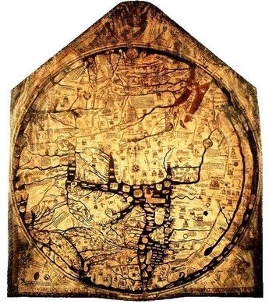
Like maps today, medieval maps were flat. “The mappae mundi [below] interpreted the world in spiritual as well as geographical terms, and included Biblical illustrations as well as portrayals of Classical learning and legend. As pictorial descriptions of the outside world, these impressive maps were also educational; they were used for teaching natural history and classical legends, and reinforcing religious beliefs.”
History 101: Lessons from the Past
History 101 is an overview course designed to help Christians understand their place in the historical timeline. With study materials in audio, video, and print, History 101 will give the student of history much to think about. This course will point the way forward by revealing how we got where we are. You will be entertained and encouraged by the stories from ancient and not-so-ancient history.
Buy NowA critic of Russell’s book claims that evidence for the belief in a flat earth can be found in the Hereford Cathedral in England and the 13th-century Hereford Mappa Mundi. This would be like an archaeological dig a thousand years from today, finding a cache of maps hanging in public schools from the 1960s and concluding that people in the 20th century believed in a flat Earth. Why are geopositioned satellites needed if Earth is flat? Three satellites would be enough for triangulation if Earth were flat. Mappa Mundi is no different from how schoolchildren study geography today, using flat maps.
Boorstin asserted that from AD 300 to at least 1300, Europe suffered under what he describes as “scholarly amnesia” due to the rise of “Christian faith and dogma [that] suppressed the useful image of the world that had been so slowly, so painfully, and so scrupulously drawn by ancient geographers.”[15] He also claimed that the scientific advances made by the Greeks were dismantled by Christians based on an appeal to the Bible. It is the Bible, independent of any competing cosmology, which supports the empirical data that the earth is a globe:
Religion enforced the scientific demonstration of the earth’s rotundity; God made the earth a sphere because it was the most perfect form. In the Old Testament there is a reference to this in Isaiah xl.22: “It is he that sitteth upon the circle of the earth”—“circle” being the translation of the Hebrew khug, sphere.[16]
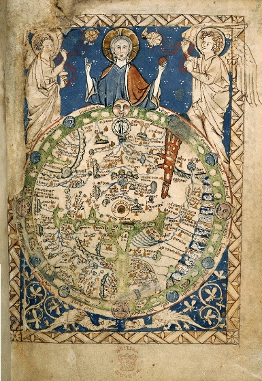
The image below is from the Psalter World Map, Mid-13th Century.
Of course, not all Christians appealed to the Bible for their views of the shape of Earth. In fact, the Bible says little on the subject. Nothing in the Bible, however, contradicts the empirical data. For example, Venerable Bede (673-735), a monk of Jarrow (in present-day Tyne and Wear, England) and “the Father of English history,” maintained “that the earth is a globe that can be called a perfect sphere because the surface irregularities of mountains and valleys are so small in comparison to its vast size.” He specifies that the “earth is ‘round’ not in the sense of ‘circular’ but in the sense of a ball.”[17] Earth is smoother than a bowling ball, but it is not rounder. It is an oblate spheroid.
In Columbus’s day, the debate wasn’t about whether Earth was flat or round. “The issue was the width of the ocean; and therein the opposition was right.”[18] Columbus underestimated Earth’s circumference and the ocean’s width by many miles. “In fact, the distance Columbus was planning to cover [based on accurate maps] was 10,600 miles by air.”[19] Providentially for Columbus and his edgy crew, the Americas stood in his way.
Even considering his mistaken conclusions about measurements, “Columbus always rates the highest accolades from scholars when it comes to seamanship. He was, without question, the finest sailor of his time.”[20] Virtually every student of Columbus accepts Bartolomé de Las Casas’s (1484-1566) opinion, written in his Historia de las Indias, that “Christopher Columbus surpassed all of his contemporaries in the art of navigation.”[21]
The Columbus myth is another example of historical revisionism, the attempt by secularists to cast the Church in a negative light. Liberal historians relish the fact that schoolchildren all over the country are being taught that Christians are ignorant, flat-earthers who will not listen to history, reason, and science. However, when we accurately survey the facts of history, we discover that true science never conflicts with the Bible. Scientific misinformation is never promoted through an accurate understanding of the Bible. Instead, people manipulate truth only outside the biblical worldview.
[1] Howard Benjamin Grose, ed., Our Wonder World, 11 vols. (Chicago: George L. Shuman & Co., [1914] 1918), 1:1, 5.
[2] America Past and Present (Scott Foresman, 1983), 98. Quoted in Russell, Inventing the Flat Earth, 3.
[3] We the People (Heath, 1982), 28-29. Quoted in Russell, Inventing the Flat Earth, 3.
[4] Stephen Jay Gould, Rocks of Ages: Science and Religion in the Fullness of Life (New York: Ballantine Books, 1998), 114.
[5] Jeffrey Burton Russell, Inventing the Flat Earth: Columbus and Modern Historians (New York: Praeger, 1991), 4. See Daniel J. Boorstin, The Discoverers: A History of Man’s Search to Know His World and Himself (New York: Random House, 1983), chaps. 11-14.
[6] John William Draper, History of the Conflict Between Religion and Science (New York: D. Appleton and Co., 1875), 159.
[7] Draper, History of the Conflict Between Religion and Science, 160.
[8] Andrew D. White, A History of the Warfare of Science with Theology in Christendom (New York: George Braziller, [1895] 1955), 108.
[9] Zvi Dor-Ner, Columbus and the Age of Discovery (New York: William Morrow, 1991), 72.
[10] James Hannam, The Genesis of Science: How the Christian Middle Ages Launched the Scientific Revolution. Hannam references John Henry, Knowledge is Power: How Magic, the Government and an Apocalyptic Vision Inspired Francis Bacon to Create Modern Science (Cambridge: Icon Books, 2003), 85.
[11] Michael Newton Keas, Unbelievable: 7 Myths About the History and Future of Science and Religion (Wilmington, DE: Intercollegiate Studies Institute, 2019), 55.
[12] Samuel Eliot Morison, Admiral of the Ocean Sea: A Life of Christopher Columbus (Boston, MA: Little, Brown and Co., 1942), 89.
[13] Quoted in Russell, Inventing the Flat Earth, 53.
[14] Russell, Inventing the Flat Earth, 53.
[15] Boorstin, The Discoverers, 100.
[16] Samuel Eliot Morison, The European Discovery of America: The Northern Voyages (New York: Oxford University Press, 1971), 6.
[17] Russell, Inventing the Flat Earth, 20.
[18] Morison, Admiral of the Sea, 89.
[19] Kenneth C. Davis, Don’t Know Much About History: Everything You Need to Know About American History but Never Learned (New York: Crown Publishers, 1990), 6.
[20] Robert H. Fuson, The Log of Christopher Columbus (Camden, ME: International Marine Publishing Co., 1987), 29.
[21] Quoted in Fuson, The Log of Christopher Columbus, 29.