

What are some of the worldview concepts that Christians have failed to beat, and what steps must be taken to beat them and offer alternatives?
1. Failure to Identify and Challenge an Opponent’s Presuppositions and Their Intended or Unintended Consequences.
“What’s it going to cost?” is the first thing a savvy shopper asks when purchasing an item, not only in the purchase price of a car or a house, but in their continued operation and maintenance. Everything we do has a cost. Economist and social critic Thomas Sowell describes finding solutions to problems as “tradeoffs,” but in the context of a fixed moral order.
Sowell proposes three questions to disarm the utopian fantasies of solution-pushers: “Compared to what?” “At what cost?” and “What hard evidence do you have?” Few are the impractical fancies of small-minded ideologues that will stand up to all three questions.
This is why Jesus tells us to “count the cost” when we make our plans. There is no perpetual motion machine. There’s always some work to do. The question is, what are the best methods to accomplish a task, because each task costs something? What is the cost of the following from Arthur C. Clarke?
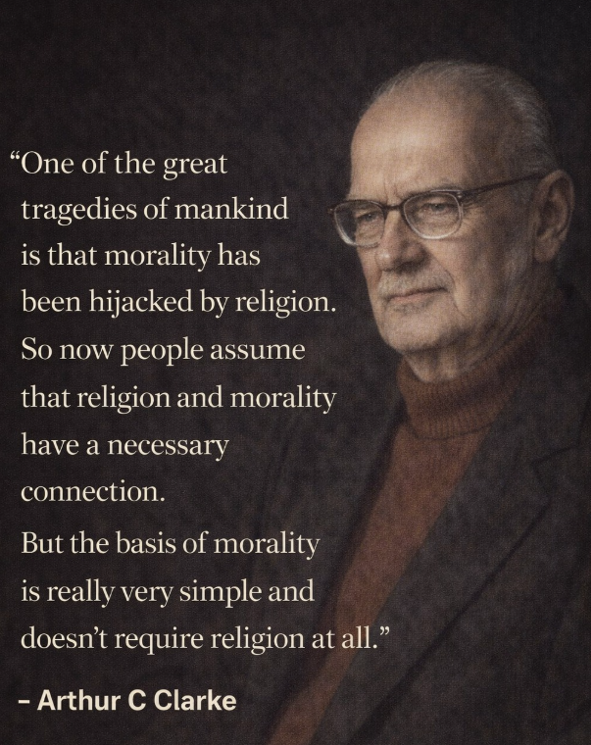
Here’s how someone on Facebook responded to Clarke’s hypothesis.
Morality is purely just doing what you know in your heart is right. If you add anything else, you’ve missed the bar.
Here is my response.
And if someone “knows” in his heart that the world would be better without Jews, like Adolf Hitler? What then? What’s your response and objective moral standard to oppose such a claim? What if what’s in my heart is different from what’s in your heart? Many famous people have claimed to “know” in their hearts what is right and wrong for the supposed good of the world. There were and are today people who “know” that slavery’s a good thing. The list of what someone claims to “know” is long.
Every person has a foundational set of principles on which their worldview is built. While it might take some probing to identify the foundational operating principles, they’re always there, and there are real-life consequences to those operating principles. For the Christian, the necessary operating assumption is “In the beginning God created the heavens and the earth” (Gen. 1:1). The outworking of this assumption has mega-real-world implications. Nothing can truly be known about us and the world around us unless we begin where the Bible begins. You and I have no meaning or value unless God exists. There’s no explanation for meaning or morality outside of a biblical worldview.
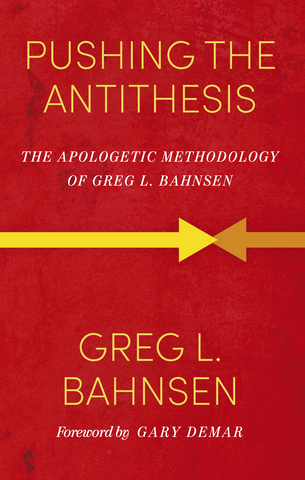
Pushing the Antithesis
Pushing the Antithesis consists of twelve chapters that include study questions, an answer key, a glossary of terms, and a comprehensive bibliography. If you want to be equipped to present the truth of the gospel in a compelling way, then Pushing the Antithesis is required reading.
Buy NowConsider this Ted Talk from Yuval Noah Harari, an atheist, materialist, homosexual, and an influential globalist for the World Economic Forum (WEF):
Human rights are just like heaven and God. It’s just a fictional story that we’ve invented to spread around. It may be a very nice story. It may be a very attractive story. You may want to believe it, but it’s just a story. It’s not a reality. It is not a biological reality, just as jellyfish, and woodpeckers, and ostriches have no rights. Homo Sapiens have no rights also. Take a human, cut him open, look inside, you find … blood, the heart, lungs, and kidneys, but you won’t find any rights. The only place you find rights is in the fictional story that humans have invented and spread around. The same thing is also true in the political field. States and nations are also like human rights, and like God, and like heaven, they too are just stories. A mountain is a reality. You can see it. You can touch it. You can even tough it. But Israel, the United States … they are just stories. Very powerful stories. Stories we may want to believe very much, but still they are just stories. You can’t really see the United States. You cannot touch it. You cannot smell it.
You can read more of Harari’s dangerous presuppositional nonsense in his 2015 book Sapiens: A Brief History of Humankind (pages 109-110). Former President Barack Obama and Bill Gates endorse this book. Did they read it? Harari’s views could have been used by those involved in the slave trade.
The first line in Carl Sagan’s book Cosmos tells us what his operating assumption was: “The universe is all that is or ever was or ever will be.”[1] Sagan wrote this in 1980. The line is like a line from The Berenstain Bears children’s book The Bears’ Nature Guide: A Nature Walk Through Bear Country where this line is found: “Nature is all that IS or WAS or EVER WILL BE.”[2]
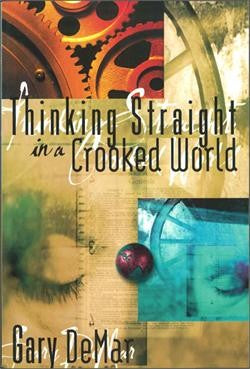
Thinking Straight in a Crooked World
The nursery rhyme "There Was a Crooked Man" is an appropriate description of how sin affects us and our world. We live in a crooked world of ideas evaluated by crooked people. Left to our crooked nature, we can never fully understand what God has planned for us and His world. God has not left us without a corrective solution. He has given us a reliable reference point in the Bible so we can identify the crookedness and straighten it.
Buy NowWell-known atheist Richard Dawkins has made similar statements. He begins with the operating assumption that there is no God. His worldview unfolds from this premise and has real-world consequences:
In the universe of blind physical forces and genetic replication, some people are going to get hurt, and other people are going to get lucky; and you won’t find any rhyme or reason to it, nor any justice. The universe we observe has precisely the properties we should expect if there is at the bottom, no design, no purpose, no evil and no good. Nothing but blind pitiless indifference. DNA neither knows nor cares. DNA just is, and we dance to its music.[3]
Over time, these operating assumptions work their way through our culture. They embed themselves, often unconsciously, in our thinking patterns. A new set of interpreting lenses filters the world we look at. Like contacts and glasses, we see through corrective lenses without noticing that they’re there. The views like those of Harari have been adopted by thousands of “intellectuals” and millions of people who read his books and watch his videos.
Once we put on corrective lenses, light entering the eye is refocused onto the optic nerve and registered in the brain. Over time, this bent light becomes a built-up grid of interpretive analysis for everything we do. What might have been shocking to someone born just after the Second World War and into the 1950s is now part of a new way of looking at the world. As species evolve (as the evolutionists claim), so do worldviews, since there is no longer a fixed standard, an established interpreting starting point, to evaluate old and new information. Everything is reevaluated based on a new set of relative values.
This is the first of several articles on the topic.
[1] Carl Sagan, Cosmos (New York: Random House, 1980), 4.
[2] Stan and Jan Berenstain, The Berenstain Bears in The Bears’ Nature Guide: A Nature Walk Through Bear Country (New York: Random House, 1975), [6–7].
[3] Richard Dawkins, River Out of Eden: A Darwinian View of Life (New York: HarperCollins/BasicBooks, 1995), 133.