

In the Foreword to Tony Campolo’s book Red Letter Christians, Jim Wallis tells a story about a secular Jewish country-music songwriter and disk jockey who told him that a new social movement was being birthed as a result of Wallis’ God’s Politics and other “social conscience” books. Here’s how Wallis tells it:
“I love your stuff and have been following your book tour.” Then he told me he believed we were starting a new movement, but he noticed we hadn’t come up with a name for it yet. “I’ve got an idea for you,” he said. “I think you should call yourselves ‘The Red Letter Christians.’ You know those Bibles that highlight the words of Jesus in red letters? I love the red-letter stuff. The rest I could do without.”[1]
Wallis continues by telling how he shared this story with Campolo, who he calls “the ‘godfather’ of Red Letter Christians… after all, he is Italian,” and how excited Tony got when he heard it.
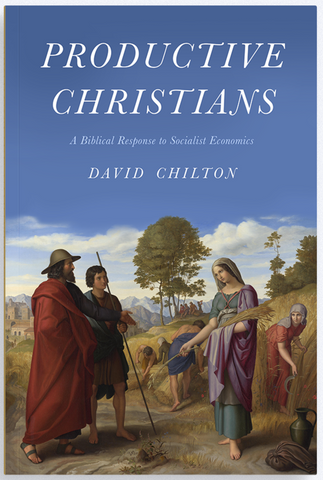
Productive Christians
For all its aspirations for justice, equality, and fairness, the rhetoric of socialism is typically marked by high sounding moralisms stuffed with cliché, guilt, pity, bluster, and resentment. What is worse is that history demonstrates that this rhetoric has had disastrous results whenever it has been translated into economic or political policy. In Productive Christians: A Biblical Response to Socialist Economics, David Chilton tells us why. He not only exposes the follies and fallacies of socialism, but he also systematically outlines the biblical alternative — an alternative that lays the groundwork for real justice, progress, prosperity, and freedom for the rich, the poor, and everyone in between.
Buy NowCampolo declares “that there are more than 2,000 verses of Scripture that call us to express love and justice for those who are poor and oppressed.”[2] What Campolo needs to find in these 2,000 verses is a single verse that grants civil government the authority to redistribute wealth. Campolo takes verses directed at individuals and turns them on their head, giving them a political twist. Here’s a representative example:
Most important, when we reflect on all Jesus had to say about caring for the poor and oppressed, committing ourselves to His red-letter message just might drive us to see what we can do politically to help those he called, “the least of these” (see Matt. 25:31-46).[3]
On the day of judgment . . . [God] will ask whether or not we fed the hungry, clothed the naked, received and cared for aliens, and brought deliverance to captive peoples (see Matt. 25:31-46).[4]
Campolo sees a political solution in these verses, as Jesus addresses what individuals have or have not done. Politically, Campolo means government intervention and wealth redistribution.
A comment to an article I wrote had this to say about the role civil government has a right to play in the area of social welfare:
There are lots of things that civil government is allowed to do that I, as a private citizen am not allowed to do like execute criminals, have my own private army, print my own money, etc. You need to take off your blinders of ideological dogmatism and think through the logical implications of what your [sic] saying. By the way, as I posted on another thread my Scriptural basis for supporting Welfare, Foodstamps, Social Security, etc. is Matthew 25:31-46.
This is the theology of Baalism, more specifically, Baal-Berithism (Judges 8:33), Baal of the Covenant. “Part and parcel of Baalism and of all non-Christian philosophy,” according to James B. Jordan, “is statism, the absolute rule of man over other men by means of force. . . . [T]he essence of Baalism as a philosophy is the belief that Nature is ultimate, and that man is the stimulator and thus the ruler of Nature. This also means that man is the stimulator and ruler of other men, since they are a part of Nature.”[5] Few, if any, Christians should adopt such a view. Baalism led to “every man doing what is right in his own eyes” (Judges 17:6). Rarely do we find in the Bible an outright abandonment of the things of the covenant. They often take time. Think of Judas. Rather, compromises are made, and elements from competing worldviews are tolerated and adopted. “Baal-Berith, the Baal of the Covenant, was a syncretistic (combination) god composed of elements from Baalism and the true faith.”[6] Israel went from Jerubbaal, Baal Fighter, to Baal-Berith, Baalism (Statism) wrapped in the religiosity of the covenant to give it authenticity. The end result was tyranny, as Jotham’s parable of the trees indicates (Joshua 9:7-21).
Judges: God's War Against Humanism
God is Himself the Great Story Teller. Being God, He can sovereignly superintend all events so as to bring His stories to life. His stories really happened. The fact that they are told as stories does not subtract one whit from their real historical character. Judges, like all so-called "history books" of the Old Testament, is really a prophecy. Judges is numbered among what are called the "Former Prophets". These books were called prophecies because the histories they recorded were regarded as exemplary. The histories showed God's principles in action, and thus formed prophetic warning to the people. If we read Judges merely as a set of exciting stories, we miss this.
Buy NowCaring for the poor is a biblical mandate, a requirement of the covenant, but using the State as the means to level incomes to accomplish this is the religion of Baalism. Yes, there are some things that civil government is permitted to do that a private citizen is not. Executing criminals and raising an army for the defense of the nation are two of them. Both the Bible and the Constitution are specific about these. Printing money and going into debt are theft and hurt the poorest among us (Isa. 1:22). To base government programs like welfare, food stamps, and social security on Matthew 25:31-46 is without foundation. The division in Matthew 25 is between sheep and goats, that is, individuals in nations. Nations don’t visit people in prison; private citizens do. Governments put people in prison; private citizens do not.
Civil governments are the biggest hindrance in helping the poor, and it’s not because they don’t tax enough and redistribute wealth efficiently. High taxes and control of the money supply (inflation/deflation) enable civil governments to control people and their property. A ten percent tax is a sign of tyranny (1 Sam. 8:15), and yet Red-Letter Christians believe in higher taxes on the rich to help the poor.
It was a taxing policy by Rome that forced Mary and Joseph to leave their stable home environment, Joseph’s job, and spend money they probably did not have to register for a government taxing program (Luke 2:1-7). Wealth redistribution policies, with all their good intentions, have the effect of hurting the poor and making them dependent on civil government—forever. Campolo advocated what Jesus condemned the Pharisees for in Mark 7:1-13, nullifying the Word of God for the sake of a political tradition that is not biblical, just, or effective.
Historically, the church did not divide the world into two opposing realms: sacred/secular, spiritual/material, or this world/the next world. More importantly, the Bible does not divide the world this way. The Bible is concerned about the distinction between good and evil, right and wrong, moral and immoral. The ethical requirements are the same for every realm: “Thy will be done on earth as it is in heaven” (Matt. 6:10).
[1] Jim Wallis in the Foreword to Tony Campolo, Red Letter Christians: A Citizen’s Guide to Faith and Politics (Ventura, CA: Regal Books, 2008), 9.
[2] Campolo, Red Letter Christians, 24.
[3] Campolo, Red Letter Christians, 22.
[4] Campolo, Red Letter Christians, 24.
[5] James B. Jordan, Judges: God’s War Against Humanism (Tyler, TX: Geneva Ministries, 1985), 113.
[6] Jordan, Judges, 156-157.