

Recently, I received an email from a woman who asked whether I could direct her to sources that refute Gnosticism. She wrote that a friend of hers “claims to be on an extraordinarily intense spiritual ‘pilgrimage’ of ‘really pressing in to know God intimately’—but this guy has in effect divorced himself from the material world and from all relationships (including his wife and 10 children) which he views as a hindrance to his spiritual growth.”
Gnostics claim to have special knowledge (gnosis is the Greek word for “knowledge”) on how to live the Christian life that is not revealed to “ordinary Christians.”
For them, God’s revelation in Scripture is not good enough or sufficient to give direction on how to live the Christian life. Of course, this refutes what the Bible says when it states that Scripture is “adequate” and equips the Christian “for every good work” (2 Tim. 3:17). She went on to say that this friend, a farmer, “was putting up hay recently and needed to get it in as they were expecting rain. Before he finished, he remembered that he had scheduled a Bible study, so he left his hay to keep the ‘spiritual’ duty. The rain came, and the hay was lost, but he felt justified that he had chosen the higher calling.”
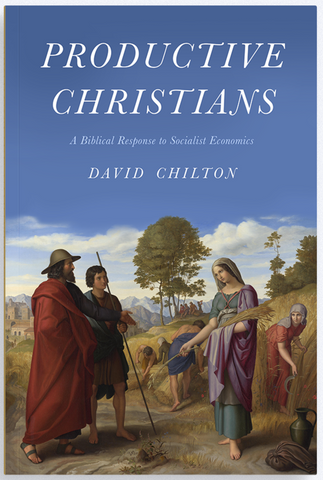
Productive Christians
In Productive Christians: A Biblical Response to Socialist Economics, David Chilton exposes the follies and fallacies of socialism, but he also systematically outlines the biblical alternative — an alternative that lays the groundwork for real justice, progress, prosperity, and freedom for the rich, the poor, and everyone in between. First published nearly half a century ago, it is more relevant and more prescient than ever. Chilton’s crystalline prose and take-no-prisoners style is as entertaining as it is informative. This is the way books on economic issues should be written: biblical, understandable, and practical.
Buy NowAnother feature of Gnosticism is the belief that there are two separate realms—“one spiritual, the other material. The spiritual realm, created by God, [is] all good; the material realm, created by the demiurge, all evil. Man [must] to be saved, not from Original Sin, but from enslavement to matter,”[1] from this world.
A further expression of Gnosticism was expressed by someone who “doesn’t believe in voting because that is a ‘worldly affair,’ and he wants only to be engaged in truly spiritual activities.” For Gnostics, the material world is on a lower plane. Only “spiritual things” are useful and profitable. A Gnostic-like belief might forbid marriage while advocating “abstaining from foods” even though “God has created these things “to be gratefully shared in by those who believe and know the truth” (1 Tim. 4:3). Godliness for the Gnostic is defined as a retreat from the world and despising the things of the world.
[The Gnostics] devised a dualistic cosmology to set against the teachings of the early Christian Church, which, they claimed, were only common deceptions, unsuited for the wise. The truth was esoteric. Only the properly initiated could appreciate it. It belonged to a secret tradition which had come down through certain mystery schools. The truth was, God could never become man. The Gnostic secret is that the spirit is trapped in matter, and to free it, the world must be rejected.[2]
For Gnostics, life “must be escaped at any cost.”[3] But if there can be no immediate material escape, then a spiritual escape is a good enough substitute. A Gnostic escapes from the responsibilities of history. But for the Christian, history is the realm of decision-making, and, therefore, is anti-Gnostic. If we are not responsible for history, then we are not responsible for decision-making. Even a casual reading of the Bible will show that our faith is to be lived out in the world so that “fruit,” good works, are manifested for the world to see and for Christians to judge (Matt. 7:15-23). No restrictions are imposed on where this fruit matures.
One of the central issues that divided gnostics and orthodox Christians in the early Church was their understanding of the relationship between religion and politics. The Church Fathers accepted the political worldliness of the Jewish faith, contending that religion and politics are interconnected and inseparable. The early Puritans and even Jonathan Edwards, following classical Calvinism, would have been clearly orthodox in this regard. The world of politics, of human institutions, was for them an essential locus of God’s redemptive work.[4]
What is contemporary Gnosticism like? While it may not manifest as ascetic practices such as pole-sitting, it does manifest in institutional escape. Institutional escape is not in the Protestant tradition, however. Our nation’s earliest Christian citizens did not view escape, eschatologically, ascetically, or institutionally as being biblical. Education, publishing, law, science, medicine, and politics, to take just some areas, were to be governed by the Word of God as were ecclesiastical affairs. Modern-day Gnosticism thrives in a climate of escapism, which entails a retreat from this world and a refusal to take responsibility for changing any part of it. If this world means nothing, then I am not responsible for its evils.
Eschatological Gnosticism persists in our day.
The antichrist heresy was apparently an early form of gnosticism, which was a system of belief opposed to orthodox Christianity and prevalent in the second and third centuries. Gnosticism generally taught that matter was evil, that the Incarnation was an illusion, and that Redemption was by way of enlightenment or gaining knowledge.[5]
The following was written by Jan Markell, a diehard dispensationalist.
The church is not in the business of taking anything away from Satan but the souls of men. The world is a sinking Titanic ripe for judgment, not Garden of Eden perfection. Jesus will take dominion of the cleansed earth. For men to speak of doing that before the judgment of this earth is spiritually arrogant. I encourage you to flee such false teachers.
Why bother teaching a Christian worldview since (1) our message is only about “souls” and (2) “the world is a sinking Titanic”? Why be concerned with a world that will inevitably sink, and probably do so in our lifetime? This is Gnosticism. For Gnostics, the material world is on a lower plane of existence. Only “spiritual things” are useful and profitable. You can read my response to Markell’s article here.
Ten Popular Prophecy Myths Exposed and Answered
Millions of books have been sold proclaiming countless false prophecies. Many Christians are beginning to take a second look at the biblical prophetic record. A seismic shift in biblical eschatology is taking place around the world because Christians, some for the first time, are willing to challenge what they have been taught based on what the Bible actually says.
Buy Now[1] Dusty Sklar, The Nazis and the Occult (New York: Dorset Press, [1977] 1989), 140-141.
[2] Sklar, The Nazis and the Occult, 147.
[3] Philip Lee, Against the Protestant Gnostics (New York: Oxford University Press, 1987), 122.
[4] Lee, Against the Protestant Gnostics, 123-124.
[5] James Nance, “The Anti-Christ and the Beast,” And It Came to Pass (Powder Springs, GA: American Vision, [1993] 2026), 112.