

According to a radio editorial some years ago, “a man’s religion and the strength of his conviction are his own personal matter” and therefore “religion should not interfere with politics.”[1] Regrettably, many churches during Hitler’s rise to power accepted the argument that religion and morality should be separated from politics based on the neutrality claim. “Religion was a private matter,” historian Richard V. Pierard writes, “that concerned itself with the personal and moral development of the individual. The external order—nature, scientific knowledge, statecraft—operated on the basis of its own internal logic and discernible laws.” Morality is a personal, not a public or political matter. Whoever controls the definition of ‘internal logic’ gets to define what constitutes a ‘discernible law.’
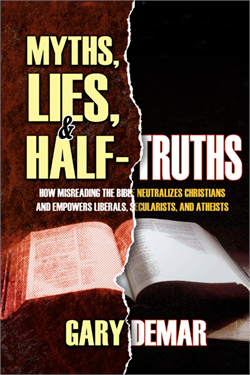
Myths, Lies, and Half-Truths
Myths, Lies, and Half-Truths takes a closer look at God's Word and applies it to erroneous misinterpretations of the Bible that have resulted in a virtual shut-down of the church's full-orbed mission in the world (Acts 20:27). Due to these mistaken interpretations and applications of popular Bible texts to contemporary issues, the Christian faith is being thrown out and trampled under foot by men (Matt. 5:13).
Buy NowThe church’s sole concern and domain was with a person’s spiritual life. “The Erlangen church historian Hermann Jorda declared in 1917 that the state, the natural order of God, followed its own autonomous laws while the kingdom of God was concerned with the soul and operated separately on the basis of the morality of the gospel.”[2] It was because of this disjunction — built on the myth of neutrality — that Hitler hoped to carry out his devilish schemes unhindered by religious arguments and pressures. Not everyone succumbed to the logic of neutrality. The “Confessional Church,” however, took a different, non-neutral position:
[It] opposed the Nazification of the Protestant churches, rejected the Nazi racial theories and denounced the anti-Christian doctrines of Rosenberg and other Nazi leaders. In between lay the majority of Protestants, who seemed too timid to join either of the two warring groups, who sat on the fence and eventually, for the most part, landed in the arms of Hitler, accepting his authority to intervene in church affairs and obeying his commands without open protest.[3]
Those “who sat on the fence,” having fallen for the neutrality myth, supported Hitler by default. While they did not openly join with the “German Christians,” a pro-Hitler alliance of ministers and churches, their inaction, their supposed neutrality, “landed them in the arms of Hitler” anyway.
Congressman Wilson Lumpkin (1783-1870) attempted to use the neutrality argument to keep Christians from arguing against removing the Cherokee Indians from Georgia in what has become known as the “Trail of Tears”:
“[Lumpkin] decried those Christians who left their proper realm and sought to involve themselves in politics as ‘canting fanatics.’ He said he had no trouble with ‘pure religion’ (that is, religion that steered clear of politics), ‘but the undefiled religion of the Cross is a separate and distinct thing in its nature from the noisy cant of the pretenders who have cost this Government, since the commencement of the present session of Congress, considerably upwards of $100,000 by their various intermeddlings with the political concerns of the country.’”[4]
Liberals and conservatives alike would be horrified at Lumpkin’s claim of religious and moral neutrality if it had been used to overlook the horrors of slavery and ethnic cleansing. But the neutrality argument is still used. In 2003, Democrat presidential candidate John Kerry criticized the Vatican for saying that “Catholic politicians like him have a ‘moral duty’ to oppose laws granting legal rights to gay couples.” He went on to say that “it’s important to not have the church instructing politicians. That is an inappropriate crossing of the line in America.”[5] Would Kerry agree to the following logic of his position?
• “It’s important not to have the church instructing politicians about slavery.”
• “It’s important not to have the church instructing politicians about ethnic cleansing.”
• “It’s important not to have the church instructing politicians about civil rights.”
Al Gore appealed to the Bible at the Tennessee Democratic Party’s annual Jackson Day dinner on August 29, 2009, in support of national healthcare. “[P]laying off the focus of the [Ted] Kennedy funeral on the Gospel of Matthew’s parable of Jesus taking care of ‘the least of us,’ [he] thundered that the country has ‘a moral duty to pass health care reform. This year.’”
Former House Speaker Nancy Pelosi (D-Calif.) said she believes she must pursue public policies “in keeping with the values” of Jesus Christ, “The Word made Flesh.” At a May 6 [2010] Catholic Community Conference on Capitol Hill, the former speaker said: “They ask me all the time, ‘What is your favorite this? What is your favorite that?’ And one time, ‘What is your favorite word?’ And I said, ‘My favorite word? That is really easy. My favorite word is the Word, is the Word. And that is everything. It says it all for us. And you know the biblical reference, you know the Gospel reference of the Word.”
Pelosi, a Catholic who favors legalized abortion, voted against the ban on partial-birth abortion that was enacted into law in 2003. She also supports homosexuality and transgenderism. I could add theft by government decree.
The church’s failure to address these issues based on the false concept of moral neutrality has made it possible for the enemies of the gospel to impose their wicked worldview on the most innocent among us, in the name of Jesus and the gospel!
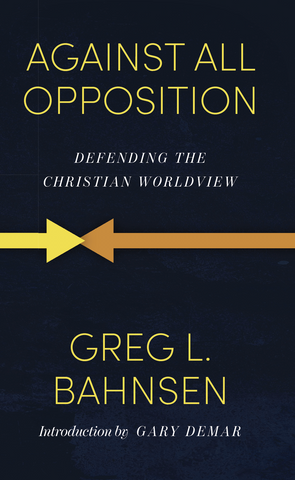
Against All Opposition
The starting point is the God of the Bible. The Bible begins with this foundational presupposition: “In the beginning God created the heavens and the earth” (Gen. 1:1). Against All Opposition lays out the definitive apologetic model to help believers understand the biblical method of defending the Christian faith.
Buy NowSo then, for a Christian to adopt the neutrality myth is to fall into the humanist trap, to believe that religious convictions are reserved for the heart, home, and place of worship. At the same time, the affairs of this world are best handled through reason, experience, and technical expertise, free of religious assumptions and convictions.
Secular humanists have no objection to our Christian faith at all, provided we reserve it strictly for ourselves in the privacy of our homes and church buildings, and just as long as we do not try to live up to our Christ principles in our business and public life. On no account must the Spirit and Word of the Lord Jesus Christ be allowed to enter the ballot booth or the market place where the real decisions of modern life are made, nor must religion interfere with such vital matters as education, politics, labor relations and profits and wages. These activities are all supposed to be “neutral,” and they can therefore be withdrawn from sectarian influences so that the secular spirit of the community may prevail.[6]
Secularists and, unfortunately, too many Christians believe that the world’s problems can be solved through technical know-how without any regard for divine intervention. This view holds that special revelation has little or nothing to say about “secular” matters such as education, politics, and law. The unbeliever, without Scripture, maintains that he can develop equitable laws, a sound educational philosophy, and a just political system devoid of a transcendental source. This is the myth of neutrality. The myth is deceptive because it suggests that those who embrace it are open-minded, generous, and nonjudgmental, whereas those who demand neutrality are closed-minded, uncharitable, and judgmental.
[1] Heard on WGST, Atlanta, Georgia (September 12, 1986).
[2] Pierard, “Why Did Protestants Welcome Hitler?,” 14.
[3] William L. Shirer, The Rise and Fall of the Third Reich (New York: Simon and Schuster, 1960), 236. Emphasis added.
[4] Quoted in John Wilson, “Why Evangelicals Can’t Opt Out of Political Engagement,” Books & Culture (July 15, 2002), link here. See John G. West, Jr, The Politics of Revelation and Reason: Religion and Civic Life in the New (Lawrence, KS: University Press of Kansas, 1996).
[5] Quoted in “Kerry criticizes Vatican Pressure,” Atlanta Journal-Constitution (August 2, 2003), D4.
[6] E. L. Hebden Taylor, “Religious Neutrality in Politics,” Applied Christianity (April 1974), 19.