
Please help us meet a $15K matching challenge here
Bible Prophecy Under the Microscope-Episode 93
Gary takes a closer look at Acts 1:11, which is often pointed to as proof that Jesus will return exactly as He left during the Ascension.
At His trial, Jesus told Caiaphas the high priest and the Sanhedrin that they would see “the Son of Man sitting at the right hand of power and coming on the clouds of heaven” (Matt. 26:64). When would this take place? “The phrase… ‘from now on’ means exactly what it says…, and refers not to some distant event but to the imminent vindication of Jesus which will shortly be obvious to those who have sat in judgement over him.”[1] What did they “see”? Certainly not an event that was thousands of years in the future. N. T. Wright comments:
Jesus is not, then, suggesting that Caiaphas will witness the end of the space-time order. Nor will he look out of the window one day and observe a human figure flying downwards on a cloud. It is absurd to imagine either Jesus, or Mark, or anyone in between, supposing the words to mean that. Caiaphas will witness the strange events which follow Jesus’ crucifixion: the rise of a group of disciples claiming that he has been raised from the dead, and the events which accelerate towards the final clash with Rome, in which, judged according to the time-honoured test, Jesus will be vindicated as a true prophet. In and through it all, Caiaphas will witness events which show that Jesus was not, after all, mistaken in his claim, hitherto implicit, now at last explicit: he is the Messiah, the anointed one, the true representative of the people of Israel, the one in and through whom the covenant God is acting to set up his kingdom.[2]
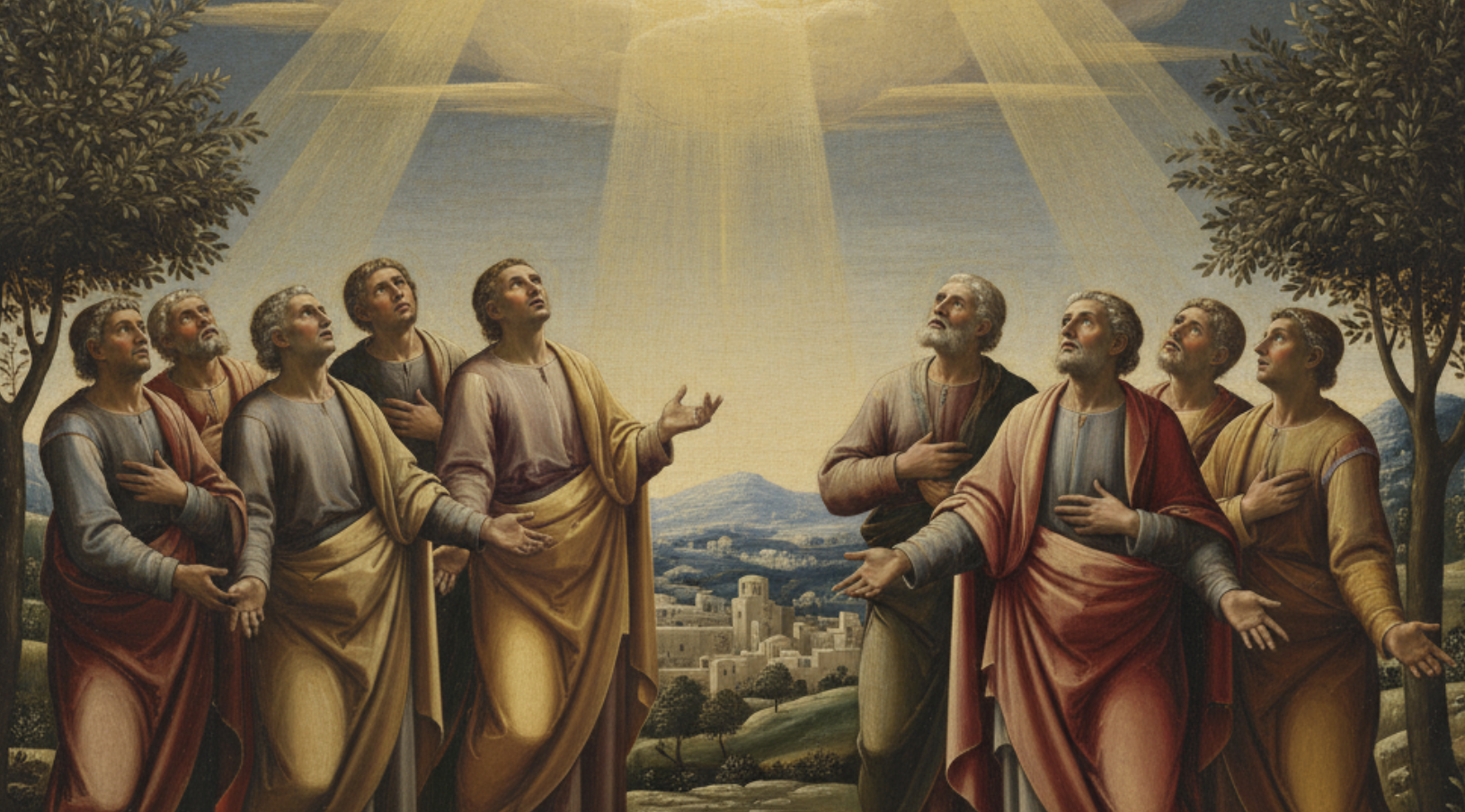
At His ascension, Jesus had come up to the Ancient of Days “with the clouds of heaven” to receive the kingdom from His Father (Mark 16:19; Acts 1:9). Jesus’ reception of the kingdom gave Him possession so that He could do with it as He pleased. He had earlier stated that the kingdom would be “taken away from” those who rejected Him and would “be given to a nation producing the fruit of it” (Matt. 21:43). The church—made up initially of believing Jews and later of believing Gentiles—is described by Peter as a “holy nation” (1 Peter 2:9). It is this “nation” that is in possession of the kingdom by right of transfer. This covenant transfer is confirmed for us at the stoning of Stephen (Acts 7:54-56). Stephen’s murderers objected to being called “stiff-necked and uncircumcised in heart and ears” (7:51). His words of condemnation had put them outside the covenant community because they, too, persecuted and killed the prophets by publicly denouncing the gospel message (7:52).
So Stephen saw Him, before his death by stoning (Acts 7:56), and thus prophesied judgment on his murderers, at the very moment when he prayed for their forgiveness. The priesthood stood on trial that day, although the execution of their sentence was yet to come, on that awful day in AD 70 when the priests were cut down at the altar as they steadily continued their sacrifices.[3]
The church was persecuted by Jewish opposition for forty years after Jesus’ death, once again confirming what Jesus had prophesied. With the destruction of Jerusalem in A.D. 70, the truth was comprehended by the tribes of Israel (Rev. 1:7). The generation that Jesus said would not pass away until all these things came to pass finally came to understand the implications of their rebellion: Jesus is the one who was given “[D]ominion, Glory and a kingdom, that all the peoples, nations, and men of every language might serve Him” (Dan. 7:14). They were not to look for another (Matt. 24:26).

Last Days Madness
In this authoritative book, Gary DeMar clears the haze of "end-times" fever, shedding light on the most difficult and studied prophetic passages in the Bible, including Daniel 7:13-14; 9:24-27; Matt. 16:27-28; 24-25; Thess. 2; 2 Peter 3:3-13, and clearly explaining a host of other controversial topics.
Buy NowGary takes a closer look at Acts 1:11, which is often pointed to as proof that Jesus will return exactly as He left during the Ascension. Most futurists use this verse to show that Jesus will return in His physical body because that would be necessary in order to fulfill “just in the same way” He went away. The problem is that this Greek phrase is translated differently in other parts of the NT.
Click here for today’s episode
Click here for all episodes of Bible Prophecy Under the Microscope
[1] R.T. France, Matthew: Evangelist and Teacher (Downers Grove, IL: InterVarsity Press, [1989] 1998), 315.
[2] N. T. Wright, Jesus and the Victory of God (Minneapolis: Fortress Press, 1998), 525.
[3] R.A. Cole, The Gospel According to Mark: An Introduction and Commentary (Grand Rapids, MI: Eerdmans, 1961), 229.