
Bible Prophecy Under the Microscope-Episode 109
Gary responds to a critic who challenges his interpretation of “this generation” in Matthew’s gospel.
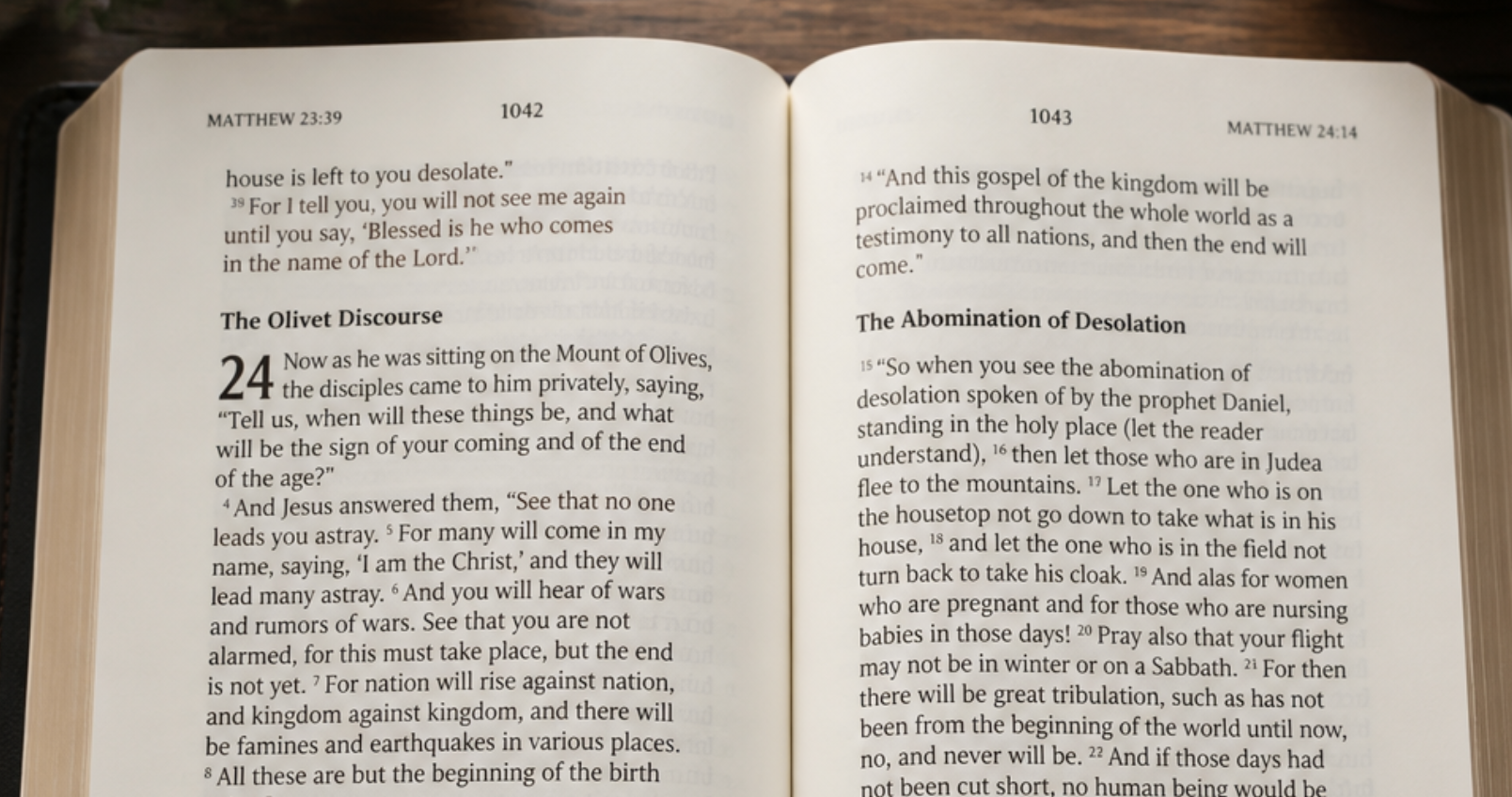
In Matthew 24:33, the word “you” (plural) is used twice: “so, you too, when you see all these things, recognize [lit. know] that He is near, right at the door.” Who does Jesus say will see “all these things”? Certainly not a future audience. “So, you too, when you see all these things.” The first “you” is obviously Jesus’ present audience as is the second “you.” No one reading Matthew 24:33 could conceive that either use of “you” by Jesus refers to an audience different from the audience to whom Jesus was addressing.
There is a third use of the second-person plural in verse 33. The Greek word ginōskete is also a second-person plural and means “you know” or “you recognize.” If Jesus had a future generation in mind, He could have eliminated all confusion by saying, “even so they too, when they see all these things, they will recognize that He is near, right at the door. Truly I say to you, that generation will not pass away until all these things take place.”
We can follow the way Matthew uses the near demonstrative “this” throughout his gospel to see that he has his present audience in view and not one in the distant future: “this way” (6:9), “this day” (6:11), “this fellow” (9:3), “this news” (9:26), “this city” (10:23), “this place” (12:6), “this man” (13:56), “this people” (15:8); “this rock” (15:18), “this desolate place” (15:33), “this little child” (18:4), “this mountain” (21:21), “this stone” (21:44), “this image” (22:20), “this gospel” (24:14), “this generation” (24:34), “this woman” (26:13), “this night” (26:31). “This” refers to what’s near.
If Jesus had wanted to identify a future generation, He could have chosen the adjective that to distinguish the generation to whom He was speaking from a future generation (e.g., Matt. 7:22 [“that day” is in the future]; 8:12 [“that place” refers to the place of judgment distant from our place and time]; 10:19 [“that hour” refers to a future time]; 24:10 [“and at that time” refers to a future time but within the time parameters of “this generation”]; 24:36 [“that day and hour” refers to a future day and hour that was near the end of their generation (1 John 2:18; Heb. 10:25), not their present day and hour]; 26:29 [“that day” refers to a time when Jesus is in the kingdom, a future time]). The texts that govern the timing of the Olivet prophecy—Matthew 23:36 and Matthew 24:34—make it clear that Jesus was speaking of the events leading up to and including the fall of Jerusalem in AD 70.
If we abandon these clear time statements, then these signs can be applied to any generation. As history attests, this is exactly what’s happened. There have always been wars, false prophets, famines, tribulation, lawlessness, and persecution. If people fail to recognize the timing of these events set by Scripture and the historical context of Jesus’ words, they will always be led astray by those who keep insisting that it’s our generation that will experience the end times.

Wars and Rumors of Wars
A first-century interpretation of the Olivet Discourse was once common in commentaries and narrative-style books that describe the fall of Jerusalem in AD 70. There is also a history of skeptics who turn to Bible prophecy and claim Jesus was wrong about the timing of His coming at “the end of the age” and the signs associated with it. A mountain of scholarship shows that the prophecy given by Jesus was fulfilled in exacting detail when He said it would: before the generation of those to whom He was speaking passed away.
Buy NowGary responds to a critic who challenges his interpretation of “this generation” in Matthew’s gospel. The critic claims Gary is assuming what he has to prove, but Gary shows the opposite. Words like “generation” can be somewhat arbitrary, but when this phrase is read in other parts of the NT, especially Acts 2, it becomes clear that it is not about many generations, but about a very particular one: those hearing Jesus’ words in the first century.
Click here for today’s episode
Click here for all episodes of Bible Prophecy Under the Microscope