
Gary continues his discussion of what happens when Christians fail to get involved and bring their biblical worldview to bear on the world around them.
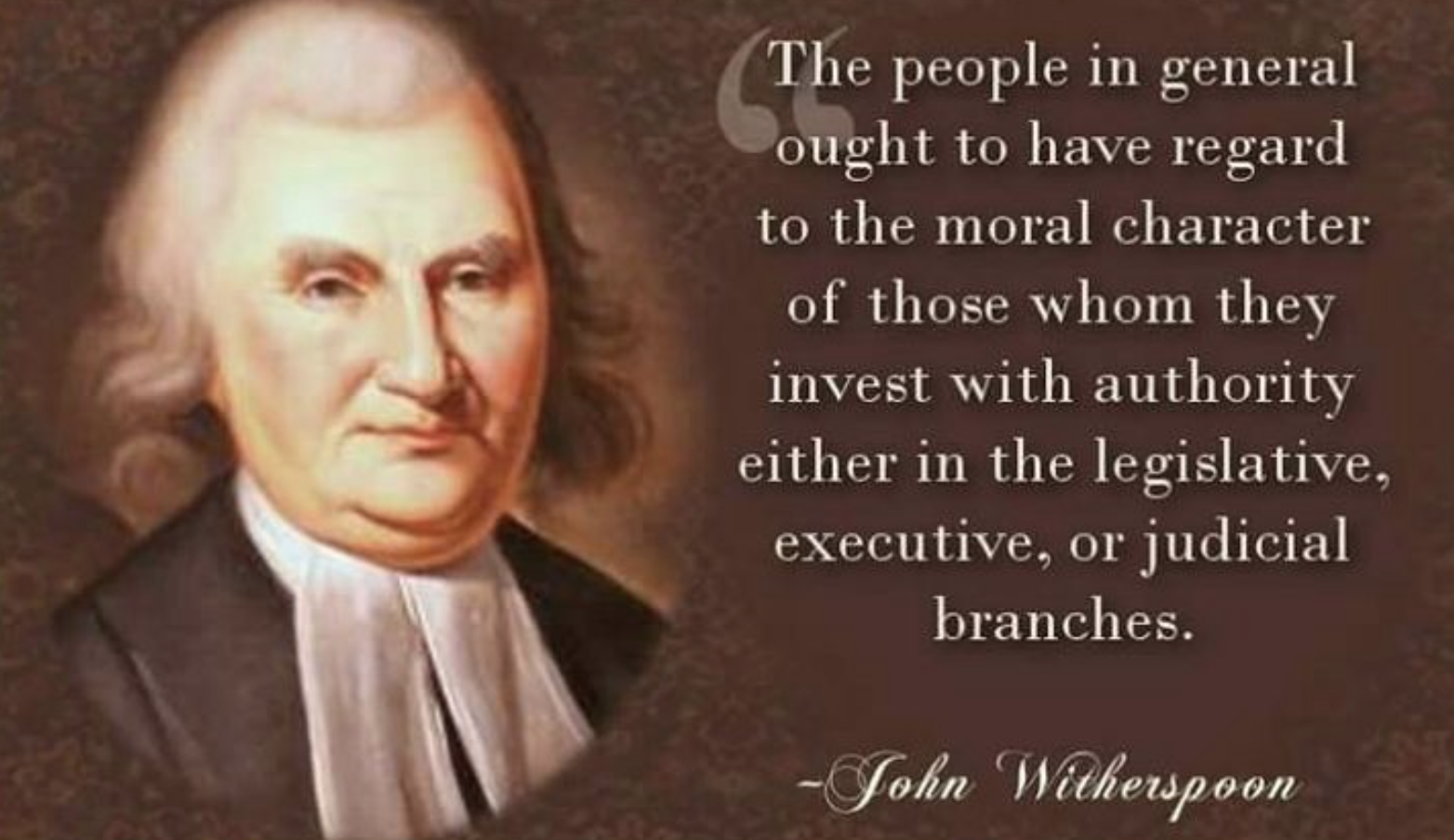
John Witherspoon, a Presbyterian minister and president of the College of New Jersey (later to be named Princeton), was also a member of the provincial congress and the only clergyman to sign the Declaration of Independence. Like all Christians of his era, Witherspoon regarded civil government to be a subordinate institution under God’s all-embracing kingdom and government (Isa. 9:6–7).
Witherspoon and other Christian patriots of his era had no delusions about “bringing in God’s kingdom” through political maneuvering. They recognized, as Benjamin Franklin so eloquently stated in his address to the Constitutional Convention, “God governs in the affairs of men.” God governs because He is King, and this world is part of His universal kingdom. While His kingdom is not “of this world,” it certainly operates in and over this world. Franklin continued:
And if a sparrow cannot fall to the ground without his notice, is it probable that an empire can rise without his aid? We have been assured . . . in the sacred writings that ‘except the Lord build the house, they labor in vain that build it’ [Ps. 127:1]. I firmly believe this, and I also believe that without his concurring aid we shall succeed in this political building no better than the builders of Babel.
The kingdoms of men are dependent upon the operation of the Kingdom of God in and over this world. Birds do not fall and kingdoms do not rise without the overruling of God’s providential hand.
More than a century before the drafting of the Declaration of Independence, John Eliot (c. 1604–1690), the Puritan missionary to the Indians, wrote in his The Christian Commonwealth (a document intended as a plan of government for the Natick Indian community), that it is not for man “to search humane Polities and Platformes of Government, contrived by the wisdom of man; but as the Lord hath carried on their works for them, so they ought to go unto the Lord, and enquire at the Word of his mouth, what Platforme of Government he hath therein commanded; and humble themselves to embrace that as the best. . . . [The] written Word of God is the perfect System or Frame of Laws, to guide all the Moral actions of man, either towards God or man.” Because we are living in God’s kingdom, Eliot taught, it is our duty to follow the King’s rules.
Myths, Lies, and Half-Truths
Like the Bereans of Paul’s day (Acts 17:11), Christians should check the veracity of all opinions against the only reliable standard of authority that God has placed in our hands: the Bible. This may mean a change in belief systems for some. There is no novelty in this. God confronted Peter directly about the inclusion of Gentiles into the household of faith (10:9–16). Paul confronted Peter “to his face” on a similar matter (Gal. 2:11–14). There are times when we all need to be knocked off our horse of mistaken opinions (Acts 9:4). “Testing” is a biblical mandate (2 Cor. 13:5; 1 John 4:1).
Buy NowGary continues his discussion of what happens when Christians fail to get involved and bring their biblical worldview to bear on the world around them. Neutrality is never possible; everyone has an ultimate principle that guides their every belief and action. Non-Christian worldviews will always be “anti-Christian” in what they think and do.