
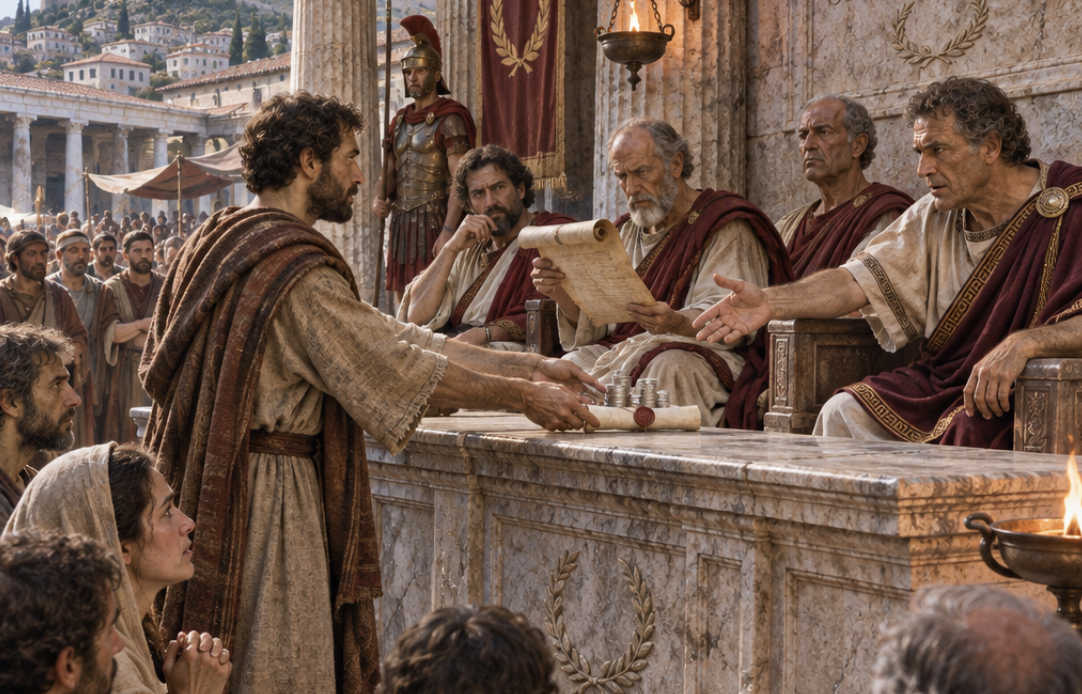
Gary draws parallels between historical events, particularly Acts 17, and the current political climate, urging Christians to take an active role.
There are two swords mentioned in the Bible. One sword belongs to the State (the iron sword), while the other sword belongs to the Church (the sword of the Spirit, the word of God). There is a proper place for both swords as we shall see, yet there is the assurance that the sword of the kingdom of Christ, the word of God, shall cause the sword of iron to be laid to rest: “And He will judge between the nations, and He will render decisions for many peoples; and they will hammer their swords into plowshares, and their spears into pruning hooks. Nation will not lift up sword against nation, and never again will they learn of war” (Isaiah 2:4; cf. Hosea 2:18; Micah 4:3).
The extension of Christ’s kingdom does not advance through violence. Rather, “the sword of the Spirit, which is the word of God” (Ephesians 6:17), is the Christian’s offensive weapon for kingdom advance. Since the nature of our warfare is spiritual (2 Corinthians 10:3), the weaponry must be of the same kind, spiritual. The world scoffs at “spiritual” weapons, but the powers of darkness remain fearful when they are used: “Put on the full armor of God, that you may be able to stand firm against the schemes of the devil” (Ephesians 6:11f., 2 Corinthians 6:7). “The Christian is assured of victory when he uses, not the iron sword of the state, but the powerful weapons of the Spirit—in particular, the word of God.”[1] It is the heart that must be changed if the enemy is to lay down his iron sword. Only the sword of the Spirit, the word of God, can do such radical and complete surgery (cf. Hebrews 4:12).
The State functions as the bearer of the iron sword as “an avenger who brings wrath upon the one who practices evil” (Romans 13:4). Its area of authority is in the punishment of outward actions that are designated as crimes according to the word of God. God has delegated to the State the task of restraining evil deeds. The State’s sword is not granted the right to enforce matters of conscience. “If one’s outward behavior is within the bounds of the law [as revealed in God’s Word] he has nothing to fear from the civil magistrate—even if he is an idolator, murderer, or whatever in his heart.”[2]
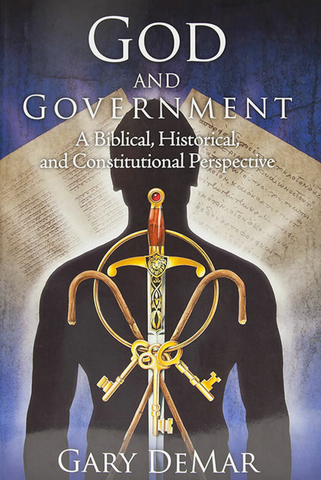
God and Government
With a fresh new look, more images, an extensive subject and scripture index, and an updated bibliography, God and Government is ready to prepare a whole new generation to take on the political and religious battles confronting Christians today. May it be used in a new awakening of Christians in America—not just to inform minds, but to stimulate action and secure a better tomorrow for our posterity.
Buy NowGary draws parallels between historical events, particularly Acts 17 and corrupt political officials, and the current political climate, urging Christians to take an active role. He is convinced that the church must not remain silent. He gives biblical examples of challenging unbiblical political beliefs and highlights the consequences of failing to engage with the state.
[1] Greg L. Bahnsen, Theonomy in Christian Ethics (Nacogdoches, TX: Covenant Media Press, [1977] 2002), 412.
[2] Bahnsen, Theonomy in Christian Ethics, 414.