
Podcaster and author Joel Richardson recently claimed that Revelation’s content was revealed to John around AD 95,[1] during Domitian’s reign (AD 81-96), based on a coin the Emperor struck. The coin features the Latin legend Divvs Caesar Imp[eratori] Domitiani F[ilivs] (“The Divine Caesar, Son of the Emperor Domitian”) on the face. The reverse depicts a naked infant seated on a globe surrounded by seven stars. Minted around AD 82-83, the coin honors Domitian’s deceased infant son, Flavius Caesar. (None of the images of the coins in this article are AI-generated.)
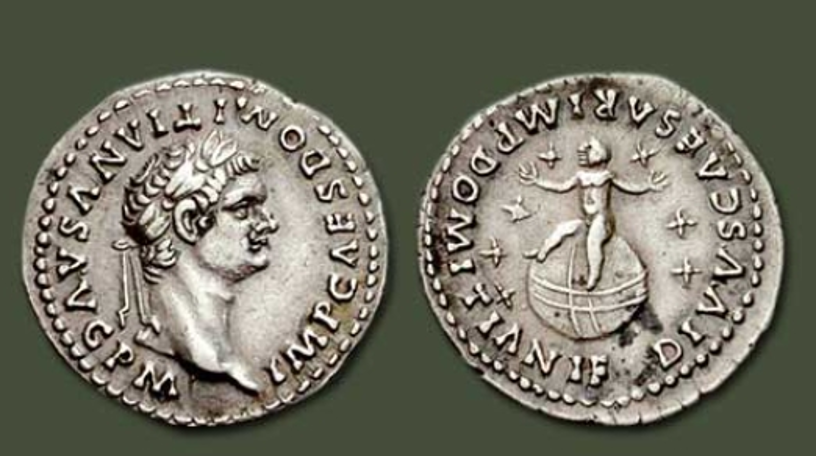
Coins for deceased emperors and empresses often feature heavenly bodies, including sun rays, the moon, and stars. The seven stars primarily symbolize immortality and deification.
According to numismatic evidence, there were several imperial coins prior to Domitian that contained the seven stars on the reverse side. For example, Robert S. McIvor points to three types of coins that were minted on the island of Crete during the reigns of Caligula and Claudius (i.e., between 37 and 54 CE) to celebrate divine Augustus.[2]
Joel Richardson claims the Domitian coin “settles the late dating of the book of Revelation” by arguing that the seven stars refer to a coin struck around AD 82-83 by Domitian. Richardson challenges those who date the composition of Revelation to before AD 70 based on the Domitian coin. (For a comprehensive study of the dating issue, see Greg L. Bahnsen’s unfinished article “The Historical Setting of the Writing of Revelation.”)[3] Richardson bears the burden of proof for his claim, since nothing in Revelation links the following verses to Domitian or to coins.
• In His right hand He [Jesus] held seven stars, and out of His mouth came a sharp two-edged sword; and His face was like the sun shining in its strength (1:16).
• As for the mystery of the seven stars which you saw in My right hand, and the seven golden lampstands: the seven stars are the angels of the seven churches, and the seven lampstands are the seven churches (1:20).
• To the angel of the church in Ephesus write: “The One who holds the seven stars in His right hand, the One who walks among the seven golden lampstands” (2:1).

The Days of Vengeance
A biblical and scholarly exposition of Revelation is laid out for readers to soak up and begin to view the world with renewed hope and optimism. Chilton skillfully shows in detail that Christians will overcome all opposition through the work of Jesus Christ. The book of Revelation is not about the antichrist, the devil, microchips, or bar codes. It is, as the very first verse says, "The Revelation of Jesus Christ."
Buy NowThe Bible is clear: “The seven stars are the angels of the seven churches.” We know this for certain because Revelation 1:20 explains the meaning. Everything else is speculation, either good or bad.[4] Richardson said the following in his podcast of September 2026:
I’ve never heard anyone who holds to the early dating even attempt to explain this. In my opinion, anyone who is honest, anyone who examines the evidence, is going to go, “Yeah, that’s pretty strong evidence. That’s a pretty clear explicit connection.” Does it prove it? Absolutely, 100% no.
It is not “a pretty clear explicit connection.” What evidence does he offer beyond speculation? I’m not opposed to speculation, but speculation is not evidence. It’s an opinion based on a minimal study of the subject.
He is correct on one point. His argument does not prove the late date 100 percent. In fact, there is no way to prove that Revelation 1:16, 20, and 2:1 refer to Domitian and his coin, mainly because Revelation does not tell us when John was exiled to Patmos (1:9), who exiled him, or whether a coin with seven stars is a key interpretive factor for the date of Revelation.
If coins with seven stars are interpretive keys for the dating of Revelation, then seven-star coins before AD 70 and after AD 95 are equally important and ruin Richardson’s claim. Richardson has found no new evidence from the Domitian coin that points, directly or indirectly, to Revelation’s date.
He gives the impression, intentional or not, that his claim is a new discovery. It’s not. The first place I saw it is in Ethelbert Stauffer’s book Christ and the Caesars: Historical Sketches, first published in German in 1952 and later in English in 1955. Stauffer states, “We see [seven stars] from early imperial times on provincial coins from Crete. Crete is the home of the myth of Zeus. There Zeus was born, and there he lies buried. So the seven planets appear on Cretan coins, now with the Zeus child at play on the heavenly globe, now with the heavenly king with his sceptre, and occasionally, too, along with the deified Augustus.”[5] The Greeks’ Zeus became the Romans’ Jupiter.
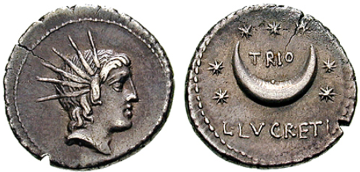
Other coins show seven stars before AD 70. Many Roman coins include seven stars. A coin from Lucius Lucretius Trio, struck during the Roman Republic and dating to around 76 BC, features an upward-pointing crescent moon surrounded by a ring of seven stars, possibly representing the constellation Ursa Major, like the Domitian coin. This coin could just as easily support a pre-AD 70 date for Revelation, since the prophecy looks back, and these coins had been circulating for decades.
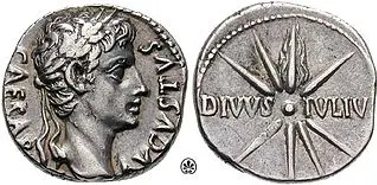
The DIVVS IVLIVS (Divine Julius) coin below is a silver denarius minted by Augustus (c. 19-18 BC) that commemorates the deification of Julius Caesar. The design references Caesar’s Comet of 44 BC amid seven stars, which appeared during Caesar’s funeral games. The Romans interpreted it as a sign that his soul had ascended to the heavens. These coins served as political propaganda, reinforcing Augustus’s status as a son of god (Divi Filius).
Several Roman coins celebrating prominent deceased personalities reproduced seven stars on their reverse: for instance, Divus Augustus, Diva Faustina, Diva Paulina.
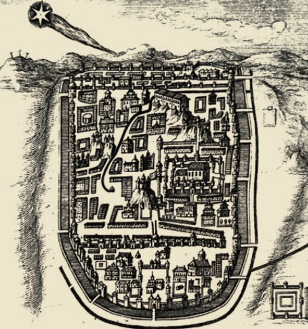
Coincidentally, Halley’s comet (considered a star like the planets) passed over Jerusalem in AD 66, four years before the temple’s destruction and around the time Revelation was revealed to John. According to the Jewish historian Flavius Josephus, the comet’s appearance was a dire omen that foretold the Roman destruction of Jerusalem in AD 70. Josephus described “a star resembling a sword, which stood over the city, and a comet, that continued a whole year” (The Jewish War, 6.5.3.289). The print below is cataloged as “Comet of 66 AD (Halley) over Jerusalem,” from Stanisław Lubieniecki’s Historia universalis omulum cometarum, published in Amsterdam in 1666.
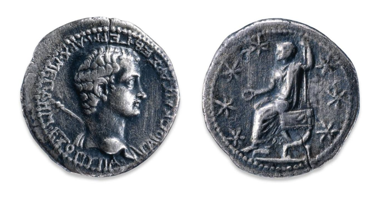
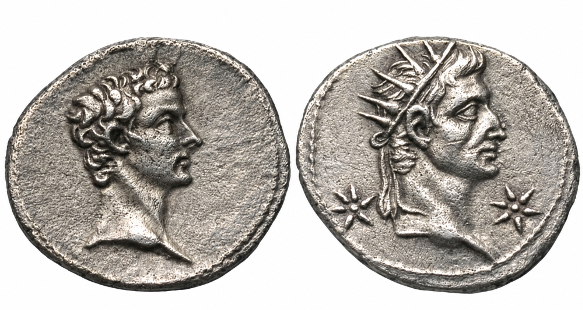
The coin below depicts the bare head of Caligula (Gaius, AD 37-41), with a scepter over his left shoulder. The reverse shows the radiate head of Divus Augustus, surrounded by seven stars, symbolizing the deified emperor. This design appears on silver denarii and gold aurei minted in AD 37 to honor Augustus, whose Temple Caligula dedicated early in his reign. Following Richardson’s interpretive logic, this coin depicts what we find in Revelation 1:16, 20, and 2:1.
The coin below depicts an Emperor with sun rays emanating from his head and flanked by two stars.
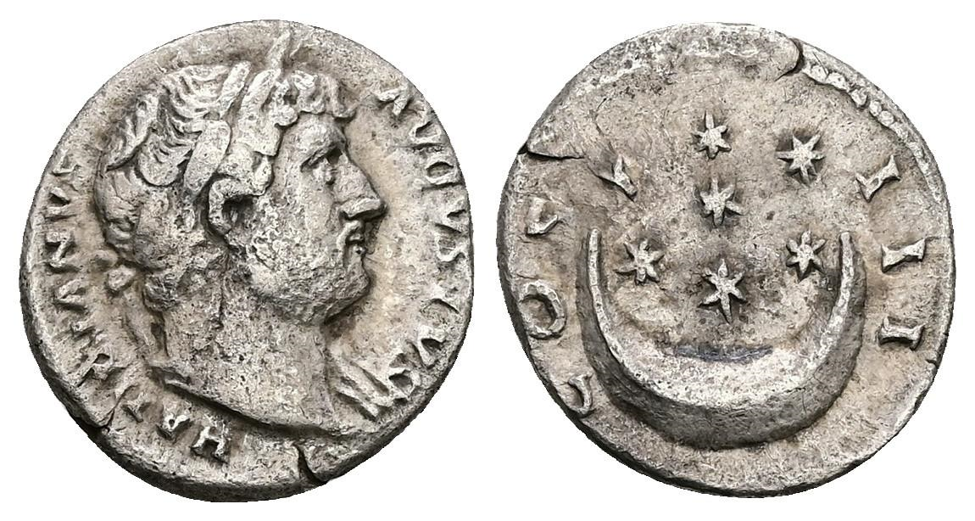
Hadrian (AD 117 to 138) issued silver denarii between AD 125 and 128 that feature a crescent moon accompanied by seven stars. The stars represent the Big Dipper, while the moon was associated with various goddesses, linking the emperor to divine protection and eternity.
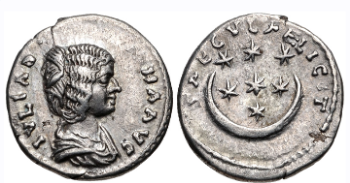
Coins struck by Septimius Severus (AD 193 to 211) feature the seven-star and lunar motifs, accompanied by legends such as SAECVL FELICIT (Happy Times) or AETERNITAS AVS (Eternal Augustus). Some coins from Nikopolis ad Istrum, a major Roman and Early Byzantine city, show six stars surrounding one large star within the crescent moon:
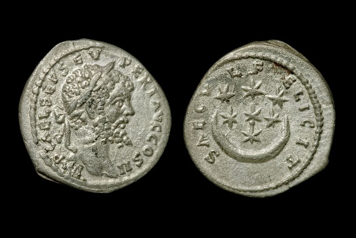
This is a Roman silver denarius issued for Julia Maesa, grandmother of the emperors Elagabalus and Severus Alexander (c. AD 160-217), with the legend IVLIA MAESA AVG (Julia Maesa Augusta). The reverse legend SAECVLI FELICITAS (“Happiness of the Age”) surrounds a crescent moon and seven stars.
Using the sun, moon, and stars to describe people or nations is nothing unusual. Abraham was promised that his descendants would be as numerous as the stars of heaven (Gen. 22:17). In Genesis 37, we read about Joseph’s dream of the sun, moon, and eleven stars bowing to him. Jacob immediately interprets the celestial bodies as his family members: the sun represents himself, the moon represents Joseph’s deceased mother Rachel, and the eleven stars represent Joseph’s eleven brothers. Revelation 12:1 uses similar language: “A great sign appeared in heaven: a woman clothed with the sun, and the moon under her feet, and on her head a crown of twelve stars.” The darkening of the sun and moon and the falling of stars indicate the demise of nations (e.g., Isa. 13:10; 24:23; 34:4; Ezek. 32:7-8; Joel 2:2, 31; 3:15; Amos 5:20; 8:9; Zeph. 1:5). “Isa 14:12 reads, ‘How you are fallen from heaven, O Day Star, son of Dawn.’”[6] Jesus borrowed this language directly from Scripture and applied it to the judgment that would befall Jerusalem before that first-century generation passed away (Matt. 24:29, 33-34). It’s not surprising that Roman rulers would elevate themselves in lofty, stellar ways, driven by arrogance and self-importance. They may have considered themselves gods or sons of the gods, but they died as all men do (Psalm 82:7). “He who sits in the heavens laughs/The Lord scoffs at them” (2:4).
The Book of Revelation Made Easy
With 22 chapters of symbolism, mysterious characters, and apocalyptic drama—all told in “picture language” unmatched in the rest of Scripture—the book of Revelation is difficult enough on its own. But in ignoring the Apostle John’s clear directives for interpreting his prophecies, contemporary theologians have wrested Revelation away from its first-century context and perverted its significance for the church—then and now—often turning the book into a stumbling block. Now in its second edition, Kenneth Gentry’s The Book of Revelation Made Easy seeks to pry John’s narrative of the victory of Christ’s bride out of the grip of speculative futurists, and put it back in the hands of everyday Christians.
Buy NowJohn, the recipient of the revelation, could just as easily have been thinking about past Roman rulers, like the Divine Julius and Caligula, whose coins were struck before AD 70. Here’s a Nero coin with two stars.[7]
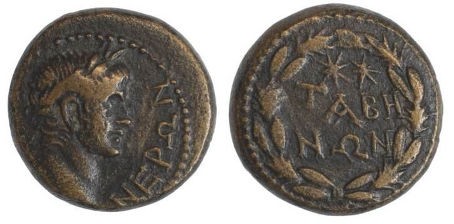
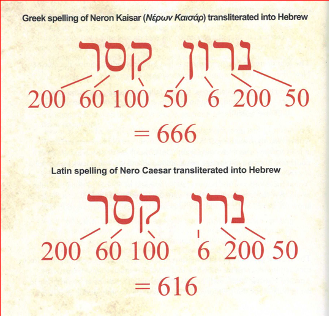
Notice the spelling NEPON (Nerōn).[8] When the name Neron Caesar is transliterated into Hebrew letters as Neron Qesar(נרון קסר), the sum of its letter values (Nun=50, Resh=200, Vav=6, Nun=50, Q=100, Samekh=60, Resh=200) equals 666 (see the chart below),[9] a figure associated with the number of the beast in Revelation 13:18 that coincides with the timing of events (1:1, 3: 22:6, 10) since there were no “soon” and “near” prophetic events after AD 95. An alternative spelling, the Latin-derived name and title Nero Qesar (נרו קסר), yields 616, which accounts for the number found in some ancient manuscripts. In both cases, Nero is the identified sea beast (13:1-10).
Craig R. Koester has analyzed the Number of the Beast (666) from Revelation in his 2016 article in the Journal of Early Christian History.[10] Koester supports the “Nero Caesar” interpretation, which argues that 666 is a gematria code for the name “Nero Caesar” written in Hebrew characters. This should not surprise us since the Revelation is written against the literary background of the Old Testament, and Jews would be the ones to decipher the number. “Let him who has understanding calculate the number of the beast …” (Rev. 13:8). He validates this theory by examining recently published papyri, graffiti, and inscriptions from ancient sites including Smyrna, Oxyrhynchus,[11] Ketef Jericho, Murabba‘at, Sardis, and Dura Europos. Additionally, Koester discusses textual variant 616, its interpretive history, and how it entered the textual tradition of Revelation, citing early church figures such as the second-century Greek bishop and Church Father Irenaeus of Lyons.
To be continued…
[1] Richardson also claims that a great persecution occurred during Domitian’s reign, and this was evidence of a late date. Historic premillennialist George Eldon Ladd admits, “there is no evidence that during the last decade of the first century there occurred any open and systematic persecution of the church.” George Eldon Ladd, A Commentary on the Revelation of John (Grand Rapids, MI: Eerdmans, 1972), 197.
[2] Sanghwan Lee, “Jesus, the Holder of the Seven Stars in His Right Hand: An Examination of Rev 1:16a in Light of Numismatic Evidence,” Brill (June 6, 2022). Link here.
[3] “In 1872 James Glasgow asserted that the defenders of the early date ‘have so established the early date of the Apocalypse as no writer of the Domitianic school can successfully meet. They find it much easier to speak lightly of what they cannot answer.’” James Glasgow, The Apocalypse Translated and Expounded (Edinburgh: T.O.T. Clark, 1982), 41. Quoted by Bahnsen in “The Historical Setting of the Writing of Revelation.”
[4] J. Nelson Kraybill, who begins with the claim that Revelation was written during Domitian’s reign, states that “a coin from the reign of Domitian (AD 81-96), most likely the emperor when John wrote Revelation, features an icon of the infant son of the emperor seated on a globe.” Apocalypse and Allegiance: Worship, Politics, and Devotion in the Book of Revelation (Grand Rapids, MI: Brazos Press, 2010), 37. He begins with an assumption and then argues from an unproven premise.
[5] Stauffer, Christ and the Caesars: Historical Sketches, trans. K. and R. Gregor Smith (Philadelphia: The Westminster Press, [1952] 1955), 152.
[6] David E. Aune, Revelation 1-5, Word Biblical Commentary (Dallas: Word, Incorporated, 1997), 52A: 107-108.
[7] The reverse side is translated as “ΤΑΒΗΝΩΝ (Tabēnōn), of the people of Tabae” (that is, from the city of Tabae).
[8] The uppercase r (rho) in Greek is written as ‘P.’
[9] For a comprehensive study about Nero being the Sea Beast of Revelation 13, see Jay Rogers’ book Nero Caesar: The Sixth Head of the Beast (Clermont, FL: Media House International, 2021).
[10] Craig R. Koester, “The Number of the Beast in Revelation 13 in Light of Papyri, Graffiti, and Inscriptions,” Journal of Early Christian History (2016), 1-21. Link here.
[11] J. K. Elliott, “Seven Recently Published New Testament Fragments from Oxyrhynchus,” Novum Testamentum 42, no. 3 (2000), 209-213.