
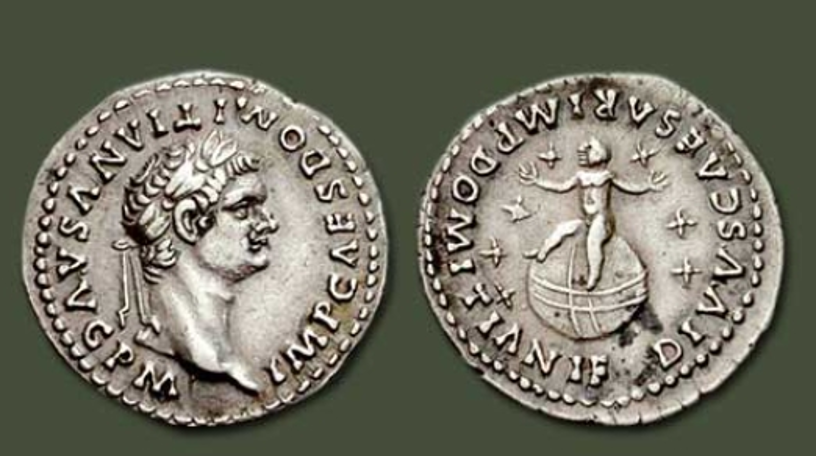
In my first part of this article, I addressed a claim Joel Richardson made on a podcast about a coin struck by Domitian around AD 82-83. He argued that the coin proved Revelation was written during Domitian’s reign and that Revelation 1:16, 20 referred directly to that coin. I showed that numerous coins with stars, some with seven stars, were struck before AD 70 and after AD 95, when Richardson claims Revelation was written. Nero is the better candidate for several reasons I outline in Part 1.
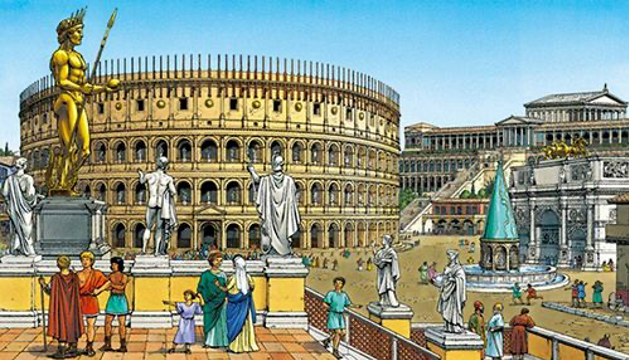
Nero commissioned a 100-foot bronze statue of himself, the Colossus Neronis, that represented him as the sun god. Nero’s successors later modified it into a statue of the sun god Sol, Colossus Solis. Nero’s crown featured sun rays radiating outward and upward. An earthquake probably toppled it in the fifth century, or the sack of Rome in AD 410 destroyed it.
David Chilton (1951-1997) wrote a commentary on Revelation that has been in print since 1987. He was a well-known preterist. The following are some of his comments on Revelation 1:16. Richardson should have read more widely before making such a dogmatic claim.
The symbolic use of the seven stars was quite well known in the first century, for the seven stars appeared regularly on the Emperor’s coins as symbols of his supreme political sovereignty. At least some early readers of the Revelation must have gasped in amazement at St. John’s audacity in stating that the seven stars were in Christ’s hand. The Roman emperors had appropriated to themselves a symbol of dominion that the Bible reserves for God alone—and, St. John is saying, Jesus Christ has come to take it back. The seven stars, and with them all things in creation, belong to Him. Dominion resides in the right hand of the Lord Jesus Christ.[1]
The Days of Vengeance
A biblical and scholarly exposition of Revelation is laid out for readers to soak up and begin to view the world with renewed hope and optimism. Chilton skillfully shows in detail that Christians will overcome all opposition through the work of Jesus Christ. The book of Revelation is not about the antichrist, the devil, microchips, or bar codes. It is, as the very first verse says, "The Revelation of Jesus Christ."
Buy NowAs a preterist, Chilton believed Revelation was written before AD 70. This means he explained that Revelation 1:16 referred to star symbols that existed before AD 70 and would have applied after the destruction of the Jerusalem temple and to this day. He points out that “the seven stars appeared regularly on the Emperor’s coins as symbols of supreme political sovereignty.” Domitian’s seven-star coin was not unusual, and neither were similar coins struck long after. Today, nations use the sun (Japan), the moon (Islamic nations), and stars (the United States of America) on their flags and coins. The European Union flag and coins contain stars.

Grant R. Osborne says something like what Chilton wrote but doesn’t link it to Domitian because stars on coins, even seven stars, weren’t unusual.
Some scholars see an astrological reference here, perhaps to the Pleiades cluster (linked in the Hellenistic world with the seven daughters of Atlas and Pleione), or as in Jewish writings with seven members of this solar system (sun, moon, Mercury, Venus, Mars, Jupiter, Saturn) linked with the seven branches of the menorah. In this sense an interesting suggestion is made by Krodel [2] (1989:95) that this could be intended to contrast with “the pretensions of Roman emperors who asserted their cosmic rule with the symbols of planets surrounding them.” In the ancient world stars were frequently seen as powers (usually the gods) that could influence the course of history and determine the destiny of humankind.[3]
Note this comment by Osborne: “as in Jewish writings with seven members of this solar system.” John could easily have had Job 9:5-9, 38:31-33, and Amos 5:8 in mind rather than any emperor. Craig R. Koester’s Revelation commentary mentions the Domitian coin, in that it “depicts the emperor’s deceased son as young Jupiter, sitting on the globe in a posture of world dominion.”[4] But this would conflict with his claim that 666 and 616 refer to Nero Caesar. Gordon Franz’s comment sounds a lot like what Richardson claims but is less dogmatic:
I cannot help but use my sanctified imagination and wonder if John did not have this coin in front of him when he penned, “and in the midst of the seven lampstands One like the Son of Man, clothed with a garment down to His feet … He had in His right hand seven stars’ (Rev. 1:13,16).”[5]
This is not biblical exegesis. Imagining what a biblical writer was doing or thinking is not how we should interpret the Bible. The biblical approach is to let the Bible speak for itself, and enough internal and external evidence supports the view that God revealed Revelation to John before the temple’s destruction.
The Bible provides the best and most reliable evidence. Revelation 11:1-2 states that the temple was still standing when John received the contents of Revelation: “measure the temple of God and the altar and those who worship there” (11:1). George Edmundson states this in his 1913 work, The Church in Rome in the First Century:
The opening verses of chapter xi. imply that the Temple of Jerusalem was still standing, and that there was no expectation of the destruction of the Shrine itself. But the outer court was to be given to the nations, who for a period represented by 42 months would trample it underfoot. [Rev. xi. I, 2. See Daniel, vii. 25, three and a half years or 42 months. It is the time of the duration of the Fourth Kingdom or Roman Empire]. This statement must have been made at the time when the legions of Titus were already closing round Jerusalem and its doom was sealed, but before it was known that the desperate character of the defence would carry with it the entire destruction of the city and its world-famous sanctuary. That Jerusalem was not destroyed when the words (xi. 8) were written—‘their dead bodies lie in the street of the Great City, which spiritually is called Sodom and Egypt, where also their Lord was crucified’ — is evident. In 95 A.D. the city was in ruins.
[T]he baleful figure of Nero dominates the entire picture of the struggle between the forces of good and evil. The wild beast, [Rev. xiii. i. At a short distance from Patmos the island of Thera or ‘the Wild Beast’ rises out of the sea.] coming up out of the sea with its seven heads and ten horns, and the imagery connected with it, was suggested to the Seer by the apocalyptic visions of Daniel vii., the fourth kingdom of Daniel being identified by him with the Roman Empire. The name of the beast [Rev. xiii. i8] is expressed by a number —‘the number of a man’ —and the number is Six Hundred and Sixty-Six…. [I]t is only when the Apocalypse is treated historically as a Neronian document that any satisfactory interpretation can be found for the imagery of certain difficult passages.[6]
Notice that Revelation 11:1 does not say, “measure a future rebuilt temple and the altar and those who will worship there.” Richardson presupposes “a future temple and a future restoration of Jerusalem.” The New Testament says nothing about a future temple or a future restoration of Jerusalem, only the temple’s destruction (Matt. 24:2). Like Domitian’s coin, Richardson and other theorists are reading into Revelation what they need to prove.
By the time the Domitian coin had been struck, the temple in Jerusalem had been in ruins for more than a decade. Not one stone was left upon another, as Jesus predicted (Matt. 24:2). Richardson appeals to archaeology, but when the date of Revelation is at stake, the strongest physical evidence is the temple’s ruins, confirmed by eyewitness accounts and archaeological findings. For his theory to carry any weight, he must find a New Testament verse stating that the temple under construction in Jesus’ day (John 2:13-22) and destroyed within a generation will be rebuilt again. There isn’t one.
Nero Caesar, who reigned from AD 54 until his suicide in 68, makes for a better candidate for the early date than Domitian based on Revelation 17:10: “There are also seven kings. Five have fallen, one is, and the other has not yet come. And when he comes, he must continue a short time.” “[T]he ‘five’ are Julius, Augustus, Tiberius, Gaius, and Claudius, who have already “fallen” (i.e., are dead). We know, therefore, that the sixth one ‘is’ (estin) the reigning emperor, Nero,” who was alive when Revelation was written. And “the other who has not yet come” is the seventh, Galba, who will only ‘remain a little while.’”[7] He reigned for only seven months, from June 8, AD 68 to January 15, 69.
The seven stars are described as the “angels” (messengers) of the seven churches—held safely in Jesus’ right hand of power and protection. The two-edged sword from His mouth symbolizes His judging word (cf. Heb. 4:12). Jesus conquers by proclamation, not by a physical sword. Jesus Himself interprets the imagery, showing that Revelation uses symbols with clear referents, not random fantasy or unbridled imagination. The “angels” may be heavenly representatives or, more likely, human messengers/overseers of each church. The key point is that Jesus Christ holds their leaders in His right hand and walks among their congregations. Before He judges Jerusalem and the nations, He first evaluates and purifies His own church and warns the seven churches that what was about to befall Jerusalem and the temple could happen to them. In Revelation 2:5, the phrase “remove your candlestick” (or lampstand) signifies the withdrawal of a church’s spiritual authority, presence, or status within the community of believers because of unrepentant sin.
Ten Popular Prophecy Myths Exposed and Answered
Millions of books have been sold proclaiming countless false prophecies. Many Christians are beginning to take a second look at the biblical prophetic record. A seismic shift in biblical eschatology is taking place around the world because Christians, some for the first time, are willing to challenge what they have been taught based on what the Bible actually says. Gary DeMar has taken on the task of exposing some of the popular myths foisted upon the public by prophetic speculators.
Buy NowDomitian and Roman emperors before and after him borrowed from God’s creation and corrupted its original meaning (Rom. 1:18-28). The sun, moon, and stars are signs of God’s creating power and sovereignty (Gen. 1:14-19). The Bible does not borrow from pagan cultures; pagan cultures borrow from the true God. “The heavens are telling of the glory of God / And their expanse is declaring the work of His hands” (Psalm 14:1). Kings, emperors, and presidents have no glory. They exist at God’s discretion. They owe their existence to God. “And let all kings bow down before him / All nations serve Him” (72:11).
Excursus
I’ve checked some premillennial commentaries that hold to a late date to see what, if anything, they say about Domitian and his coin as a date for Revelation’s composition.
• “There is no warrant for connecting the seven stars with the seven planets or with images on Domitian coins (Stauffer).”[8]
• “That Jesus holds the seven stars in his right hand means that he is in control of the churches, and that he is among the lampstands means that he is present with the churches.”[9]
• While John F. Walvoord mentions the Domitian coin and Stauffer’s comments, he states, “The mystery of the seven stars is defined in the Scriptures; however, in verse 20: ‘The seven stars are the angels of the seven churches.’”[10]
• “The ‘seven stars’ which John says are the angels of the seven churches are held in His right hand. In his Gospel, John said that the believer is secure in Christ’s hands. This is also true of the church (John 10:28-30).”[11]
• “In his strong hand he held ‘seven stars’—symbolical of the destiny of the churches as it lay in the pastors.”[12]
• “In the phrase ‘in his right hand he held seven stars,’ the right hand is the place of power and safety, and the ‘seven stars’ Christ held in it are identified with the seven angels of the seven churches in Asia (v. 20). This is the only detail in the vision that is identified. Why the symbolism of stars? This probably relates to the use of ‘angels’ as those to whom the letters to the seven churches are addressed (chs. 2-3). Stars are associated in the OT and in Revelation with angels (Job 38:7; Rev 9:1) or faithful witnesses to God (Da 12:3). The first letter (that to Ephesus) includes in its introduction a reference to the seven stars (2:1), and in 3:1 they are associated closely with the ‘seven spirits of God.’”[13]
• “Verse 16. In his right hand he held seven stars. This signifies his care of the churches (1:20; see John 10:28).”[14]
• “Taking a clue from Revelation 1:20, we understand this to mean that Christ is present in the midst of the congregation and holds them in his control.”[15]
• “The image of the seven stars in Christ’s right hand would have also spoken to the people of John’s time in other ways. First, this is an anti-astrology message. The stars do not control our destiny and are not to be feared. Christ is the Lord who holds the stars in his hand. Second, the symbol of the stars challenges the divine claims of certain Roman Caesars. To illustrate, the young son of the Emperor Domitian died in A.D. 83. Domitian proclaimed the child a god and minted coins picturing his mother, Domitia, as queen of heaven, and the child holding the stars in his hands. In Revelation 1, John removes the stars from human hands and places them where they rightfully belong—in the hand of Christ. He thus declares the Roman Caesars to be false imitations of the true cosmic ruler, who is Christ the Lord.”[16]
• “In his right hand seven stars” The stars are afterwards interpreted as representing the seven angels, messengers, or bishops of the seven Churches. Their being in the right hand of Christ shows that they are under his special care and most powerful protection.”[17]
• “There is no need to search for a mythological or astrological background such as Pleiades (the seven daughters of Atlas and Pleione, placed by Zeus among the stars) or the seven planets (sun, moon, Mercury, Venus, Mars, Jupiter, and Saturn). [For a presentation of this idea, see M. Wojciechowski, “Seven Churches and Seven Celestial Bodies,” Biblische Notizen, 45 (1988), 48-50.] That Christ has the full complement of stars in his right hand indicates his sovereign control over the churches [Roloff comments that ‘in the ancient world the stars were viewed as powers that determine the course of the world and control human destiny in a variety of ways. Dominion over them thus means supreme power and authority that encompasses everything” (36).] It may also imply protection (John 10:28: ‘no one can snatch them out of my hand’).”[18]
• “Let the churches know that their risen Redeemer is mighty; is crowned with glory and honor and set over the realm of nature and the empire of the world, “King of kings and Lord of lords.” Let them have no fear as to the final triumph of his cause.”[19]
[1] Chilton, The Days of Vengeance: An Exposition of the Book of Revelation (Dallas, GA: Dominion Press, 1987), 75-76. Also see Michael Barber, Coming Soon: Unlocking the Book of Revelation and Applying its Lessons Today (Stubenville, OH: Emmaus Road Publishing, 2005), 47.
[2] “The seven stars in his right hand contrast with the pretensions of Roman emperors who asserted their cosmic rule with the symbols of planets surrounding them. Moreover, in astrological magic the stars, or planets, were believed to determine the destiny of people and nations. Christ holding the seven stars in his right hand appears as the one and the only one who controls the fate of each individual and of the cosmos as a whole. Moreover, an ironic interpretation will turn the stars into ecclesiastical angels who are subject to censure and praise (v. 20).” Gerhard A. Krodel, Revelation, Augsburg Commentary on the New Testament (Minneapolis, MN: Augsburg Publishing House, 1989), 95.
[3] Grant R. Osborne, Revelation, Baker Exegetical Commentary on the New Testament (Grand Rapids, MI: Baker Academic, 2002), 92.
[4] Revelation: A New Translation with Introduction and Commentary (The Anchor Yale Bible Commentaries) (New Haven, CT: Yale University Press, 2014), 253.
[5] “Propaganda, Power, and Perversion of Biblical Truths: Coins Illustrating the Book of Revelation,” Biblical Archaeology (November 15, 2021). https://bit.ly/4xLq6ts
[6] (London: Longmans, Green and Co., 1913), 172-173, 174.
[7] Kenneth L. Gentry, Jr., The Divorce of Israel: A Redemptive-Historical Interpretation of Revelation, 2 vols. (Acworth, GA and Vallecito, CA: Tolle Lege Press and Chalcedon Foundation, 2024), 2:1341.
[8] Alan F. Johnson, The Expositor’s Bible Commentary: with The New International Version (Grand Rapids, MI: Zondervan, 1996), 34.
[9] James M. Hamilton, Jr., Revelation: The Spirit Speaks to the Churches (Wheaton, IL: Crossway, 2012), 51.
[10] The Revelation of Jesus Christ (Chicago: Moody Press, 1966), 45.
[11] John P. Newport, The Lion and the Lamb: A Commentary on the Book of Revelation for Today (Nashville: Broadman Press, 1986), 137.
[12] Ray Summers, Worthy Is the Lamb: An Interpretation of Revelation (Nashville: Broadman Press, 1951), 105.
[13] Alan F. Johnson, “Revelation,” in The Expositor’s Bible Commentary: Hebrews–Revelation, eds. Tremper Longman III and David E. Garland, rev. ed. (Grand Rapids, MI: Zondervan, 2006), 13:606.
[14] George Eldon Ladd, A Commentary on the Revelation of John (Grand Rapids, MI: Eerdmans, 1972), 33.
[15] Robert H. Mounce, What Are We Waiting For? A Commentary on Revelation (Eugene, OR: Wipf & Stock Publishers, 2004), 6.
[16] Christopher A. Davis, Revelation, The College Press NIV Commentary (Joplin, MO: College Press Pub., 2000), 121.
[17] Adam Clarke, Revelation 1:16.
[18] Robert H. Mounce, The Book of Revelation, The New International Commentary on the New Testament (Grand Rapids, MI: Eerdmans, 1997), 59.
[19] Henry Cowles, The Revelation of John; With Notes, Critical, Explanatory, and Practical (New York: D. Appleton and Company, 1871), 64.