
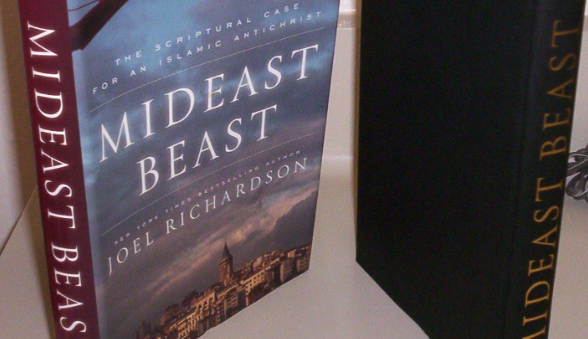
“Joel Richardson” (his pen name) has written several books on eschatology (Mystery Babylon, When Jew Rules the World, and The Islamic Antichrist) and produced numerous videos. One of his latest is “The One Prophecy that Debunks Preterism, Replacement Theology, and the Lies of the Anti-Semites.” It’s about the “day of the Lord” and Ezekiel 38. If he thinks Ezekiel 38 “debunks” preterism, he is in for a rude awakening. I’ll address his comments in my next article and maybe in a video podcast (AV is moving to do video podcasts).
When someone like Richardson accuses an opposing prophecy view of advocating “replacement theology” and “antisemitism,” you know you’re going to be taken on a wild interpretive ride! Stay tuned. Poisoning the well is a favorite tactic when weak arguments are employed. It’s like playing the race card. “Before listening to anything preterists say, keep in mind they are antisemitic. Now I’m going to misrepresent what they have to say to prove it.” Hal Lindsey tried this in 1989 with his book The Road to Holocaust. In our rebuttal book, The Legacy of Hatred Continues, Peter J. Leithart and I showed that dispensationalism is leading Israel down the road to another holocaust.
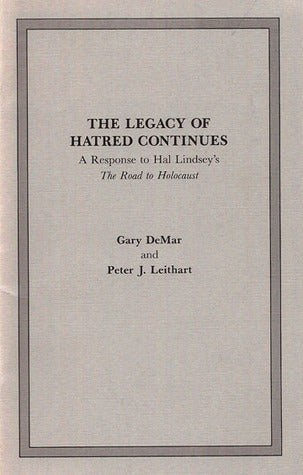
The Legacy of Hatred Continues
We pursued all the means at our disposal to meet with Hal Lindsey over the "anti-Semitism" charges he made in his poorly researched book The Road To Holocaust and directs against amillennialists, historic premillennialists, and postmillennialists, especially Christian Reconstructionists. He would not meet with us. We were told that "Lindsey is not interested in talking about it. His basic word is write a book in response" (personal letter to Gary DeMar from a professor at Dallas Theological Seminary, March 17, 1989). This is that book. We believe that Hal Lindsey is wrong in making eschatology the test of orthodoxy. As we will point out in The Legacy of Hatred Continues, the problem is not eschatology but ethics, obedience not expectations. ''Anti-Semitism'' crosses all eschatological lines, just as love for the Jews crosses all eschatological lines.
Buy NowI agree with Richardson when he writes, “I am firmly convinced that Islam is the single greatest challenge the Church will face,” but he gets this next part wrong: “before the return of Jesus.” He also gets this right, “yet most are still either asleep or in denial,” but for the wrong reason. The church is asleep and in denial because millions of Christians have bought into the end-time prophetic system called “dispensationalism.”
In 2010, I spoke with Joel at the “Take America Back Conference” held in Miami, October 15-18, sponsored by World Net Daily (WND), the publisher of his books. I mentioned that I had been working on a response to his article “Preterism: The Marxist’s Theological Tool.” In an earlier draft, he claimed Gary North was a Marxist, the only person who wrote an economic commentary on the Bible in 30+ volumes! Joel lives in the bubble of futurist eschatology. It’s his version of eschatology that allows Marxism, Islamism, and Secularism to fester and pollute our world because they are said to be inevitable tools of the antichrist who must wreak havoc on the world in the “last days.” It’s really Last Days Madness.
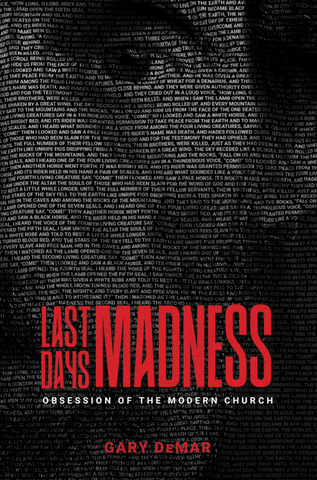
Last Days Madness
In this authoritative book, Gary DeMar clears the haze of "end-times" fever, shedding light on the most difficult and studied prophetic passages in the Bible, including Daniel 7:13-14; 9:24-27; Matt. 16:27-28; 24-25; Thess. 2; 2 Peter 3:3-13, and clearly explaining a host of other controversial topics.
Buy NowThe only escape from the clutches of these perverted ideologies is the “rapture of the church.” Joel believes the Antichrist is a Muslim leader, specifically the Mahdi, the messianic figure expected in Islamic eschatology. He argues that the Mahdi fulfills the biblical description of the antichrist. Muslims and unbelieving Jews are the biblical definition of antichrists: they deny “that Jesus is the Christ” and “the Father and the Son” (1 John 2:22), and they do not acknowledge Jesus Christ as coming in the flesh” (2 John 7). When were these “antichrists”? In John’s day. There were many of them, and their existence was evidence that it was the “last hour” then (1 John 2:18). The Bible says nothing about an end-time antichrist.
Preterists see Marxism, Islamism, and Secularism as worldview dead ends. They survive because Christians don’t have an earth-bound strategy and eschatology to confront and replace them. Marxists, Islamists, and Secularists are eschatological futurists. They believe their worldview will conquer the world, and their advocates work hard to make it happen. This is not true for end-time eschatologists like Richardson. The end is inevitably set for these movements to win.
Let’s go back to Gary North. In 1968, he wrote Marx’s Religion of Revolution: The Doctrine of Creative Destruction. In 1989, he published a much-expanded edition titled Marx’s Religion of Revolution: Regeneration Through Chaos. Dispensationalism is similar in that it teaches regeneration through chaos in an event called “the rapture of the church.” The more chaos there is in the world, the more evidence there is that the rapture is near. There’s no fighting against it because it’s a prophetic inevitability.
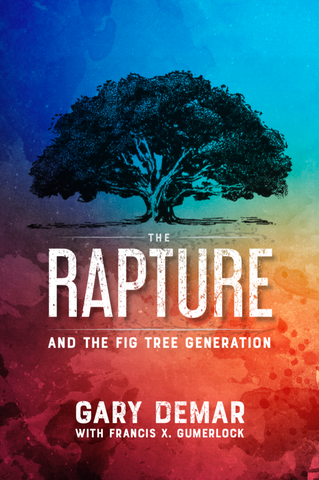
The Rapture and the Fig Tree Generation
Since the national reestablishment of Israel in 1948, countless books and pamphlets have been written defending the doctrine assuring readers that it could happen at any moment. Some prophecy writers claimed the “rapture” would take place before 1988. We are far removed from that date. Where are we in God’s prophetic timetable?
Buy NowAccording to dispensationalists Mark Hitchcock, Jonathan Cahn, and others, the United States will be wiped out. How do we “know” this? Because the United States is not mentioned in the Bible! This means that we are headed for certain doom, and there is nothing Christians can do about it. It’s Bible prophecy.
Consider these statements from well-known dispensationalists:
• “This world is not going to get any easier to live in. Almost unbelievably hard times lie ahead. Indeed, Jesus said that these coming days will be uniquely terrible. Nothing in all the previous history of the world can compare with what lies in store for mankind.”[1]
• “What a way to live! With optimism, with anticipation, with excitement. We should be living like persons who don’t expect to be around much longer.”[2]
• “I don’t like cliches, but I’ve heard it said, ‘God didn’t send me to clean the fishbowl, he sent me to fish.’ In a way, there’s a truth in that.”[3] If you don’t clean the fishbowl, the fish die. We can’t and shouldn’t try to clean the fishbowl because Bible prophecy tells us it’s futile.
• “The premillennial position sees no obligation to make distinctly Christian laws.”[4]
• Ted Peters writes that dispensationalism “functions to justify social irresponsibility,” and many “find this doctrine a comfort in their lethargy.”[5]
William Edgar, a professor of apologetics at Westminster Theological Seminary, recounts the time in the 1960s he spent studying at L’Abri in Switzerland under the tutelage of Francis A. Schaeffer (1912-1984).[6]
I can remember coming down the mountain from L’Abri and expecting the stock market to cave in, a priestly elite to take over American government, and enemies to poison the drinking water. I was almost disappointed when these things did not happen.[7]
Edgar speculated, with good reason, that it was Schaeffer’s eschatology that negatively affected the way he saw and interpreted world events. One of Schaeffer’s last books, A Christian Manifesto, called for civil disobedience as a stopgap measure to postpone an inevitable societal decline. “The fact remains that Dr. Schaeffer’s manifesto offers no prescriptions for a Christian society. . . . The same comment applies to all of Dr. Schaeffer’s writings: he does not spell out the Christian alternative. He knows that you ‘can’t fight something with nothing,’ but as a premillennialist, he does not expect to win the fight prior to the visible, bodily return of Jesus Christ to earth to establish His millennial kingdom.”[8] Tom Sine offers a startling example of the effect “prophetic inevitability” can have on some people:
“Do you realize if we start feeding hungry people things won’t get worse, and if things don’t get worse, Jesus won’t come?” interrupted a coed during a Futures Inter-term I recently conducted at a northwest Christian college. Her tone of voice and her serious expression revealed she was utterly sincere. And unfortunately I have discovered the coed’s question doesn’t reflect an isolated viewpoint. Rather, it betrays a widespread misunderstanding of biblical eschatology . . . that seems to permeate much contemporary Christian consciousness. I believe this misunderstanding of God’s intentions for the human future is seriously undermining the effectiveness of the people of God in carrying out his mission in a world of need. . . . The response of the (student) . . . reflects what I call the Great Escape View of the future. So much of the popular prophetic literature has focused our attention morbidly on the dire, the dreadful, and the destruction of all that is.[9]
Eschatological ideas have consequences, and many Christians are beginning to understand how those ideas have shaped the cultural landscape. A world always on the precipice of some great and inevitable apocalyptic event is not in need of redemption but only of escape. As one end-time speculator put it, “the world is a sinking Titanic ripe for judgment.”[10]
[1] Charles C. Ryrie, The Living End (Old Tappan, NJ: Revell, 1976), 21.
[2] Hal Lindsey, The Late Great Planet Earth (Grand Rapids, MI: Zondervan, 1970), 145.
[3] Hal Lindsey, “The Great Cosmic Countdown,” Eternity (January 1977), 21.
[4] Norman L. Geisler, “A Premillennial View of Law and Government,” Moody Monthly (October 1985), 129.
[5] Ted Peters, Futures: Human and Divine (Atlanta, GA: John Knox, 1978), 28, 29.
[6] See Colin Duriez, Francis Schaeffer: An Authentic Life (Wheaton, IL: Crossway Books, 2008), 42.
[7] William Edgar, “Francis Schaeffer and the Public Square” in J. Budziszewski, Evangelicals in the Public Square: Four Formative Voices on Political Thought and Action (Grand Rapids, MI: Baker Academic, 2006), 174.
[8] Gary North and David Chilton, “Apologetics and Strategy,” in Tactics of Christian Resistance: A Symposium, ed. Gary North (Tyler, TX: Geneva Divinity School, 1983), 127-128. Emphasis in original.
[9] Tom Sine, The Mustard Seed Conspiracy: You Can Make a Difference in Tomorrow’s Troubled World (Waco, TX: Word, 1981), 69.
[10] Jan Markell, “Kingdom Now: We’re Not Returning to Eden.” For a response, see Gary DeMar, “Is the World a Sinking Titanic?,” Biblical Worldview (May 2007), 4-6.