
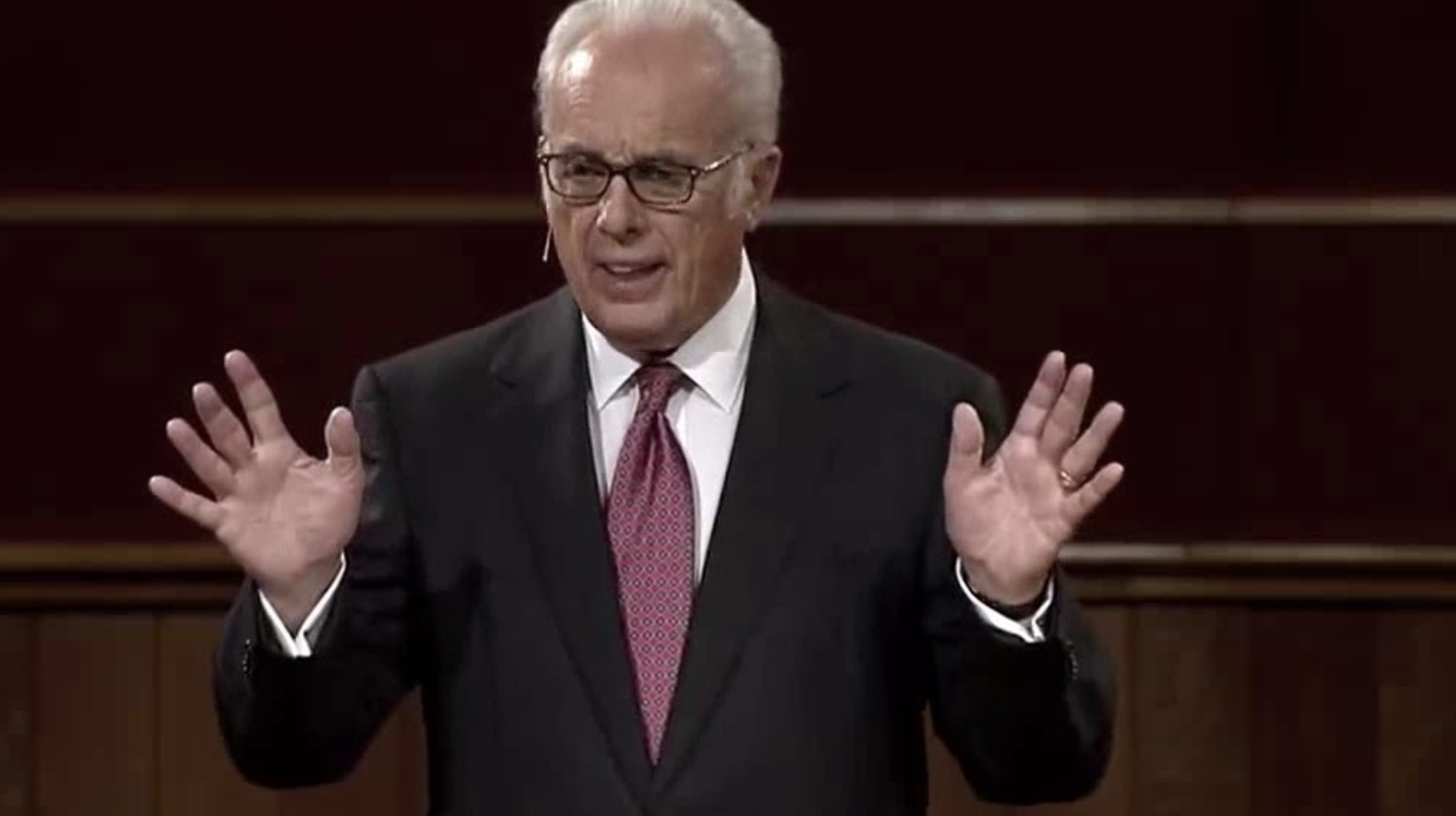
Jonathan Sedlak, author of Reading Matthew, Trusting Jesus: Christian Tradition and First-Century Fulfillment within Matthew 24-25, told me in a recent phone call that it was John MacArthur’s book The Second Coming: Signs of Christ’s Return and the End of the Age (2006) that led him to investigate preterism because it mentioned several preterists, including me (although my name is misspelled as Demar rather than DeMar).
In The Second Coming, MacArthur seems to go out of his way to avoid dealing with the inherent problems of his prophetic system. Here’s just one example:
[N]otice Christ’s only explicit remarks about the destruction of the temple are those recorded in verse 2 [of Matthew 24], as Jesus and the disciples were departing from the temple (v. 1). In the Olivet Discourse itself He makes no clear reference to the events of A.D. 70. His entire reply is an extended answer to the more important question about the signs of His coming and the end of the age. Virtually ignoring their initial question, He said nothing whatsoever about when the destruction of Jerusalem would occur. That is because those events were not really germane to the end of the end of the age. They were merely a foretaste of the greater judgment that would accompany His return, previews of what is to come ultimately. (SC, 80)
This is a remarkable statement, given that nothing in the context of the Olivet Discourse indicates that Jesus is “ignoring their initial question.” How does MacArthur know this? He doesn’t. This is not exegesis. He is reading his dispensational system into the text. He scrupulously avoids the heart of the debate over the time texts, especially regarding “this generation” (24:34).

Last Days Madness
In this authoritative book, Gary DeMar clears the haze of "end-times" fever, shedding light on the most difficult and studied prophetic passages in the Bible, including Daniel 7:13-14; 9:24-27; Matt. 16:27-28; 24-25; Thess. 2; 2 Peter 3:3-13, and clearly explaining a host of other controversial topics.
Buy Now“Virtually ignoring their initial question, He said nothing whatsoever about when the destruction of Jerusalem would occur.” Nothing whatsoever? MacArthur (or whoever edited this book) had to say this because to admit that Jesus was describing what was going to happen to the temple that was standing there—“not one stone here shall be left upon another” (24:3)—would mean Jesus had a great deal to say “about when the destruction of Jerusalem would occur.” It would occur before that existing generation passed away (24:34).
I could say a lot about MacArthur’s comments on Matthew 24, but I’ve said them repeatedly elsewhere. I found this comment surprising.
Notice, moreover, that the great tribulation Christ described involves cataclysm and suffering on a global cosmic scale (vv. 29-30)—not a local holocaust in Jerusalem only. (SC, 78)
If Jesus isn’t describing “a local holocaust in Jerusalem only,” then how is it that it can be avoided by escaping to the mountains outside of Judea (24:16-20)?
The cosmic language of 24:29-30 is typical of cosmic language used to describe a judgment on Babylon (Isa. 13:1-11) and “Judah and against all the inhabitants of Jerusalem” (Zeph. 1:1-4). See R.C. Sproul’s comments in Matthew: An Expositional Commentary (2019). For example, “In Old Testament prophecy, there is a very clear use of cosmic phenomena in descriptions of judgment. In other words, when God promised to send judgment, He often spoke in highly figurative language” (653-654). Sproul then quotes Isaiah 13:9-10, 13, and 34:4. He notes that while “Jesus’ language was figurative, … He was describing a judgment event that literally happened within that generation.” (654) Sproul goes on to note that “Josephus writes that certain signs were observed between the years AD 60 and 70, one of which was a blazing comet.” (655). Josephus described a comet, a “star resembling a sword,” that passed over Jerusalem in AD 66, which many might have believed was a sign of an approaching calamity.
MacArthur’s The Second Coming reads as if it was written in a hurry or maybe edited in a hurry. For example, in one place MacArthur writes that preterists “ultimately depart from and nullify the strict literal sense of Matthew 24:34,” while on the previous page he chides preterists for insisting that Matthew 24:34 should be interpreted with “wooden literalness.” (SC, 81, 80) MacArthur should have studied how “this generation” is used elsewhere in the New Testament. “This generation” always refers—without exception—to the generation to whom Jesus is speaking.[1] Since the meaning of “this generation” is crucial for establishing the proper time setting for the Olivet Discourse, MacArthur should have spent considerable time justifying his interpretation. See my books Last Days Madness and Wars and Rumors of Wars, John Bray’s Matthew 24 Fulfilled, and James Jordan’s Matthew 23-25 for a thorough discussion of this topic.
MacArthur described the preterist interpretation of “this generation” a “misunderstanding” (SC, 219) without addressing the extensive arguments preterists use to defend their position. Preterists are not the only ones who have this “misunderstanding.” Here are three examples from commentators who would not describe themselves as preterists:
• [T]he obvious meaning of the words “this generation” is the people contemporary with Jesus. Nothing can be gained by trying to take the word in any sense other than its normal one: in Mark (elsewhere in 8:12, 9:19) the word always has this meaning.[2]
• [This generation] can only with the greatest difficulty be made to mean anything other than the generation living when Jesus spoke.[3]
• The significance of the temporal reference has been debated, but in Mark “this generation” clearly designates the contemporaries of Jesus (see on Chs. 8:12, 38; 9:19) and there is no consideration from the context which lends support to any other proposal. Jesus solemnly affirms that the generation contemporary with his disciples will witness the fulfillment of his prophetic word, culminating in the destruction of Jerusalem and the dismantling of the Temple.[4]
I could quote many more examples. See the list in my book Wars and Rumors of Wars. Why didn’t MacArthur attempt to refute these non-preterist scholars? Do they misunderstand Scripture’s clear teaching?

Wars and Rumors of Wars
A first-century interpretation of the Olivet Discourse was once common in commentaries and narrative-style books that describe the fall of Jerusalem in AD 70. There is also a history of skeptics who turn to Bible prophecy and claim Jesus was wrong about the timing of His coming at “the end of the age” and the signs associated with it. A mountain of scholarship shows that the prophecy given by Jesus was fulfilled in exacting detail when He said it would: before the generation of those to whom He was speaking passed away.
Buy NowIn addition to an incomplete study of how “this generation” is used in the gospels, MacArthur morphed “near” and “shortly” into “imminent” without ever making an exegetical case for it. If the Holy Spirit wanted to convey that Jesus could return at “any moment” over nearly 2000 years (so far), He would have directed the biblical writers to use Greek words meaning “any moment,” not “near” or “shortly.” He didn’t.
Consider James 5:8-9, a passage MacArthur uses to support his contention that Jesus could come “at any moment” but was near to those who first received and read his letter. (SC, 51) “You too be patient; strengthen your hearts, for the coming of the Lord is at hand” (5:8). The “you” (plural) referred to them. “At hand,” or “near,” cannot be made to mean “any moment.” The next verse defines “at hand”: “Behold, the Judge is standing right at the doors” (5:9). “At hand” = “right at the doors.” How far from the door is Jesus in Revelation 3:20? Being “right at the door” means being close enough to knock. Compare James 5:9 with Matthew 24:33, “even so you too, when you see all these things, recognize that He is near, at the doors.”
MacArthur’s short commentary on Revelation, Because the Time is Near: John MacArthur Explains the Book of Revelation, is a problem historically since nearly 2000 years have passed since the events were said to take place soon” (1:1; 22:6) “because the time is near” (1:3; 22:10) for those who first read the Apocalypse (1:1). MacArthur is either oblivious to the debate surrounding this issue or he tactically decided to steer his readers around the topic so as not to raise a very big red flag.
David Chilton, author of Paradise Restored, The Great Tribulation, and The Days of Vengeance, told me that he listened to a series of talks by MacArthur on hermeneutics and biblical interpretation. David was impressed by how helpful it was. Then he listened to some messages that MacArthur gave on Bible prophecy and could not understand why MacArthur was not following the interpretive principles he fleshed out in his short course on hermeneutics.
MacArthur states that interpreting “this generation” in a “wooden literalness” fashion would mean that “the rest of the Olivet Discourse must be spiritualized or otherwise interpreted figuratively in order to explain how Christ’s prophecies could all have been fulfilled by A.D. 70 without His returning bodily to earth.” (SC, 80) Do preterists spiritualize (a word not often defined) the events Jesus described in Matthew 24 and elsewhere in the gospels? Not at all! There were literal earthquakes (Matt. 27:54; 28:2; Acts 16:26) and literal famines (Acts 11:28; cf. Rom. 8:35), just as Jesus predicted (Matt. 24:7). The same is true of literal “false prophets” (1 John 4:1).
What do we make of Paul’s statement that the “gospel” had been preached “throughout the world [kosmos]” (Rom. 1:8), “to all the nations” (Rom. 16:25-26; 1 Tim. 3:16d), “in all creation under heaven” (Col. 1:23; also 1:6), just as Jesus predicted would take place (Matt. 24:14) before that generation passed away? Jesus used the Greek word oikoumenē in verse 14. When compared with how it’s used in Luke 2:1 and Acts 11:28, the gospel only had to be preached throughout the then-known world to be fulfilled, and it was. Then there are Jesus’ specific words that the literal temple the disciples asked about would be destroyed before the last apostle died (Matt. 16:27-28), before their generation passed away (24:34).
Last Days Madness and Wars and Rumors of Wars answer every argument MacArthur raises, and his books avoid addressing. Some might claim that MacArthur is unaware of the work done in this area. This debate has been around for centuries. Anyone writing on this topic should be aware of the current literature. He knew what was going on. He (or his editor) quotes an internet article of mine and references other preterist sources like Ken Gentry.
[1] See Gary DeMar, Last Days Madness: Obsession of the Modern Church and Wars and Rumors of Wars at AmericanVision.org
[2] Robert G. Bratcher and Eugene A. Nida, A Translator’s Handbook of the Gospel of Mark (New York: United Bible Societies, 1961), 419.
[3] D.A. Carson, “Matthew” in The Expositor’s Bible Commentary, gen. ed. Frank E. Gaebelein, 12 vols. (Grand Rapids, MI: Zondervan, 1985), 8:507.
[4] William L. Lane, Commentary on the Gospel of Mark (Grand Rapids, MI: Eerdmans, 1974), 480.