

Gary welcomes Kim Burgess back to answer a listener’s question about 1 Corinthians 15:24–28.
My thesis in this series is that OT Israel was Yahweh’s chosen means to bring salvation to the Gentile nations of the world. Not understanding this principle gets us off track. People think that eschatology, because of the influence of the historic creeds of the Church and of the various systematic theologies, is only about the “end of time” in world history. It is not. In the most foundational sense in the Bible, Biblical eschatology is about OT Israel, and especially about the consummation of Israel’s history of redemption that led from the call of, and the promises made to, Abraham on to the person and work of Christ together with the consequences that all this redemptive history had for world history and its own subsequent consummation. As we have already seen in previous Episodes, Israel’s eschatology was dealing with the objective and the covenantal in the sense of redemption accomplished as that is then “worked out” in the world among the Gentile nations by way of redemption applied…
Without this background understanding in the Old Testament, the New Testament is not going to make much sense. The New Testament is left floating in air, as it were, without these Old Testament roots or foundation behind it to supply the context for it, which is why I thought some time needed to be taken here to focus on this topic. True, we are hitting it on the fly to deal with all this background material so quickly: Adam, the fall, Noah, the flood, the Tower of Babel, and all leading up to Abraham, whose calling is going to morph into the nation of OT Israel.
But here is another key question. Where do we start seeing Israel as a people in Scripture in a full-blown sense? It is not in Genesis. That book is the record of the patriarchs—Abraham, Isaac, and Jacob—leading on eventually to Israel. We see Israel in earnest for the first time in the book of Exodus, right? We see Israel’s bondage in Egypt. But, just as importantly, where do we cease to see Israel in Scripture, and I include the New Testament too in the scope of this question? To be honest, this is a kind of a trick question because the answer is, well, we do not cease to see Israel in Scripture. OT Israel, that is, the national form or manifestation of Israel, did not fall until AD 70. But we believe, as preterists, that this catastrophic event took place after the New Testament documents were all written, and so it took place past the pages of the New Testament.
This tells us something important. Israel, the nation, spans the whole gamut from Exodus through to Revelation. Now, true, the New Testament Church (ekklēsia) was going to come into being when the New Covenant order started with the person and redemptive work of Jesus, but this does not mean that Israel per se is supplanted by the Church. No, we are not advocating any “supersessionism” or what is called “replacement theology” per Israel.
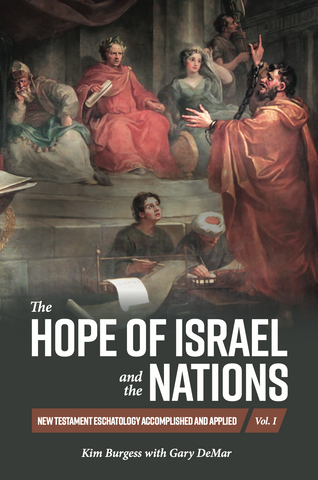
The Hope of Israel and the Nations
The reader and student of the Bible must first understand the content of the New Testament writings in terms of how those in the first century would have understood it. The New Testament is written against the background of the Old Testament. The shadows of the Old were fulfilled in the reality of the New. All the rituals and ceremonies were fulfilled in Jesus. The same is true of the temple, land, blood sacrifices, the nature of redemption, the resurrection of the dead, the breaking down of the dividing wall dividing Jews and Gentiles, and so much more. The New Testament's emphasis is on the finished work of Jesus and its application, not only to that Apostolic generation but to the world today.
Buy NowGary welcomes Kim Burgess back to answer a listener’s question about 1 Corinthians 15:24–28. The preliminary work of Christ in the period of AD 30 to 70 was to bring in the Kingdom of God. That work specifically involved making of none effect the “rulers, authorities, and powers” (vs. 24) that stood in the way of the coming of the Kingdom, referred to in vs. 25 as Christ’s “enemies.”