

Gary discusses the biblical perspectives and the responsibilities of pastors in addressing controversial issues.
While the Bible may be believed in principle, it is too often denied in practice. When we are told that “Christians must address ‘issues’ in the society,” the following disclaimer is often given: “but not institutions.” How does one address issues but not institutions since “issues arise within institutions and cannot be properly addressed unless one has some idea of what an institution in God’s world should be like”? The key to fighting any evil is to understand how God’s world works. Without that understanding there is no possibility of changing anything. There must be a model. That model must come from the person who designed the model. God has designed the world, and the Bible is the Owner’s Manual on how it works. “Without a model, we draw our options over issues from the alternatives presented by the society.” This is exactly what the church has done. Prevailing anti-Christian ideologies have shaped the church’s view of the world.
This approach leaves the Christian with few regulations. “A diversity of cultural contexts and political structures” mitigates the application of a narrowly focused law system, even if it’s from God. The absence of specific biblical regulations means an ethical free-for-all. If the Christian’s life is not regulated by “detailed regulations,” then we can’t expect much from the Bible to be applied to the world at large.
We have moved from specific guidelines to being “moved by the Holy Spirit.” The Spirit and the Word are never in opposition. Much has been done in the name of the Holy Spirit, and not all of it can be supported by Scripture. But what does it mean, for example, to “pay your taxes”? Is the State free to tax citizens at any rate? Are there biblical norms for taxation? If there are no “detailed regulations,” then the State is free to confiscate all our income by an appeal to the general law “pay your taxes.” Keep in mind that the prohibition regarding abortion is found with those laws Dr. Henry says are no longer obligatory during the New Testament era (Ex. 21:22–25). There’s no direct prohibition of abortion in the New Testament, although it is certainly possible to infer such a prohibition (Luke 1:41), but only because the Old Testament is more specific. Neither will you find a prohibition of bestiality in the New Testament (cf. Ex. 22:19; Lev. 18:23–25).
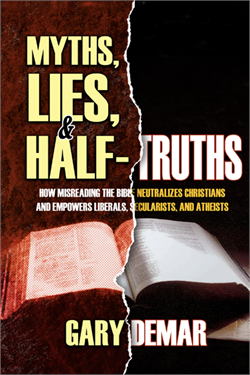
Myths, Lies, and Half-Truths
Like the Bereans of Paul’s day (Acts 17:11), Christians should check the veracity of all opinions against the only reliable standard of authority that God has placed in our hands: the Bible. This may mean a change in belief systems for some. There is no novelty in this. God confronted Peter directly about the inclusion of Gentiles into the household of faith (10:9–16). Paul confronted Peter “to his face” on a similar matter (Gal. 2:11–14). There are times when we all need to be knocked off our horse of mistaken opinions (Acts 9:4). “Testing” is a biblical mandate (2 Cor. 13:5; 1 John 4:1).
Buy NowGary discusses the biblical perspectives and the responsibilities of pastors in addressing controversial issues. He critiques the arguments made by James Talarico, emphasizing the need for a clear understanding of the Bible’s stance on abortion and the importance of teaching these principles in churches. The unborn child is considered a human being in biblical texts and pastors should be teaching these topics from the pulpit.