
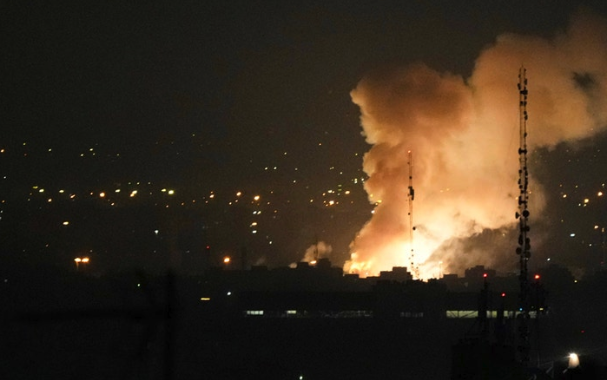
There are reports that troops are being told that what’s happening with Iran is a divine end-time event related to the return of Jesus and Armageddon. I’ve seen reports that Pete Hegseth is pushing this narrative. I find that claim hard to believe, since Hegseth is a member of a CREC Church affiliated with the denomination founded by Douglas Wilson. Wilson certainly does not believe that Armageddon is right around the corner.
I would not be surprised, however, if some people in the military believe that prophecy is being fulfilled before our eyes. Such a belief is pushed 24/7 on Facebook, Christian television, numerous pop-prophecy books, and articles. Jack Hibbs, Amir Tsarfati, David Jeremiah, and numerous online prophetic end-time “experts” are promoting the belief that the rapture is near, citing passages such as Jeremiah 49:34-39. Hibbs said in a recent message, “God has a plan for Elam…. There is no historian and no biblical scholar that will tell you that the prophecy of Elam was fulfilled, and it’s done and completed…. Remember the bucket you saw about the past—it doesn’t go there—but it does go in the bucket of the present.”
You might wonder what Elam has to do with Iran? Nothing. Jeremiah is not describing modern-day Persia. Elam was the son of Shem (Gen. 10:22). The Elamites are mentioned in Abraham’s time (Gen. 14), Isaiah, Jeremiah, Daniel, and Acts. Hibbs wants to turn a fulfilled prophecy into events surrounding Iran with no justification by ripping texts out of their historical context. He and others have done something similar with modern-day Russia, finding Russia in Ezekiel 38-39. See my book, The Gog and Magog End-Time Alliance, for a thorough refutation of this claim.
The Gog and Magog End-Time Alliance
Jet planes … missiles … and atomic weapons. You will search in vain in Ezekiel 38 and 39, and you will not find them. You will, however, find horses, bows and arrows, shields, clubs, and chariots. If the Gog and Magog prophecy was written for a time more than 2500 years in the future from Ezekiel’s day, why didn’t God describe the battle in terms that we could relate to and understand? Why confuse Ezekiel’s first readers and us?
Buy NowLike so much of what Jack Hibbs teaches on Bible prophecy, he is incorrect. Jeremiah 49:34-39 goes in the bucket of the past. “This prophecy was fulfilled by Cyrus,” Theodore Laetsch states, “the shepherd and anointed of the Lord (Is. 44:28; 45:1), who incorporated Elam as a province in his vast empire. Elamites and Medians formed part of the army of Cyrus and aided him in conquering the Babylonian Empire (Is. 21:2; Jer. 50:3, 29, archers; v. 22 bow).”
Even Amir Tsarfati, who is a dispensationalist, understands the context and timing properly. The following is from a Facebook Post (3.6.2026).
Jeremiah 49:34-39 is a prophecy that has already been fulfilled. The first part speaks of the breaking of the bow of Elam—the destruction of its military power and national strength. Historically, the Kingdom of Elam was decisively defeated by the Assyrian Empire under King Ashurbanipal, and its central government collapsed during a series of invasions between 647 and 646 BC. Although Susa was razed in 647 BC, the final and complete subjugation of Elam took place around 640 BC.
After the fall of Assyria in 612 BC, the territory of Elam was absorbed into the expanding Babylonian Empire under Nebuchadnezzar II. Since Jeremiah’s prophecy was given roughly between 597 and 594 BC, he may therefore be referring to the complete loss of Elam’s independent military capability that occurred during this later period.
The latter part of the prophecy speaks of restoration, declaring that in the latter days the Lord will restore the fortunes of Elam. Elamites are later mentioned in Acts 2:9 as part of the diverse crowd of Jews and proselytes present in Jerusalem at Pentecost, witnessing the apostles speaking in other tongues. Coming from the ancient region of Elam in southwestern Iran, their presence highlights the international character of the early church from its very beginning and the rapid spread of the gospel across different peoples and lands.
What do we do with some translations that use the phrase “the last days” in Jeremiah 49:39? Is that the best translation? In his commentary on Jeremiah (Eerdmans, 1980), J.A. Thompson translates the Hebrew as “in days to come.” The same is true of several translations (NIV, NLT, NET Bible). The Contemporary English Version has the phrase as “someday.” Others have “latter days,” “end of days,” “process of time,” “later on,” and “last of days.”
John L. Mackay stresses that “the picture is not wholly bleak. ‘Yet I will restore the fortunes of Elam in days to come,’ declares the Lord. A similar reversal of fortune for other peoples is also envisaged in 48:47 and 49:6. This is not to be taken as an addition made by a later editor, but a vision granted to the prophet of the greater purpose the Lord had for the nations, no matter how distant and unelaborated the prospect was in his day. Perhaps what is in view here is the way in which Elam with its capital Susa was at the heart of the Persian empire (Neh. 1:1; Dan. 8:2), but there was a further measure of fulfilment in the Elamites mentioned as present at Pentecost in Acts 2:9, 11.”
As Tsarfati stresses, there is a New Testament counterpart where the redemption of Elam is accounted for, as Laetsch and other commentators point out. “In the New Testament era, Elam also will participate in the spiritual deliverance and salvation of God’s kingdom of Grace (cp. 2:9), for Jehovah is the God not only of judgment, but of salvation for Jews and Gentiles.”[1]
Back to Douglas Wilson and Pete Hegseth. Wilson is a preterist. His commentary on Revelation is about 98% preterist. That means he, like others, argues that Revelation describes events that have already happened. He believes that most of the events described in Revelation were fulfilled in the lead-up to and destruction of the temple, and in the judgment against Jerusalem in AD 70. Wilson writes, “the grim reality represented by this convulsive battle [Armageddon] is most likely to be understood as the demolition of Jerusalem” that Jesus prophesied would take place before that Apostolic generation passed away (Matt. 24:34). If this battle is a past event, as I discuss in my books Last Days Madness and Wars and Rumors of Wars, it’s highly unlikely that Hegseth would have told the troops that the attack on Iran is related to Revelation 16:15. “The Lord here [in Revelation 16:16],” Wilson writes, “announces that He is coming as a thief, which need not refer to His Second Coming. The same phrase was used earlier in Revelation to encourage the saints in Sardis to walk circumspectly (Rev. 3:3). The sixth bowl has been poured out. Very little time is left.” That “little time” was then, not now.
Revelation describes events that were “soon” to take place (1:1; 22:6) because the time was “near” (1:3; 22:10). Not near to us today, but near to those who first read or heard Revelation. The time indicators are very clear. Every preterist commentary on Revelation 16 will show that Armageddon is not about a future battle with Iran or any other nation today. Kenneth Gentry states that “Armageddon (16:16) refers to AD 70.”[2] I make the same point in Last Days Madness.

Last Days Madness
In this authoritative book, Gary DeMar clears the haze of "end-times" fever, shedding light on the most difficult and studied prophetic passages in the Bible, including Daniel 7:13-14; 9:24-27; Matt. 16:27-28; 24-25; Thess. 2; 2 Peter 3:3-13, and clearly explaining a host of other controversial topics.
Buy NowIt’s the dispensationalists who are pushing the last days argument and who believe that the return of Jesus is near. It’s not the so-called Christian Nationalists. Facebook is filled with numerous end-time claims by amateur prophecy sleuths. They’ve been pushing this narrative for decades. The following image is from a comic book based on Lindsey’s 1973 book There’s a New World Coming.
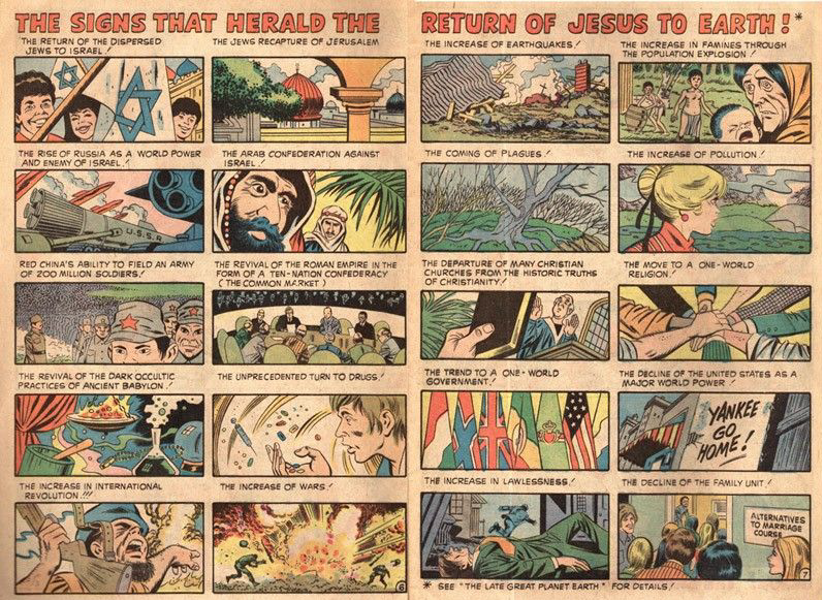
Hal Lindsey wrote The 1980’s: Countdown to Armageddon in 1981, 45 years ago! He followed it up with several books, including this gem: Planet Earth 2000: Will Mankind Survive? (1994). In an interview in Christianity Today(April 15, 1977), Lindsey declared, “There are a lot of world leaders who are pointing to the 1980s as being the time of some very momentous events. Perhaps it will be then. But I feel certain that it will take place before the year 2000.” “Second verse, same as the first.”
Predicting Armageddon is a full-time job for prophecy pundits. Consider Dwight Wilson’s book Armageddon Now!, first published in 1977, the same year Lindsey’s Christianity Today interview was published. It’s a critical historical analysis of premillennial dispensationalist predictions regarding the end times, particularly focusing on Russia and Israel since 1917. The book examines how numerous prophetic forecasts—such as the Rapture, Armageddon, and the rise of the Antichrist—have repeatedly failed, often tied to major geopolitical events like the Russian Revolution, the founding of Israel in 1948, the Soviet Union’s collapse in 1991, and the Gulf War in 1991.
Dr. Gary North provided a preface for the 1991 edition that the Institute for Christian Economics reprinted. Wilson frames the book as a cautionary tale, warning against the sensationalism and flawed literalism that have plagued much of dispensational prophecy literature. The book remains relevant today as it critiques the recurring pattern of apocalyptic expectations that ignore historical and exegetical thoroughness. Despite its warnings, many mainstream dispensational leaders continue to promote speculative prophecy, as seen in the aftermath of events like the 1991 Soviet collapse and the 1991 Gulf War—events that Dwight Wilson had already shown were misinterpreted by prophecy enthusiasts.
[1] Jeremiah: Concordia Classic Commentary Series (St. Louis: Concordia Publishing House, 1952), 351-352.
[2] The Divorce of Israel: A Redemptive-Historical Interpretation of Revelation, 2 vols. (Tolle Lege Press and Chalcedon Foundation, 2024), 1:505.