

The phrase “Do you believe in God?” is a direct line from Andy Weir’s novel Project Hail Mary, where the character Ryland Grace asks his colleague Steve if he believes in God. In the 2026 film adaptation, this question is reimagined as a conversation between Ryland Grace (Ryan Gosling) and project leader Eva Stratt (Sandra Hüller).
Stratt responds to Grace’s inquiry about her faith with the line, “It’s better than the alternative” (or “It beats the alternative”), acknowledging that belief in God offers hope when scientific odds are overwhelmingly against them. Well, it’s more than that. (If you watch the film in a movie theater, stay for the closing credits and listen to the Ike and Tina Turner song, “Glory, Glory.”)
Richard Dawkins, a prominent high priest of the religion of atheism, has declared that he’s a “cultural Christian.” Of course, he is. He has no other choice. So is every atheist who doesn’t consistently follow through with his or her atheistic assumptions. If I could sit down with Mr. Dawkins, I would press him to be logically consistent with his materialistic, atheistic, and evolutionary assumptions. I would have him consider Canada’s Psycho Killer or watch this short video titled “Cruel Logic.”
Luka Rocco Magnotta (born Eric Clinton Newman) was accused of killing and dismembering 33-year-old Lin Juna, a male Chinese student. Magnotta carved up Juna’s body, sexually abused the corpse, and filmed and posted the horror online.
Days after the killing, Montreal police discovered the victim’s torso in a suitcase by the trash outside an apartment along a busy highway.
His severed hands and feet were sent through the mail to federal political parties in Ottawa and to two schools in Vancouver. The head was found in a Montreal park months later.
The ten-minute video shows Juna “being stabbed in a frenzy with an ICE-PICK, before being dismembered, sexually abused and his flesh EATEN with a knife and fork.”
In a letter to The Sun, Magnotta wrote that “Once you kill, and taste blood, it’s impossible to stop.” Is this a remnant of an evolutionary survival mechanism that has been repressed because of what Richard Dawkins calls “culture Christianity”? Kind of like domesticated pigs that escaped their pens, live and breed in the wild, and go feral. The Lord of the Flies comes to mind.
In an atheistic, materialistic, mud-to-man evolutionary process, did Magnotta do anything that could be considered morally wrong? If he did, what is the basis of the standard that Juna himself could have used as he was being “sliced and diced”? Who says that ice-picking someone to death and eating the carcass is fundamentally evil? Who gets to say that this or that behavior is good or bad? By what standard are such judgments made?

Why It Might be OK to Eat Your Neighbor
Love your neighbor, or Eat your neighbor? It’s been said that you can’t get blood out of a stone. Similarly, no matter how atheists try, they can’t account for moral standards that must be obeyed when there is no accounting for good or evil. The most damning assessment of a matter-only cosmos devoid of a Creator is that we got to this place in our evolutionary history by acts of violence whereby the strong conquered the weak with no one to support or condemn them.
Buy NowThe standard can’t be for something called the “social good” since defining what’s good for society doesn’t have an unimpeachable moral foundation, given the origins of what we call life today. If the evolutionary theory of origins is true, there was no morality when the first sign of life emerged from the biotic soup. It was a molecule-eat-molecule beginning to the survival of the fittest.
If the first life form had the equivalent of an ice pick, it could have used it, and there was no law in the cosmos that would have said, “Thou shalt not icepick to death your fellow life-form molecule.” An evolutionist might argue that it was good for more highly evolved life forms to develop a moral code for the good of society. “Mutual cooperation is the necessary outgrowth of evolution,” the Darwinists tell us. Says who and by what impeachable standard? Maybe our arbitrary moral laws are holding back greater evolutionary development.
Let’s get back to Richard Dawkins, who described himself as a “cultural Christian” in an interview he gave before delivering a speech at Charleston College in South Carolina on March 9, 2013.
“I guess I’m a cultural Christian,” he said. He compared his cultural Christianity to people who “call themselves Jews, including Herb Silverman. He’s a Jewish atheist. He identifies with Jewish culture, believes he’s a part of the Jewish tradition, and that’s valuable.” This answers nothing. What about someone who identifies with a culture that, at one time, identified with cannibalism and human sacrifice?
The Aztecs had raided neighboring tribes for years, capturing thousands of victims for human sacrifice. Cortez and his men were horrified at what they saw. Aztec temples were stacked with human skulls. When Cortez spotted a sacrificial pyramid, he made his way up the hundred and fourteen steps with some of his best soldiers following close behind. Montezuma was at the top waiting for him. What Cortez and his battle-hardened men saw shocked them. Montezuma had just sacrificed some boys, and blood was everywhere.
Bernal Diaz, an eyewitness, describes the scene: “All the walls … were so splashed and encrusted with blood that they were black, the floor was the same and the whole place stank vilely…. The walls were so clotted with blood and the soil so bathed with it that in the slaughterhouses of Spain there is not such another stench.”[1]
As the Spaniards climbed down the temple pyramid and made their way through the city, they saw more unspeakable horrors. They passed rooms where the bodies of sacrificial victims were being prepared for feasts. They saw racks that held more than a hundred thousand human skulls. Aztec society was built on blood, the blood of thousands of helpless victims.
It was their tradition and culture. Who was to say it was wrong?
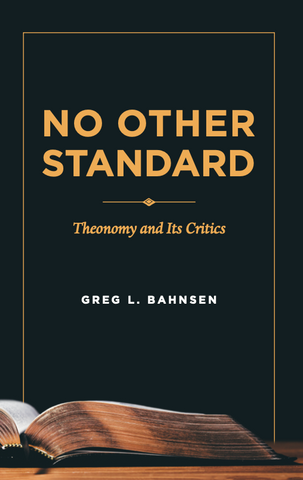
No Other Standard
No Other Standard is Dr. Bahnsen’s response to various books, articles, and other critiques that have circulated over the years. Bahnsen skillfully takes his critics’ arguments apart, showing that they have either misrepresented his position or misrepresented the Bible. Line by line, point by point, he shows that they have not understood his arguments and have also not understood the vulnerability of their own logical and theological positions. Joe Louis once said of an ill-fated scheduled opponent in the ring, “He can run, but he can’t hide.” Likewise, Bahnsen’s critics. No Other Standard corners them all, and one by one, floors them.
Buy NowMontezuma, following Dawkins’ “cultural Christian” and Silverman’s “cultural Jew” traditions, should have said to Cortez. “I’m a cultural Aztec. You can’t rightly judge my cultural traditions and customs by these arbitrary foreign traditions. In fact, there is no such thing as a cosmic judge of anything.”
What could a consistent atheist say to the Aztecs? There were no “cultural Christians” among them. It took an outside moral worldview to put an end to it.
Jackson, Dawkins, Silverman, and nearly every atheist who claims justification for a moral worldview must borrow morality from Christianity because there is no way to account for morality in a materialistic world. Darwin wrote about a “moral sense” among animals, but he lived in a world shaped by a distinctly biblical moral culture. He was projecting that moral culture onto evolved biological units that were killing and eating for survival.
While channel surfing many years ago, I came across the second installment of the six-part series “The Trials of Life.” I soon learned what Benjamin Franklin meant when he described the eagle as a bird of “bad moral character.” With two eaglets in the nest and not enough food to go around, the mother eagle allows the weakest eaglet to die. She then cannibalizes the dead eaglet and feeds it to the survivor. Was this natural or unnatural? Is this moral animal behavior that we should emulate? How do we know? Should we follow the example of the eagles or something else?
[1] Quoted in Albert Marrin, Aztecs and Spaniards: Cortes and the Conquest of Mexico (New York: Atheneum, 1986), 111.