

Please help us meet a $15K matching challenge here
In another conference talk Gary gave recently, he discusses the apologetics of preterism.
During the Symposium, James Hamilton said if the destruction of Jerusalem was the fulfillment of the Olivet Discourse, then why didn’t the biblical writers comment about the subject after the event? The answer is quite simple: The New Testament books were written before AD 70. John A. T. Robinson, in his book Redating the New Testament, developed the thesis that every New Testament book was written before the destruction of Jerusalem, including the book of Revelation. There are many events recorded in the Bible that are not found in non-biblical historical works. Consider everything from the announcement to Zechariah that his wife Elizabeth would give birth to John the Baptist and the ascension of Jesus into heaven and much of what is in between.
There aren’t many historical works from the first century that touch on the period, so to find a source as complete as the works of Josephus of that period of history is a providential find of the first order.
Through a process of discovery, I found that a preterist interpretation of the Olivet Discourse was a common feature in commentaries and in various narrative-style books that describe the fall of Jerusalem in AD 70 as it is outlined in the Olivet Discourse of the synoptic gospels.
• Thomas Newton, Dissertations on the Prophecies (1754). Newton, like James Hamilton, was a premillennialist, but unlike Hamilton, Newton is a preterist when it comes to much of the Olivet Discourse.
• Nehemiah Nisbett, The Prophecy of the Destruction of Jerusalem (1787).
• George Halford, The Destruction of Jerusalem: An Absolute and Irresistible Proof of the Divine Origin of Christianity, etc (1805).
• William Patton, The Judgment of Jerusalem Predicted in Scripture, Fulfilled in History (1876).
• Alfred J. Church, The Story of the Last Days of Jerusalem (1902).
There are also numerous editions of Alexander Keith’s (1791-1880) Evidence of the Truth of the Christian Religion Derived from the Literal Fulfillment of Prophecy, etc., first published in 1832, in which he includes a chapter on “The Destruction of Jerusalem.” It went through numerous editions and many printings.
Keith’s apologetic work on prophecy was designed to counter liberal claims that the Bible is merely the work of men. Bible prophecy, Keith maintained, demonstrated that this was an impossible claim that could not be defended in terms of many examples of fulfilled prophecy. Edward Giddings, in his book American Christian Rulers, “relates how Keith’s book was instrumental in persuading Supreme Court chief justice John Marshall of the messianic claims of Jesus Christ in the days before his death on July 6, 1835.”[1] The following is from Giddings:
[Marshall] believed in the truth of the Christian revelation, but not in the divinity of Christ; therefore he could not commune in the Episcopal Church. But, during the last months of his life, he read Keith on Prophecy, where our Saviour’s divinity is incidentally treated, and was convinced by his work, and the fuller investigation to which it led, of the supreme divinity of the Saviour.[2]
Keith used a number of extra-biblical sources, as do almost every Bible expositor, ancient and modern, to offer support for the biblical record regarding fulfilled prophecy. It was no different when he came to the Olivet Discourse.
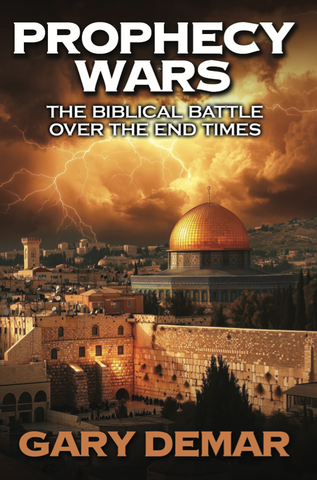
Prophecy Wars: The Biblical Battle Over the End Times
If you’re willing to take the Bible at its word, the study of prophecy can strengthen your faith, but if your trust is in man’s speculations, you will be disappointed every time. And that is why Bible prophecy is such a crucial area for apologetics. Skeptics of all stripes have condemned the Bible as inaccurate merely because various well-meaning Christians have been in error about the End Times.
Buy NowIn another conference talk Gary gave recently, he discusses the apologetics of preterism. Many futurists are vehemently opposed to any argument put forth by any preterist, to the point that they call it heresy, even though they must reword and redefine simple words in the New Testament. Gary gives some advice about how to approach such people.
Click here for today’s episode
Click here to browse all episodes of The Gary DeMar Podcast
[1] Eric Rauch, Publisher’s Foreword, Alexander Keith, Evidence of the Truth of the Christian Religion: Derived from the Literal Fulfillment of Prophecy (White Hall, WV: Tolle Lege Press, [1834] 2011), v.
[2] Edward Giddings, American Christian Rulers, or Religion and Men of Government (New York: Bromfield and Company, 1889), 332. American Christian Rulers was reprinted by American Vision Press, Powder Springs, Georgia, in 2011. The corresponding page number in the new edition is 348.