
Please help us meet a $15K matching challenge here
For decades, secularists have told us that what certain countries need is democracy. What if a country votes to make Sharia law the law of the land? Once power is secured through the democratic process, the door is often shut to exclude those who might challenge the status quo. American politicians have used the democratic process, through promises to special interest groups, to gain power, shut off dissent, and establish their own secular theocracy.
“A professor found that a vast majority of his university students were unable to tell the U.S. Constitution from the Russian constitution…. Many students respond, confessing how they have never read the U.S. Constitution and how they appreciate the foresight of the founding fathers to implement minimum wage and paternity leave,”[1] of which the Constitution is silent.
Constitution 101: The Biblical Foundations
Constitution 101 is a complete education. In this course, you will learn from top legal and historical minds about this amazing document and what it really means to be a constitutional republic. Complete with audio, video, and text, Constitution 101 is filled with dozens of hours of learning. After watching, listening, and reading all of the material in this course, you will be ready to take on any skeptic making claims about our country and its founding document being "secular."
Buy NowLet’s begin with “theocracy.” The word “theocracy” consists of two Greek words: theos (God) and kratos (power or rule). In its simplest definition, theocracy means the “rule of God,” not the rule of the church. That would be an ‘ecclesiocracy.’ The word ‘theocracy’ is not found in the Bible, although the concept is present. Most do not know the definition of theocracy. Here’s an example of someone who confuses ‘theocracy’ with ‘ecclesiocracy.’
Unfortunately, there are some Christian groups … who are espousing an unhealthy Christian nationalism that merges Christian identity with national identity and wraps the Gospel in the American flag. And the most extreme among them would even welcome a theocratic kingdom on earth where religious leaders dictate how the society is governed.
This is not the proper definition of theocracy, though it is popular. The word ‘theocracy’ was coined by Flavius Josephus, a first-century Jewish historian for the Romans, whose Wars of the Jews parallels Jesus’ prediction of the Destruction of Jerusalem by the Romans in AD 70 (Matt. 24; Mark 13; Luke 21).[2] The word appears in Against Apion (2.164-165): “placing all sovereignty and authority in the hands of God.”[3]
Gabriel Sivan, a Jewish writer who has contributed articles to the Encyclopedia Judaica, offers the following as a helpful clarification of the term:
To the modern ear the word ‘theocracy’ has distinctly pejorative overtones, suggesting the rule of some oppressive priestly caste, “government by state by immediate Divine guidance or by officials regarded as divinely guided,” to quote a standard definition. Yet, unlike certain other systems known in antiquity, “the ‘Theocracy’ of Moses was not a government of priests, as opposed to kings; it was a government by God Himself, as opposed to the government by priests or kings” (Dean Arthur Stanley, A History of the Jewish Church, 1862). The U.S. jurist and statesman Oscar Straus, a close associate of President Theodore Roosevelt, also stressed this point in his study of American culture’s indebtedness to the Hebraic concept: “The very fact that … with the single exception of Eli, no priest was ever elected to the magistracy during the entire period of the Commonwealth, decidedly [negates] any such interpretation” (The Origin of the Republican form of Government in the United States of America, 1887).[4]
I explain these principles in my books God and Government (with Student Workbook), Restoring the Foundation of Civilization, and Liberty at Risk.
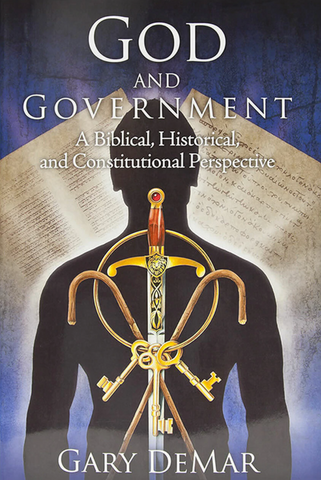
God and Government
With a fresh new look, more images, an extensive subject and scripture index, and an updated bibliography, God and Government is ready to prepare a whole new generation to take on the political and religious battles confronting Christians today. May it be used in a new awakening of Christians in America—not just to inform minds, but to stimulate action and secure a better tomorrow for our posterity
Buy NowGod is the Sovereign Theocrat/Governor. He has instituted limited human governments for our world: family, church, and civil governments. The church and civil spheres are jurisdictionally separate but bound to follow God’s law as they apply to each sphere. Every law is based on someone’s view of morality. Rushdoony makes this point.
It must be recognized that in any culture the source of law is the god of that society…. If law has its source in man’s reason, then reason is the god of that society. If the source is an oligarchy, or in a court, senate, or ruler, then that source is the god of that system…. [I]n any society, any change of law is an explicit or implicit change of religion.[5]
Every political system is theocratic if either the individual (Libertinism, Moral Anarchy, King, Monarch) or the group (Democracy, Oligarchy) is the basis of what’s morally right or wrong. Atheistic regimes are theocratic since they place the source of law in the independent and unbound ruler (“every person doing what is right in his own eyes”: Judges 17:6), a power-entrenched group, or the civil sphere, in which elected or appointed officials became a “law unto themselves.” Communism and many modern civil governments come to mind.
The rejection of the true God leads inescapably to the choice of another god. Democracy can become theocratic if absolute power is given to the voice of the people. You may have heard the Latin phrase, Vox populi, vox dei. Those who promote a particular worldview and seek to implement it socially, educationally, politically, and judicially have elevated humans to the status of gods. Their intentions are theocratic. Only their choice of god or gods has changed.
The word “Messianic” is used in a similar way. While it’s generally attributed to religious figures, it can also apply to education (“The Messianic Character of American Education”) and politics (“The Messianic State”).
Theocracy is no different. Once there is no need for a transcendent God, there is no longer an operating system of fixed laws. Man becomes the new god collectivized in the State. To use Hegel’s phrase, “the State is god walking on earth.”
Conde Pallen’s utopian novel, Crucible Island, describes what happens when the God of the Bible is rejected, and the State becomes God. Man looks for a substitute provider so that “the individual should have no thought, desire, or object other than the public welfare, of which the State is the creator and the inviolable guardian. As soon as the child is capable of learning, he is taught the Socialist catechism, whose first questions run as follows:”
Q. By whom were you begotten?
A. By the sovereign State.Q. Why were you begotten?
A. That I might know, love, and serve the Sovereign State always.Q. What is the sovereign State?
A. The sovereign State is humanity in composite and perfect being.Q. Why is the State supreme?
A. The State is supreme because it is my Creator and Conserver in which I am and move and have my being and without which I am nothing.Q. What is the individual?
A. The individual is only a part of the whole, and made for the whole, and finds his complete and perfect expression in the sovereign State. Individuals are made for cooperation only, like feet, like hands, like eyelids, like the rows of the upper and lower teeth.[6]
A biblical worldview creates boundaries for all governing authorities. Each sphere has its jurisdictional limits, authority, and enforcing powers.
[1] Sarah Rumpf, “Professor finds most students can’t differentiate between US and Russian Constitutions,” Fox News (September 20, 2022).
[2] See “APPENDIX B: Josephus on the Fall of Jerusalem” in David Chilton’s Paradise Restored: A Biblical Theology of Dominion.
[3] “Some peoples have entrusted the supreme political power to monarchies, others to oligarchies, yet others to the masses. Our lawgiver [Moses], however … gave to his constitution the form of what—if a forced expression be permitted—may be termed a ‘theocracy,’ placing all sovereignty and authority in the hands of God.”
[4] Gabriel Sivan, The Bible and Civilization (New York: Quadrangle/The New York Times Book Co., 1973), 145.
[5] Rousas J. Rushdoony, Institutes of Biblical Law (Nutley, NJ: The Craig Press, 1973), 4-5.
[6] Conde Pallen, Crucible Island: A Romance, an Adventure and an Experiment (New York: The Manhattanville Press, 1919), 109-110.